In one narrative of doom, developments in entertainment & recreation like the mass media or designer drugs continuously threaten humanity by creating ever more effective superstimuli —stimuli which are irresistible, as they exploit hardwired preferences, which humans find impossible to resist en masse, any more than the herring gull chick can resist begging for food from a colorfully-painted needle rather than an accurate model of herring gull heads, or other birds can resist nurturing bigger brighter more colorful eggs rather than their own, or Australian jewel beetles can resist mating with beer bottles.
Obesity is on the rise as the food-industrial complex engineers ever more palatable foods, stuffed with salt and fat and sugar, deliciously addictive. Tech companies harvest gigabytes of personal data, using ever more sophisticated & advanced AI tailoring of ads to individuals, pervasively inserted into their media streams, persuading them to buy or think whatever the advertisers wish (subliminal advertising being so dangerously effective it must be outlawed). Media and pornography and harlequin romance novels offer inhumanly perfect simulacrum of sexually attractive & high status people, selecting the most beautiful people out of hundreds of millions and then further enhancing them with special effects into hyperreality, with infinite amounts of porn for every preference and kink on tap via the Internet—and sexbots eventually to come. Social media like Facebook or Instagram expose us to highly-selective curated ideal lifestyles, inspiring envy for lives that never were, and spreading rage and depression. Cheap pervasive ‘firewater’ shattered aboriginal tribes and groups, already weakened by epidemic and dispossession, who had never been exposed to industrial-scale alcohol, even in England, where in the early Industrial Revolution, alcohol consumption spiked in the USA 1 and “there were gin pushcarts working their way through the streets of London” as Shirky puts it (“Gin, Television, and Social Surplus”), and alcoholism & the “corner saloon” was seen as one of the most severe of all social ills (prompting Prohibition). Ultraviolence on TV desensitizes men to violence while early TV was a “vast cultural wasteland” sucking up hundreds of billions of man-hours a year watching vapid shows like Gilligan’s Island (even now, if time diaries are to be believed, Americans continue to spend multiple hours a day on average watching TV).2 Penny dreadfuls, and then comic books, seduce innocent children with their gruesome lurid imagery blurring the line between fantasy & reality while glorifying criminality & aggression, triggering waves of murderous juvenile delinquency. New highly potent “research chemical” opiates manufactured in Chinese labs ravage the American hinterland. Slot machines & video games offer push-button experiences more compelling than real life, with video gamers taught to stalk & entrap vulnerable women, or collapsing in Internet cafes and streamers dying at their post, ‘click’ or ‘social gaming’ companies like Zynga cunningly exploiting helplessly addictive users by mastery of Pavlovian operant conditioning techniques embodied in Farmville, steadily draining them of all their cash in return for making meaningless numbers go up while the players cease even to enjoy the game (and VR increasingly offering a full replacement for dreary reality)—and need one mention how violent games glamorize gun violence and are are simulators training teenagers for school shootings like Columbine? “Fake news”, manufactured in bulk online & flooding Americans through social media, ensured the election of President Donald Trump & the reign of the Republican Party, threatening to end the American democratic experiment forever. Psychological research into human behavior has been weaponized as “nudges” by greedy marketers, suckering buyers into buying overpriced goods like hotel rooms by shady gimmicks such as claiming to almost be out of rooms. Worse, new online mediums and advanced ‘reinforcement learning’ algorithms manipulate innocent viewers into watching or reading dangerous materials, leading to a steady spiral of ever more extreme content consumption culminating in anti-vaccine or Flat Earth or Republican beliefs, with “ Elsagate ” and “ unboxing ” addling children into nonsensical violent sexual video loops interspersed with brainwashing consumerism into the pre-verbal. With continued progress in science & technology, one day we may invent the final entertainment or drug, a species-wide Infinite Jest, something so entertaining or addictive that humanity wireheads itself into being unable to feed, protect, or reproduce itself—eventually going extinct. They literally amuse themselves to death.
This theory can even be extended to explain the Fermi paradox’s Great Silence: why do we see absolutely no trace of alien civilizations when astronomical data indicates habitable worlds should be quite common and technological/statistical considerations show the universe could be rapidly colonized? Many explanations for the Great Silence show a spectacular failure of imagination by postulating extremely narrow mechanisms, like “Western liberalism” or “nuclear war”, for the Silence, which do not do a good job of explaining why the hyperintelligent eusocial ants of Knara Prime went extinct or the immortal sentient silicon crystals of Delti 10 never spread across the universe or the absence of the self-stabilizing chaotic storm cell civilizations of the Jovian planets. But the “amusing oneself to death” hypothesis is plausibly universal: since precognition is impossible and it’s impossible to know the true fitness of actions & choices in advance, all evolved species must use proxies for fitness; if they advance in science & technology to the point of interstellar civilization being possible, they must also have developed a wide variety of tools and understanding of their own physical substrates, which allow faking fitness signals and hijacking preferences; if that is possible, then at least some individuals will do so out of curiosity or for incentives; hence, all interstellar civilizations are at risk of amusing themselves to death and if the risk is sufficiently great, it could be the Great Filter.
In another narrative, superstimuli may be problems, but they tend to be self-limiting ones: people adapt, culturally and biologically, to them, and the problems gradually go away, if indeed they were ever remotely as big as they were portrayed to be, in an endless Sisyphean cycle of technology panics. Early advertising strikes a modern reader as being laughably transparent, crude, and unconvincing 3; the first Internet banner ads in the 1990s reportedly had clickthrough rates >10%, while now the most sophisticated & carefully targeted ad is doing well if it can get a 0.01% clickthrough rate—assuming the traffic isn’t all bots or accidental misclicks—as audiences experience “advertising wearout” & adapt to ignore ads (Kinnucan et al 1993, Blair1987/2000, Braun & Moe2013); and there are serious questions about to what extent Internet advertising works at all & if the tiny effects can actually be measured (see references in my ad A/B test). Alcohol ravaged American Indian tribes and contributed to the destruction of many of them, but while alcoholism and drug abuse remain endemic problems on Indian reservations, the pitch does not appear so apocalyptic these days; Prohibition to reduce alcoholism, rather than being such a burning issue that the very Constitution must be amended, is invoked mostly as a historical fiasco & criticism of the War on Drugs. TV faces competition from other forms of recreation, and is no longer so dominant, with the intellectual quality of TV massively increasing over time (in part thanks to peculiar tech economics like Wall Street investing tens of billions of dollars into Netflix/Amazon to try to replace Hollywood), leading to what has been widely called a golden age of television. Consumers, just as they did in response to earlier advertising, gradually wise up to gimmicks when they seen them too often, and are increasingly cynical about “nudges”. Fake news, whatever contribution it did make to the 2016 US Presidential election, saw its viewership among Americans then crash 2016–2018 (and a disastrous 2018 mid-term election for the Republicans/Trump). Video and computer games, for all the moral panics over them, have proven to be mostly substitutes for other forms of socializing and media consumption, and the occasional “young man collapses dead while playing MMORPG/FPS/etc game” news report remains but a highly rare event, of no more consequence than “young man collapses dead when tackled in sports game” (and often perhaps for the same reason, congenital heart defects), with the various laws passed like curfews being largely unnecessary overreactions; Zynga, poster child of the new wave of exploitative games forecast to be a boot stomping on the wallet of humanity forever, has since reeled from FB changes & loss of most of its users, its 2018 stock now a quarter of its 2012 14ya high; social games have taken over the gaming world in the form of “e-sports” competitive gaming leagues & professional players with their own stadiums, streaming, casual mobile gaming, and multiplayer games (bearing a deliberate and striking resemblance to regular sports, and a far cry from playing Super Mario Brothers by oneself on an NES). Media consumption often appears motivated far less by the entertainment or esthetic value of the media, than by the desire to participate in trends, signal affiliation with particular groups, or create common referents with other people—all of which inherently curtails media consumption because there is no point in too-obscure media or consuming too much, as that eliminates or crowds out the true function of the media consumption (one might say ‘entertainment’ gives itself far too much credit for being entertaining). Norms for social media are already evolving rapidly, with widespread awareness of the falsity of self-presentations on social media and counter-memes for reducing use, or at least containing the harm with methods like auto-deleting posts (eg. Snapchat). Porn and media are more accessible than ever, indeed, but nevertheless, access to them appears to have little to do with reproduction—American fertility rates are stable and appear far more affected by economic recessions & real estate prices & college attendance than by access to broadband. Likewise, the demographic transition worldwide appears linked mostly to female education, independent of pornography. This is despite the admittedly enormous time soaked up by media—peaking at 9 hours of TV per day per American household around 2009, and yet, people managed to hold down jobs and live their lives and do science and have children. Inherently, any new problem triggers responses and backlashes as people burn out, learn, and pass on knowledge of how to avoid the problems & use it healthily, the technology is modified, societal mechanisms like laws & regulation kick in, the new thing becomes integrated into existing social norms/rituals, and if nothing else, people adapt to it either by cultural inheritance (families/subgroups/ethnicities with adaptive memes flourish while others fall into decadence) or genetically (alcohol abuse may be an example).
Wild populations constantly increase in fitness (Burt1995, Hendry et al 2018), and larger selective pressures produce larger changes, as demonstrated by many successful artificial selection experiments. Further, there is both genetic & cultural evolution at work.
Heritability of Leisure-Time Activities & Media Consumption
MaTCH
The Polderman et al 2015 twin-study mega- meta-analysis of k = 2,748 studies picks up a few results relevant to the question of media/entertainment/leisure-time, with the most relevant categorization being “Recreation and Leisure”, but their online interface for visualization has no way to get the original studies rather than just the model-fitting & wordclouds AFAIK (considerably limiting MaTCH’s usefulness as a database to consult for meta-analyses about specific traits):
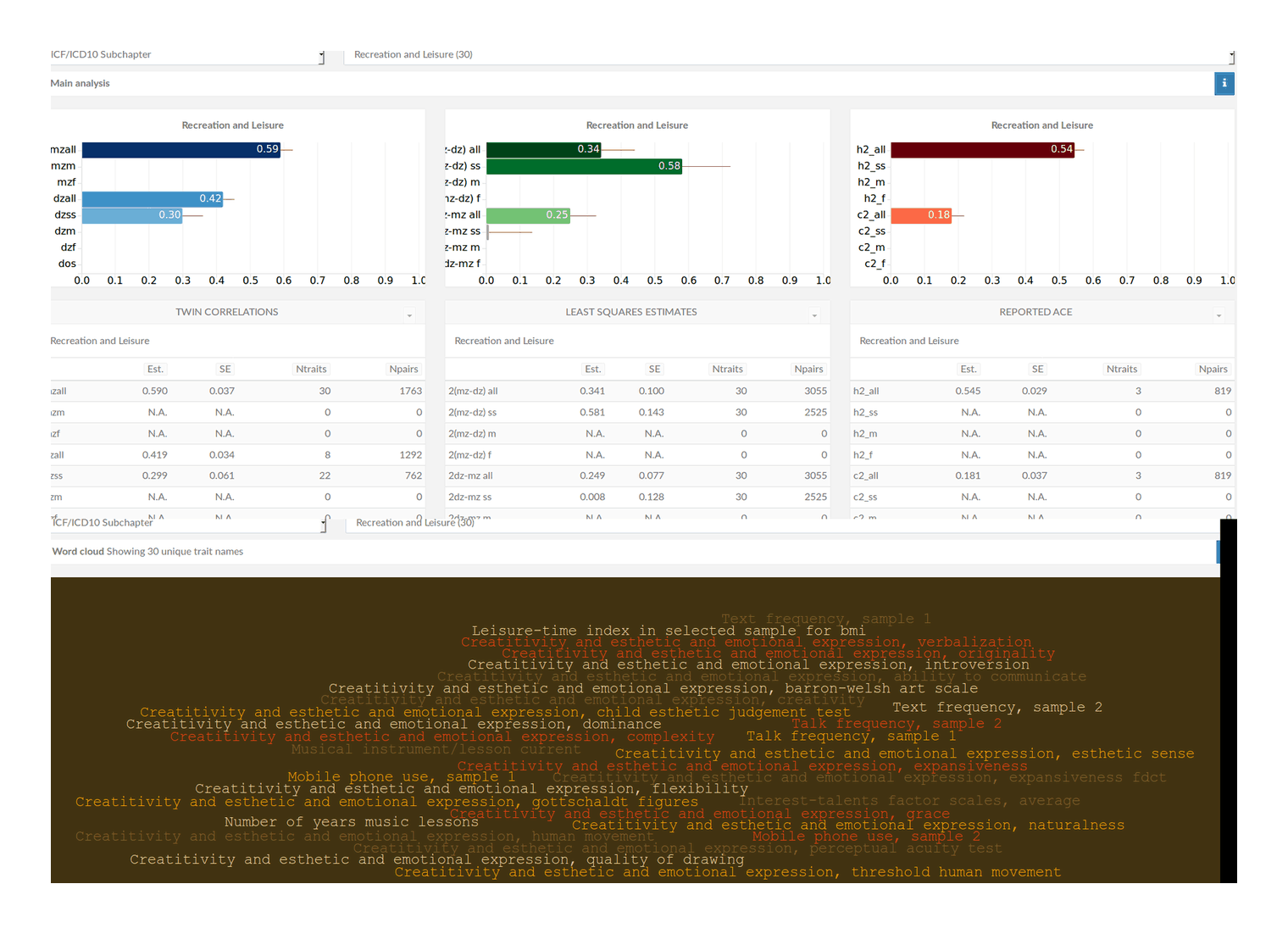
MaTCH (“Meta-Analysis of Twin Correlations and Heritability”) database visualization of twin study results on traits classified under ICF/ICD10 subchapter “Recreation and Leisure”
General Literature
For a more fine-grained description, I consulted my bibliographies and used a Google Scholar search along with followup searches of music heritable / game heritable, searches of reverse citation & “related articles” for a few key articles, and checking relevant-looking citations in the body of articles.
I looked primarily for heritability estimates of things which could be described as media or entertainment consumption patterns, media or esthetic preferences, leisure time activities, and the like. I exclude most studies of religiosity because while highly heritable & relevant, it’s arguably not perceived as optional or recreational by most people; I excluded many studies of musical pitch perception/tone identification because those reflect a basic musical aptitude which apparently is not even causally increased by musical practice 4; I also exclude measures of vocational aptitude/interest (like the inventories collected in several large-scale twin registries) as those may reflect economic considerations & local opportunities & wishful dreaming more than actual life activities; for physical activity, I try to include only measures of voluntary/leisure rather than work-related or raw physical movement (eg. accelerometer logs, which would include things like fidgeting); similarly, I don’t try to comprehensively cover food preferences or eating habits (much less the vast literature on various kinds of drug consumption & abuse), even though those are arguably primarily recreational activities. Where multiple models fits are reported, I try to use the heritability from what the authors regard as the best-fitting model, and when a CE or E model is selected rather than ACE/DCE/DE, I report as 0.00, and I sum a 2 and d 2 if both are available; if only monozygotic & dizygotic twin correlations are reported, I (or another author) use the Falconer formula (2 × (r MZ − r DZ)).
The full table is available in the appendices due to length (>500 entries).
Looking over the table, we can see that the predictions are borne out: all sorts of preferences & activities are substantially heritable, and a good guess at a mean heritability would indeed be ~0.50 (a simple unweighted average of all the heritabilities in the table is ~0.30, dragged down by the especially high measurement error /instability of many Loehlin & Nichols1976 items).
Some of the heritabilities are estimated at 0.00 but looking at those, they tend to be small samples where the confidence intervals are wide (often the model-fitting gives up & settles on a simple E model for lack of data) or where the trait is probably not being measured well (indeed, probably most of the heritabilities have substantial measurement error as they are based on self-reports and single-item binary/Likert scale questionnaires), so their true heritabilities are almost certainly much higher; generally, only the exercise/sport-related heritabilities have adequate sample sizes because data is routinely collected on those for investigation into basic demographics like weight/ BMI /health, while traits like bingo playing or TV watching are almost never measured. There is an unfortunate absence of any followups or investigations using modern molecular genetics, so there are no SNP heritabilities or polygenic scores to mention.5 Hopefully future studies will provide much more precise and broad estimates of these variables, such as using pedigrees extracted from social media—an example would be Facebook, where their researchers can easily extract large family pedigrees with rich detail on books/movies/etc, giving precise estimates of additive heritability & epistasis & estimating time trends, or even just directly extracting samples of tens of thousands of identical twins, and allow examination of other covariates to explain interests 6
Other things I noticed looking through the studies were that dominance genetics are reported unusually often (perhaps related to the influence of personality on preferences/activities, as personality traits appear likely to be under balancing selection /frequency-dependent selection which would reduce additive genetics 7), shared-environment effects show definite patterns of fadeout with age while heritability seems to increase with age and possibly peak in young adulthood (a Wilson effect?), and there may be sex-dependent effects where females have higher shared-environment and lower heritabilities than males (greater conformism/social concerns?).
External Links
- Kevin Kelly2010, What Technology Wants: chapter 10, “Lessons of Amish Hackers” (blog version)
- “The Amish understand a life-changing truth about technology the rest of us don’t”
- “A genetic perspective on the association between exercise and mental health in the era of genome-wide association studies”, de Geus2020
- “Analysis of genetic and environmental correlation between leisure activities and cognitive function in aging Chinese twins”, Xu et al 2020
Appendix
Literature Review
To demonstrate the point that there are pervasive genetic influences on all aspects of media consumption or leisure time activities/preferences/attitudes, I compile >580 heritability estimates from the behavioral genetics literature (drawing particularly on Loehlin & Nichols1976’s A Study of 850 Sets of Twins), roughly divided in ~13 categories.
| Computer | “Generalized Problematic Internet Use Scale 2” (GPIUS-2) total | 0.00 | Hahn et al 2017 | |
|---|---|---|---|---|
| Computer | “Problematic Internet Use Scale” (PIUS) total | 0.42 | Deryakulu & Ursavas2014, “Genetic and environmental influences on problematic internet use: A twin study” | |
| Computer | Compulsive Internet Use Scale (CIUS) | 0.48 | Vink et al 2015, “Heritability of compulsive Internet use in adolescents” | |
| Computer | GPIUS-2 subscale Mood regulation | 0.33 | Hahn et al 2017 | |
| Computer | GPIUS-2 subscale Negative outcomes | 0.22 | Hahn et al 2017 | |
| Computer | GPIUS-2 subscale Self-regulation | 0.21 | Hahn et al 2017 | |
| Computer | GPIUS-2 subscale Social interaction | 0.00 | Hahn et al 2017 | |
| Computer | IAT subscale Loss of control | 0.16 | Hahn et al 2017 | |
| Computer | IAT subscale Salient use | 0.00 | Hahn et al 2017 | |
| Computer | Internet social media use (all) | 0.48 | York 2017 | |
| Computer | Internet social media use (family) | 0.30 | York 2017 | |
| Computer | Internet social media use (friends) | 0.61 | York 2017, “A regression approach to testing genetic influence on communication behavior: Social media use as an example” | |
| Computer | PIUS subscale “excessive use” of Internet | 0.19 | Deryakulu & Ursavas2014 | |
| Computer | PIUS subscale “negative consequences associated with Internet use” | 0.86 | Deryakulu & Ursavas2014 | a 2 = 0.00 + d 2 = 0.864 |
| Computer | PIUS subscale “social comfort/benefit” of Internet use | 0.21 | Deryakulu & Ursavas2014 | |
| Computer | Young’s “Internet Addiction Test” (IAT) total | 0.00 | Hahn et al 2017, “Internet addiction and its facets: The role of genetics and the relation to self-directedness” | |
| Computer | Young’s “Internet Addiction Test” (IAT) | 0.58 | Li et al 2014, “A twin study of problematic internet use: its heritability and genetic association with effortful control” | |
| Computer | Young’s “Internet Addiction Test” (IAT) | 0.66 | Li et al 2014 | |
| Computer | frequency of Internet use after 11PM | 0.36 | Long et al 2016 | |
| Computer | frequency of Internet use | 0.41 | Long et al 2016, “The genetic and environmental contributions to internet use and associations with psychopathology: A twin study” | |
| Computer | hours of Internet use | 0.10 | Kirzinger et al 2012 | |
| Computer | time on educational Internet websites | 0.34 | Ayorech et al 2017, “Personalized Media: A Genetically-Informative Investigation of Individual Differences in Online Media Use” | |
| Computer | time on entertainment Internet websites | 0.37 | Ayorech et al 2017 | |
| Computer | time spent playing computer games on Internet | 0.39 | Ayorech et al 2017 | |
| Computer | time spent playing video games consoles | 0.39 | Hassan2023 | |
| Computer | time spent playing computer games | 0.25 | Hassan2023 | |
| Computer | time spent using Facebook on Internet | 0.24 | Ayorech et al 2017 | |
| Computer | total Internet time/Private Internet use | 0.44 | Hahn et al 2017 | |
| Computer | using the Internet primarily to access social networking sites | 0.39 | Long et al 2016 | |
| Computer | using the Internet to contact peers | 0.00 | Long et al 2016 | |
| Computer | hours of computer use | 0.34 | Kirzinger et al 2012, “Genetic and environmental influences on media use and communication behavior” | |
| Computer | mobile phone use (yes/no) | 0.49 | Miller et al 2012, “The Heritability and Genetic Correlates of Mobile Phone Use: A Twin Study of Consumer Behavior” | |
| Computer | phone talking frequency | 0.59 | Miller et al 2012 | |
| Computer | phone talking frequency | 0.34 | Miller et al 2012 | |
| Computer | phone texting frequency | 0.53 | Miller et al 2012 | |
| Computer | phone texting frequency | 0.51 | Miller et al 2012 | |
| Computer | Talked for over 30 minutes at a time on the telephone | 0.28 | Loehlin & Nichols1976, Heredity, Environment and Personality: A Study of 850 Sets of Twins | Objective Behavior Inventory, #191; for full details on all Loehlin & Nichols1976 calculation, see the appendix. |
| Computer | Placed a long distance call of over 500 miles | 0.34 | Loehlin & Nichols1976 | Objective Behavior Inventory, #223 |
| Music | LTI “Music and Artistic Activities” | 0.51 | Hur et al 1996 | |
| Music | LTI “The Arts” | 0.62 | Waller et al 1995, “Occupational and Leisure Time Interests, and Personality” | Note: Waller et al 1995 reports MZ/DZ correlations split by sex, MZA separately, and provides test-retest reliability for each subscale; I have combined the 3 groups into a single unattenuated heritability estimate. See the appendix for details. |
| Music | Interest factor | 0.21 | Coon & Carey1987, “Twins and musical ability: An analysis of if-then relationships (abstract)” /Coon & Carey1989, “Genetic and environmental determinants of musical ability in twins” | Coon & Carey1989 is a factor analysis of 27 items from the appendix of Loehlin & Nichols1977, most/all of which are included in this table as well on the item-level. (See also Hambrick & Tucker-Drob2015.) |
| Music | Interest factor | 0.17 | Coon & Carey1987 | |
| Music | School Performance factor | 0.30 | Coon & Carey1989 | |
| Music | School Performance factor | 0.14 | Coon & Carey1989 | |
| Music | Vocal Performance factor | 0.71 | Coon & Carey1989 | |
| Music | Vocal Performance factor | 0.20 | Coon & Carey1989 | |
| Music | Nonschool Performance factor | 0.38 | Coon & Carey1989 | |
| Music | Nonschool Performance factor | 0.10 | Coon & Carey1989 | |
| Music | Honors factor | 0.38 | Coon & Carey1989 | |
| Music | Honors factor | 0.20 | Coon & Carey1989 | |
| Music | music accomplishment | 0.26 | Hambrick & Tucker-Drob2015, “The genetics of music accomplishment: Evidence for gene-environment correlation and interaction” | Like Coon & Carey1989, a re-analysis of Loehlin & Nichols1977 data. |
| Music | music practice | 0.38 | Hambrick & Tucker-Drob2015 | |
| Music | McGue Talent Inventory: Music | 0.66 | Vinkhuyzen et al 2009a, “The Heritability of Aptitude and Exceptional Talent Across Different Domains in Adolescents and Young Adults” | |
| Music | McGue Talent Inventory: Music | 0.30 | Vinkhuyzen et al 2009a | |
| Music | McGue Talent Inventory: Music (extreme response) | 0.92 | Vinkhuyzen et al 2009a | Vinkhuyzen et al 2009a conducted a second set of heritabilities using an extremized dichotomization for respondents claiming top-end/exceptional aptitude/talent |
| Music | Participating in musical, dramatic or artistic activities | 0.12 | Loehlin & Nichols1976 | Time Diary, #35 |
| Music | One or more musical instruments | 0.00 | Loehlin & Nichols1976 | Items In The Home, #578 |
| Music | Practiced on a musical instrument | 0.28 | Loehlin & Nichols1976 | Objective Behavior Inventory, #133 |
| Music | Played a musical instrument | 0.06 | Loehlin & Nichols1976 | Honors, #1029 |
| Music | Hours of music practice, lifetime | 0.41 | Mosing et al 2014 | See also Mosing et al 2015. |
| Music | Hours of music practice, lifetime | 0.69 | Mosing et al 2014 | |
| Music | Music achievement | 0.57 | Mosing et al 2015, “Did sexual selection shape human music? Testing predictions from the sexual selection hypothesis of music evolution using a large genetically-informative sample of over 10,000 twins” (Table S2) | Creative Achievement Questionnaire (CAQ) 8 (male) |
| Music | Music achievement | 0.09 | Mosing et al 2015 | CAQ (female) |
| Music | Swedish Flow Proneness Questionnaire: Music Flow subscale | 0.40 | Butkovic et al 2015, “Personality related traits as predictors of music practice: Underlying environmental and genetic influences” | |
| Music | Took voice lessons | 0.00 | Loehlin & Nichols1976 | Objective Behavior Inventory, #137 |
| Music | Number of years taking music lessons | 0.60 | Vinkhuyzen et al 2009b | |
| Music | Current musical instrument playing/lessons | 0.85 | Vinkhuyzen et al 2009b | |
| Music | Becoming an accomplished musician (performer or composer) | 0.26 | Loehlin & Nichols1976 | Life Goals, #390 |
| Music | Gave a public recital (vocal, instrumental etc.) | 0.18 | Loehlin & Nichols1976 | Objective Behavior Inventory, #79 |
| Music | Played a piano or other instrument while others were singing | 0.14 | Loehlin & Nichols1976 | Objective Behavior Inventory, #84 |
| Music | Sang in a church choir | 0.20 | Loehlin & Nichols1976 | Objective Behavior Inventory, #105 |
| Music | Sang in a school choir | 0.34 | Loehlin & Nichols1976 | Objective Behavior Inventory, #106 |
| Music | Sang in a small ensemble (trio, quartet, etc.) | 0.26 | Loehlin & Nichols1976 | Objective Behavior Inventory, #107 |
| Music | Played in a dance or jazz band | 0.00 | Loehlin & Nichols1976 | Objective Behavior Inventory, #205 |
| Music | Played in a concert orchestra | 0.38 | Loehlin & Nichols1976 | Objective Behavior Inventory, #300 |
| Music | Performed with a professional orchestra | 0.60 | Loehlin & Nichols1976 | Honors, #1027 |
| Music | Played in a school musical organization | 0.30 | Loehlin & Nichols1976 | Honors, #1028 |
| Music | Played in a dance or jazz band for wages | 0.54 | Loehlin & Nichols1976 | Honors, #1030 |
| Music | Received a rating of ‘Good’ or ‘Excellent’ in a: national music contest | 0.68 | Loehlin & Nichols1976 | Honors, #1032 |
| Music | Received a rating of ‘Good’ or ‘Excellent’ in a: regional or state music contest | 0.16 | Loehlin & Nichols1976 | Honors, #1033 |
| Music | Received a rating of ‘Good’ or ‘Excellent’ in a: city or county music contest | 0.00 | Loehlin & Nichols1976 | Honors, #1034 |
| Music | Received a rating of ‘Good’ or ‘Excellent’ in a: school music contest | 0.48 | Loehlin & Nichols1976 | Honors, #1035 |
| Music | Organized your own dance or jazz band | 0.14 | Loehlin & Nichols1976 | Honors, #1031 |
| Music | Organized a singing group | 0.42 | Loehlin & Nichols1976 | Honors, #1036 |
| Music | Conducted a choir, band or orchestra | 0.00 | Loehlin & Nichols1976 | Objective Behavior Inventory, #136 |
| Music | Directed (publicly) a band or orchestra | 0.00 | Loehlin & Nichols1976 | Honors, #1037 |
| Music | Played in a marching band | 0.34 | Loehlin & Nichols1976 | Objective Behavior Inventory, #307 |
| Music | musical creativity (combined score) | 0.84 | Ukkola et al 2009, “Musical aptitude is associated with AVPR1A-haplotypes” | See also Ukkola- Vuoti et al 2011 whose pedigree statistics suggest heritability of listening to music at various ages, but doesn’t report heritabilities. |
| Music | musical creativity: composing | 0.40 | Ukkola et al 2009 | |
| Music | musical creativity: arranging | 0.46 | Ukkola et al 2009 | |
| Music | musical creativity: improvising | 0.62 | Ukkola et al 2009 | |
| Music | Composed music which has been given at least one public performance | 0.00 | Loehlin & Nichols1976 | Honors, #1026 |
| Music | IPAT Music Preference Test: factor A | 0.41 | Vandenberg1962, “The Hereditary Abilities Study: Hereditary Components in a Psychological Test Battery” | Factor B & E are not reported by Vandenberg1962 for unspecified reasons; the IPAT handbook is not available, but 2 Cattell papers (Cattell & Anderson1953 / Cattell & Saunders1954) suggest to me that the factors are not simply musical genres. |
| Music | IPAT Music Preference Test: factor C | 0.31 | Vandenberg1962 | |
| Music | IPAT Music Preference Test: factor D | 0.49 | Vandenberg1962 | |
| Music | IPAT Music Preference Test: factor F | 0.24 | Vandenberg1962 | |
| Music | IPAT Music Preference Test: factor G | 0.27 | Vandenberg1962 | |
| Music | IPAT Music Preference Test: factor H | 0.00 | Vandenberg1962 | |
| Music | IPAT Music Preference Test: factor I | 0.34 | Vandenberg1962 | |
| Music | IPAT Music Preference Test: factor J | 0.38 | Vandenberg1962 | |
| Music | IPAT Music Preference Test: factor K | 0.11 | Vandenberg1962 | |
| Music | computer music | 0.26 | Martin et al 1986 | |
| Music | loud music | 0.11 | Olson et al 2001 | |
| Music | jazz music | 0.42 | Simonson & Sela2011 | |
| Music | jazz music | 0.45 | Martin et al 1986 | |
| Music | Listened to modern (progressive) jazz | 0.12 | Loehlin & Nichols1976 | Objective Behavior Inventory, #56 |
| Music | Listened to New Orleans’ (Dixieland) jazz | 0.20 | Loehlin & Nichols1976 | Objective Behavior Inventory, #57 |
| Music | Listened to folk music | 0.10 | Loehlin & Nichols1976 | Objective Behavior Inventory, #58 |
| Music | Listened to classic or semi-classical music | 0.40 | Loehlin & Nichols1976 | Objective Behavior Inventory, #267 |
| Music | Listened to records in a store without buying | 0.20 | Loehlin & Nichols1976 | Objective Behavior Inventory, #204 |
| Music | Bought a folk music record | 0.16 | Loehlin & Nichols1976 | Objective Behavior Inventory, #86 |
| Music | Bought a popular or jazz record | 0.22 | Loehlin & Nichols1976 | Objective Behavior Inventory, #109 |
| Music | Bought a classical or semi-classical record | 0.16 | Loehlin & Nichols1976 | Objective Behavior Inventory, #128 |
| Music | A collection of classical records | 0.08 | Loehlin & Nichols1976 | Items In The Home, #585 |
| Music | Attended an orchestra concert | 0.10 | Loehlin & Nichols1976 | Objective Behavior Inventory, #148 |
| Music | opera music | 0.39 | Simonson & Sela2011 | |
| Music | Listened to the radio | 0.02 | Loehlin & Nichols1976 | Objective Behavior Inventory, #81 |
| Music | Studied with the radio, record player, or TV on | 0.38 | Loehlin & Nichols1976 | Objective Behavior Inventory, #319 |
| Music | An FM radio | 0.00 | Loehlin & Nichols1976 | Items In The Home, #613 |
| Music | A Hi-Fi or Stereo set | 0.00 | Loehlin & Nichols1976 | Items In The Home, #586 |
| Music | Worked on Hi-Fi or radio equipment | 0.14 | Loehlin & Nichols1976 | Objective Behavior Inventory, #303 |
| Music | A tape recorder | 0.00 | Loehlin & Nichols1976 | Items In The Home, #600 |
| Video | days per week with TV usage | 0.24 | Kirzinger et al 2012 | |
| Video | LTI “TV Viewing” | 0.09 | Hur et al 1996 | |
| Video | LTI “Passive Entertainment” | 0.82 | Waller et al 1995 | |
| Video | LTI “Police Calls-Fires” | 0.61 | Waller et al 1995 | |
| Video | TV viewing time | 0.27 | Plomin et al 1990, “Individual differences in television viewing in early childhood: Nature as well as nurture” | |
| Video | TV viewing time | 0.36 | Plomin et al 1990 | |
| Video | TV viewing time | 0.35 | Plomin et al 1990 | |
| Video | Watching TV/TV viewing time | 0.24 | Loehlin & Nichols1976 | Time Diary, #26 |
| Video | hours of TV watching | 0.36 | Kirzinger et al 2012 | |
| Video | hours of TV watching | 0.23 | Kirzinger et al 2012 | |
| Video | passive activity (hours of TV/“sitting around doing nothing”/listening to music) | 0.00 | Haberstick et al 2014 | |
| Video | passive activity (hours of TV/“sitting around doing nothing”/listening to music) | 0.35 | Haberstick et al 2014 | |
| Video | hours of video watching | 0.30 | Kirzinger et al 2012 | |
| Video | Watched TV | 0.00 | Loehlin & Nichols1976 | Objective Behavior Inventory, #171 |
| Video | A TV set | 0.16 | Loehlin & Nichols1976 | Items In The Home, #615 |
| Video | Daydreaming | 0.00 | Loehlin & Nichols1976 | Time Diary, #32 |
| Video | Fooling around, wasting time | 0.14 | Loehlin & Nichols1976 | Time Diary, #37 |
| Video | Spent an hour at a time daydreaming | 0.08 | Loehlin & Nichols1976 | Objective Behavior Inventory, #325 |
| Video | Attending movies and plays | 0.00 | Loehlin & Nichols1976 | Time Diary, #27 |
| Video | Went to the movies | 0.00 | Loehlin & Nichols1976 | Objective Behavior Inventory, #154 |
| Video | Saw a foreign movie | 0.08 | Loehlin & Nichols1976 | Objective Behavior Inventory, #160 |
| Video | Went to the movies alone | 0.06 | Loehlin & Nichols1976 | Objective Behavior Inventory, #264 |
| Video | A movie or slide projector | 0.06 | Loehlin & Nichols1976 | Items In The Home, #601 |
| Video | X-rated movies | 0.687 | Hatemi et al 2010, “Not by Twins Alone: Using the Extended Family Design to Investigate Genetic Influence on Political Beliefs” | Table 3 |
| Video | striptease shows | 0.51 | Martin et al 1986, “Transmission of social attitudes” | Table 1 9 |
| Video | Attended a burlesque show | 0.00 | Loehlin & Nichols1976 | Objective Behavior Inventory, #121 |
| Video | Attended a professional stage play | 0.24 | Loehlin & Nichols1976 | Objective Behavior Inventory, #156 |
| Video | Attended a student stage play | 0.34 | Loehlin & Nichols1976 | Objective Behavior Inventory, #165 |
| Video | Attended a ballet performance | 0.12 | Loehlin & Nichols1976 | Objective Behavior Inventory, #173 |
| Video | Pin-ups | 0.12 | Loehlin & Nichols1976 | Items In Room, #813 |
| Video | Went to a night club with a floor show | 0.10 | Loehlin & Nichols1976 | Objective Behavior Inventory, #143 |
| Intellectual | Total Creative Achievement scale (TCA=ACA+SCA) of the Creative Achievement Questionnaire (CAQ) | 0.61 | Piffer & Hur2014, “Heritability of Creative Achievement” | Based on Carson et al 2005. The CAQ might be taken as vocational assessment rather than leisure-time/hobbies, but as de Manzano & Ullén2018 point out, “The twin sample was fairly small—338 twins…Assuming the same prevalence as reported in Roeling et al 2017, this means that there would only have been around 9 professional artists included in the sample.” |
| Intellectual | Scientific Creative Achievement (SCA) CAQ subscale (scientific discovery/invention/culinary) | 0.43 | Piffer & Hur2014 | |
| Intellectual | Scientific Creative Achievement (SCA) CAQ subscale (scientific discovery/invention); extremized (maximal response across any domain) | 0.68 | de Manzano & Ullén2018, “Genetic and environmental influences on the phenotypic associations between intelligence, personality, and creative achievement in the arts and sciences” | Table S6 |
| Intellectual | “Leisure-Time Interests” inventory (LTI): “Intellectual Activities” | 0.57 | Hur et al 1996, “Genetic and shared environmental influences on leisure-time interests in male adolescents” | |
| Intellectual | LTI “Intellectual Interests” | 0.76 | Waller et al 1995 | |
| Intellectual | intellectual activity | 0.40 | Haberstick et al 2014 | |
| Intellectual | intellectual activity | 0.16 | Haberstick et al 2014 | |
| Intellectual | Intellectual Activities | 0.47 | McGue et al 2014 | eg. “How often do you take a course or participate in study group? How often do you read a book, news magazine or technical report?” |
| Intellectual | Being read to by parents | 0.81 | Vinkhuyzen et al 2009b, “Genetic influences on ‘environmental’ factors” | |
| Intellectual | Reading books before age 12 | 0.72 | Vinkhuyzen et al 2009b | a 2 = 0 + d 2 = 0.72 |
| Intellectual | Reading books at/after age 13 | 0.72 | Vinkhuyzen et al 2009b | a 2 = 0 + d 2 = 0.72 |
| Intellectual | LTI “Reading” | 0.75 | Waller et al 1995 | |
| Intellectual | reading books | 0.47 | Olson et al 2001 | a 2 = 0.37 + d 2 = 0.20 |
| Intellectual | Reading for pleasure | 0.06 | Loehlin & Nichols1976 | Time Diary, #24 |
| Intellectual | McGue Talent Inventory: Writing | 0.43 | Vinkhuyzen et al 2009a | |
| Intellectual | McGue Talent Inventory: Writing (extreme response) | 0.83 | Vinkhuyzen et al 2009a | |
| Intellectual | McGue Talent Inventory: Language | 0.71 | Vinkhuyzen et al 2009a | |
| Intellectual | McGue Talent Inventory: Language (extreme response) | 0.50 | Vinkhuyzen et al 2009a | |
| Intellectual | McGue Talent Inventory: Mathematics | 0.11 | Vinkhuyzen et al 2009a | |
| Intellectual | McGue Talent Inventory: Mathematics (extreme response) | 0.87 | Vinkhuyzen et al 2009a | |
| Intellectual | Made entries in a diary or journal | 0.32 | Loehlin & Nichols1976 | Objective Behavior Inventory, #88 |
| Intellectual | Worked on a scrap book | 0.32 | Loehlin & Nichols1976 | Objective Behavior Inventory, #90 |
| Intellectual | Bought a paper-back book | 0.14 | Loehlin & Nichols1976 | Objective Behavior Inventory, #127 |
| Intellectual | Sci-Fi | 0.46 | Simonson & Sela2011 | |
| Intellectual | Wrote articles for a school paper, yearbook, or similar publication | 0.16 | Loehlin & Nichols1976 | Objective Behavior Inventory, #142 |
| Intellectual | Read magazines at a newsstand without buying any | 0.28 | Loehlin & Nichols1976 | Objective Behavior Inventory, #150 |
| Intellectual | Read poetry that was not required reading | 0.42 | Loehlin & Nichols1976 | Objective Behavior Inventory, #231 |
| Intellectual | Wrote poetry on your own initiative | 0.30 | Loehlin & Nichols1976 | Objective Behavior Inventory, #232 |
| Intellectual | Looked something up in an encyclopedia | 0.00 | Loehlin & Nichols1976 | Objective Behavior Inventory, #241 |
| Intellectual | Read in bed before going to sleep | 0.42 | Loehlin & Nichols1976 | Objective Behavior Inventory, #329 |
| Intellectual | Practiced decorative or unusual handwriting | 0.08 | Loehlin & Nichols1976 | Objective Behavior Inventory, #346 |
| Intellectual | Looked up a word in the dictionary | 0.02 | Loehlin & Nichols1976 | Objective Behavior Inventory, #363 |
| Intellectual | Writing good fiction (poems, novels, short stories, etc.) | 0.64 | Loehlin & Nichols1976 | Life Goals, #384 |
| Intellectual | Being well read | 0.08 | Loehlin & Nichols1976 | Life Goals, #385 |
| Intellectual | Took a course over and above requirements | 0.16 | Loehlin & Nichols1976 | Done During Past Year, #412 |
| Intellectual | Read one or more non-fiction books that were not required reading | 0.16 | Loehlin & Nichols1976 | Done During Past Year, #427 |
| Intellectual | Read one or more novels that were not required | 0.20 | Loehlin & Nichols1976 | Done During Past Year, #446 |
| Intellectual | Read the biography of a famous person | 0.00 | Loehlin & Nichols1976 | Done During Past Year, #454 |
| Intellectual | Library of more than 200 books | 0.04 | Loehlin & Nichols1976 | Items In The Home, #577 |
| Intellectual | A typewriter | 0.26 | Loehlin & Nichols1976 | Items In The Home, #603 |
| Intellectual | An encyclopedia set | 0.00 | Loehlin & Nichols1976 | Items In The Home, #604 |
| Intellectual | An unabridged dictionary | 0.14 | Loehlin & Nichols1976 | Items In The Home, #606 |
| Intellectual | 5 or more magazine subscriptions | 0.00 | Loehlin & Nichols1976 | Items In The Home, #607 |
| Intellectual | A world atlas | 0.00 | Loehlin & Nichols1976 | Items In The Home, #608 |
| Intellectual | Books in a foreign language | 0.00 | Loehlin & Nichols1976 | Items In The Home, #609 |
| Intellectual | Maps | 0.04 | Loehlin & Nichols1976 | Items In Room, #814 |
| Intellectual | Quotations and mottoes | 0.36 | Loehlin & Nichols1976 | Items In Room, #816 |
| Intellectual | Diplomas | 0.08 | Loehlin & Nichols1976 | Items In Room, #819 |
| Intellectual | calendars or schedules | 0.24 | Loehlin & Nichols1976 | Items In Room, #821 |
| Intellectual | Medals | 0.04 | Loehlin & Nichols1976 | Items In Room, #827 |
| Intellectual | Biological charts | 0.50 | Loehlin & Nichols1976 | Items In Room, #828 |
| Intellectual | Flags | 0.00 | Loehlin & Nichols1976 | Items In Room, #829 |
| Intellectual | Had a paper published in a scientific journal | 0.00 | Loehlin & Nichols1976 | Honors, #1003 |
| Intellectual | Won a prize for any other scientific work or study | 0.10 | Loehlin & Nichols1976 | Honors, #1011 |
| Intellectual | Won a prize or award for a work published in a public newspaper or magazine | 0.00 | Loehlin & Nichols1976 | Honors, #1046 |
| Intellectual | Edited a school paper or literary magazine | 0.18 | Loehlin & Nichols1976 | Honors, #1047 |
| Intellectual | Won a literary award for creative writing | 0.00 | Loehlin & Nichols1976 | Honors, #1048 |
| Intellectual | Had poems, stories, essays or articles published in a school publication | 0.30 | Loehlin & Nichols1976 | Honors, #1049 |
| Intellectual | Wrote an original, but unpublished piece of creative writing on my own (not as part of a course) | 0.06 | Loehlin & Nichols1976 | Honors, #1050 |
| Intellectual | Published one or more issues of my own newspaper | 0.46 | Loehlin & Nichols1976 | Honors, #1051 |
| Intellectual | Had poems, stories or articles published in a public newspaper or magazine (not school) | 0.20 | Loehlin & Nichols1976 | Honors, #1052 |
| Intellectual | Obtained a book or journal from the library | 0.36 | Loehlin & Nichols1976 | Objective Behavior Inventory, #176 |
| Intellectual | Read the Bible | 0.08 | Loehlin & Nichols1976 | Objective Behavior Inventory, #177 |
| Intellectual | Visited a museum | 0.26 | Loehlin & Nichols1976 | Objective Behavior Inventory, #184 |
| Intellectual | Participated in a science contest or talent search | 0.24 | Loehlin & Nichols1976 | Objective Behavior Inventory, #298 |
| Intellectual | Participated in a scientific contest or talent search | 0.38 | Loehlin & Nichols1976 | Honors, #1005 |
| Intellectual | Did an independent, scientific experiment (not a course assignment) | 0.20 | Loehlin & Nichols1976 | Honors, #1000 |
| Intellectual | Invented a patentable device | 0.00 | Loehlin & Nichols1976 | Honors, #1002 |
| Intellectual | Gave a prepared talk to 15 or more people | 0.10 | Loehlin & Nichols1976 | Objective Behavior Inventory, #80 |
| Intellectual | Attended a public lecture (not for a course) | 0.36 | Loehlin & Nichols1976 | Objective Behavior Inventory, #77 |
| Intellectual | Entered a speech or debate contest | 0.14 | Loehlin & Nichols1976 | Objective Behavior Inventory, #249 |
| Intellectual | Participated in a debate or speech contest | 0.14 | Loehlin & Nichols1976 | Objective Behavior Inventory, #305 |
| Intellectual | Placed first, second or third in a: national speech or debate contest | 0.00 | Loehlin & Nichols1976 | Honors, #1012 |
| Intellectual | Placed first, second or third in a: regional or state speech or debate contest | 0.00 | Loehlin & Nichols1976 | Honors, #1013 |
| Intellectual | Placed first, second or third in a: city or county speech or debate contest | 0.18 | Loehlin & Nichols1976 | Honors, #1014 |
| Intellectual | Placed first, second or third in a: school speech or debate contest | 0.70 | Loehlin & Nichols1976 | Honors, #1015 |
| Intellectual | Tried to convince someone to change his (her) religious beliefs | 0.28 | Loehlin & Nichols1976 | Objective Behavior Inventory, #344 |
| Intellectual | LTI “Politics” | 0.44 | Waller et al 1995 | |
| Intellectual | Political interest (PI) at age 17 | 0.70 | Kornadt et al 2018, “On the genetic and environmental sources of social and political participation in adolescence and early adulthood” | |
| Intellectual | Political interest (PI) at age 23 | 0.67 | Kornadt et al 2018 | |
| Intellectual | Tried to convince someone to change his (her) political or social beliefs | 0.24 | Loehlin & Nichols1976 | Objective Behavior Inventory, #345 |
| Intellectual | importance of news consumption | 0.35 | Kirzinger et al 2012 | |
| Intellectual | Read the editorial page of a newspaper | 0.00 | Loehlin & Nichols1976 | Objective Behavior Inventory, #348 |
| Intellectual | Keeping up to date with political affairs | 0.32 | Loehlin & Nichols1976 | Life Goals, #392 |
| Intellectual | Signed a petition | 0.00 | Loehlin & Nichols1976 | Done During Past Year, #425 |
| Intellectual | Wrote a ‘letter-to-the-editor’ | 0.46 | Loehlin & Nichols1976 | Objective Behavior Inventory, #227 |
| Intellectual | Wrote a letter to a congressman | 0.08 | Loehlin & Nichols1976 | Objective Behavior Inventory, #353 |
| Intellectual | Talked in a language other than English | 0.40 | Loehlin & Nichols1976 | Objective Behavior Inventory, #135 |
| Intellectual | Tutored someone for money | 0.58 | Loehlin & Nichols1976 | Objective Behavior Inventory, #140 |
| Intellectual | Tutored someone for free | 0.46 | Loehlin & Nichols1976 | Objective Behavior Inventory, #141 |
| Intellectual | Bought or sold corporate stocks | 0.00 | Loehlin & Nichols1976 | Objective Behavior Inventory, #242 |
| Intellectual | Read the Stock Market quotations | 0.18 | Loehlin & Nichols1976 | Objective Behavior Inventory, #359 |
| Intellectual | Bought stamps for a stamp collection | 0.10 | Loehlin & Nichols1976 | Objective Behavior Inventory, #194 |
| Intellectual | Obtained the autograph of a famous person | 0.20 | Loehlin & Nichols1976 | Objective Behavior Inventory, #332 |
| Intellectual | Set up a schedule with specific times for various activities | 0.36 | Loehlin & Nichols1976 | Done During Past Year, #431 |
| Intellectual | The walls are blank (by choice) | 0.26 | Loehlin & Nichols1976 | Items In Room, #811 |
| Intellectual | A telescope | 0.00 | Loehlin & Nichols1976 | Items In The Home, #595 |
| Intellectual | Chemical laboratory equipment | 0.10 | Loehlin & Nichols1976 | Items In The Home, #597 |
| Intellectual | Electronic laboratory equipment | 0.00 | Loehlin & Nichols1976 | Items In The Home, #598 |
| Intellectual | Botany or zoology laboratory equipment | 0.36 | Loehlin & Nichols1976 | Items In The Home, #599 |
| Intellectual | A barometer | 0.00 | Loehlin & Nichols1976 | Items In The Home, #612 |
| Intellectual | A [hanging] mobile | 0.36 | Loehlin & Nichols1976 | Items In Room, #815 |
| Intellectual | Scientific models | 0.20 | Loehlin & Nichols1976 | Items In Room, #817 |
| Intellectual | Scholarship trophies | 0.52 | Loehlin & Nichols1976 | Items In Room, #820 |
| Intellectual | Built a piece of equipment or laboratory apparatus on my own (not course work) | 0.24 | Loehlin & Nichols1976 | Honors, #1004 |
| Intellectual | Collected insect specimens | 0.34 | Loehlin & Nichols1976 | Objective Behavior Inventory, #314 |
| Intellectual | hybrid cars | 0.37 | Simonson & Sela2011 | |
| Intellectual | nudist camps | 0.28 | Martin et al 1986 | |
| Intellectual | self-denial | 0.28 | Martin et al 1986 | |
| Intellectual | Frequency of news use: Frequency of news use: “Local TV news” | 0 | York & Haridakis2020 | |
| Intellectual | Frequency of news use: “News on comedy shows” | 0.34 | York & Haridakis2020 | |
| Intellectual | Frequency of news use: “Online news” | 0.54 | York & Haridakis2020 | |
| Intellectual | Frequency of news use: “Social media news” | 0.15 | York & Haridakis2020 | |
| Intellectual | Frequency of news use: “Mobile news use” | 0.35 | York & Haridakis2020 | |
| Intellectual | Frequency of news use: “Liberal news (MSNBC, CNN)” | 0.59 | York & Haridakis2020 | |
| Intellectual | Frequency of news use: “NPR” | 0.47 | York & Haridakis2020 | |
| Intellectual | Frequency of news use: “Conservative news (FOX)” | 0.58 | York & Haridakis2020 | |
| Intellectual | Frequency of news use: “Conservative talk radio” | 0.45 | York & Haridakis2020 | |
| Intellectual | Frequency of news use: “Overall news Use” | 0.35 | York & Haridakis2020 | |
| Artistic | Artistic Creative Achievement (ACA) CAQ subscale (visual arts/music/creative writing/dance/drama/architecture/humor) | 0.67 | Piffer & Hur2014 | |
| Artistic | Artistic Creative Achievement (ACA) CAQ subscale (visual arts/music/creative writing/dance/drama); extremized | 0.37 | de Manzano & Ullén2018 | |
| Artistic | cultural activity personal goals | 0.00 | Salmela- Aro et al 2009 | |
| Artistic | McGue Talent Inventory: Arts | 0.60 | Vinkhuyzen et al 2009a | |
| Artistic | McGue Talent Inventory: Arts (extreme response) | 0.56 | Vinkhuyzen et al 2009a | |
| Artistic | Modern Art | 0.46 | Hatemi et al 2010 | |
| Artistic | Performed magic or card tricks | 0.22 | Loehlin & Nichols1976 | Objective Behavior Inventory, #82 |
| Artistic | Worked backstage on a play | 0.26 | Loehlin & Nichols1976 | Objective Behavior Inventory, #114 |
| Artistic | Read for a part in a high school or church play | 0.28 | Loehlin & Nichols1976 | Honors, #1021 |
| Artistic | Read for a part in a play which was not sponsored by my school or church | 0.10 | Loehlin & Nichols1976 | Honors, #1022 |
| Artistic | Acted in a play | 0.00 | Loehlin & Nichols1976 | Objective Behavior Inventory, #275 |
| Artistic | Had minor roles in one or more players | 0.08 | Loehlin & Nichols1976 | Honors, #1017 |
| Artistic | Had a leading role in one or more plays | 0.38 | Loehlin & Nichols1976 | Honors, #1016 |
| Artistic | Wrote a play | 0.02 | Loehlin & Nichols1976 | Honors, #1018 |
| Artistic | Appeared on radio or TV as a performer | 0.12 | Loehlin & Nichols1976 | Honors, #1020 |
| Artistic | Directed a play | 0.88 | Loehlin & Nichols1976 | Honors, #1019 |
| Artistic | Some art supplies or equipment | 0.30 | Loehlin & Nichols1976 | Items In The Home, #579 |
| Artistic | Reproductions of famous paintings | 0.06 | Loehlin & Nichols1976 | Items In The Home, #587 |
| Artistic | Examples of original art work (paintings, sculpture, ceramics, etc.) | 0.00 | Loehlin & Nichols1976 | Items In The Home, #588 |
| Artistic | Abstract paintings | 0.28 | Loehlin & Nichols1976 | Items In Room, #822 |
| Artistic | Other paintings or drawings | 0.12 | Loehlin & Nichols1976 | Items In Room, #823 |
| Artistic | Sculpture | 0.42 | Loehlin & Nichols1976 | Items In Room, #825 |
| Artistic | Attended an art exhibition | 0.02 | Loehlin & Nichols1976 | Objective Behavior Inventory, #271 |
| Artistic | Produced a work of art (not for a course) | 0.28 | Loehlin & Nichols1976 | Objective Behavior Inventory, #254 |
| Artistic | Made your own Christmas cards | 0.26 | Loehlin & Nichols1976 | Done During Past Year, #434 |
| Artistic | Worked on a number painting | 0.32 | Loehlin & Nichols1976 | Objective Behavior Inventory, #118 |
| Artistic | Painted a picture (oil, watercolor, pastel, etc.) | 0.26 | Loehlin & Nichols1976 | Objective Behavior Inventory, #201 |
| Artistic | Becoming accomplished in one of the performing arts (acting, dancing, etc.) | 0.40 | Loehlin & Nichols1976 | Life Goals, #371 |
| Artistic | Producing good artistic work (painting, sculpture, decorating, etc.) | 0.52 | Loehlin & Nichols1976 | Life Goals, #389 |
| Artistic | Exhibited a work of art (painting, sculpture, etc.) at: A national art show | 0.00 | Loehlin & Nichols1976 | Honors, #1038 |
| Artistic | Exhibited a work of art (painting, sculpture, etc.) at: A regional or state art show | 0.20 | Loehlin & Nichols1976 | Honors, #1039 |
| Artistic | Exhibited a work of art (painting, sculpture, etc.) at: A city or county art show | 0.32 | Loehlin & Nichols1976 | Honors, #1040 |
| Artistic | Exhibited a work of art (painting, sculpture, etc.) at: A school art show | 0.24 | Loehlin & Nichols1976 | Honors, #1041 |
| Artistic | Won a prize or award for an artistic creation (painting, sculpture, etc.) at: A national art show | 0.38 | Loehlin & Nichols1976 | Honors, #1042 |
| Artistic | Won a prize or award for an artistic creation (painting, sculpture, etc.) at: A regional or state art show | 0.02 | Loehlin & Nichols1976 | Honors, #1043 |
| Artistic | Won a prize or award for an artistic creation (painting, sculpture, etc.) at: A city or county art show | 0.52 | Loehlin & Nichols1976 | Honors, #1044 |
| Artistic | Won a prize or award for an artistic creation (painting, sculpture, etc.) at: A school art show | 0.36 | Loehlin & Nichols1976 | Honors, #1045 |
| Religion | Religious Leisure Time Interests (LTI) | 0.47 | Waller et al 1990, “Genetic And Environmental Influences On Religious Interests, Attitudes, And Values: A Study Of Twins Reared Apart and Together” 10 | |
| Religion | LTI “Religion” | 0.66 | Waller et al 1995 | |
| Religion | LTI “Religious Activities” | 0.00 | Hur et al 1996 | |
| Religion | Religious group attendance | 0.046 | Day et al 2018 | SNP heritability. |
| Religion | Taught Sunday school | 0.44 | Loehlin & Nichols1976 | Objective Behavior Inventory, #277 |
| Religion | Religious articles | 0.18 | Loehlin & Nichols1976 | Items In Room, #818 |
| Religion | Discussed religion with friends | 0.48 | Loehlin & Nichols1976 | Objective Behavior Inventory, #189 |
| Religion | Attended a church or service of a religion other than your own | 0.04 | Loehlin & Nichols1976 | Objective Behavior Inventory, #222 |
| Religion | Attended a religious revival meeting | 0.24 | Loehlin & Nichols1976 | Objective Behavior Inventory, #240 |
| Appearance | Personal care (bathing, fixing hair, putting on make-up, etc.) | 0.10 | Loehlin & Nichols1976 | Time Diary, #33 |
| Appearance | Used ‘Man-Tan’, ‘Tan-O-Rama’, ‘Q.T.’ or similar [tanning] products | 0.04 | Loehlin & Nichols1976 | Objective Behavior Inventory, #69 |
| Appearance | Polished your toenails | 0.06 | Loehlin & Nichols1976 | Objective Behavior Inventory, #94 |
| Appearance | Paid someone to polish your shoes | 0.34 | Loehlin & Nichols1976 | Objective Behavior Inventory, #321 |
| Appearance | Got a tattoo | 0.00 | Loehlin & Nichols1976 | Done During Past Year, #429 |
| Appearance | Cut your own hair | 0.50 | Loehlin & Nichols1976 | Objective Behavior Inventory, #322 |
| Appearance | Grew a beard | 0.08 | Loehlin & Nichols1976 | Done During Past Year, #435 |
| Appearance | Bleached or dyed your hair | 0.44 | Loehlin & Nichols1976 | Done During Past Year, #436 |
| Appearance | Wore a wig | 0.20 | Loehlin & Nichols1976 | Done During Past Year, #437 |
| Appearance | Changed your hair style | 0.56 | Loehlin & Nichols1976 | Done During Past Year, #456 |
| Appearance | Changed clothes during the day (exclude gyms or athletics) | 0.18 | Loehlin & Nichols1976 | Objective Behavior Inventory, #101 |
| Appearance | Tried on clothes in a store without buying anything | 0.42 | Loehlin & Nichols1976 | Objective Behavior Inventory, #265 |
| Appearance | Attended a fashion show | 0.00 | Loehlin & Nichols1976 | Objective Behavior Inventory, #183 |
| Appearance | Borrowed clothing from a friend | 0.06 | Loehlin & Nichols1976 | Objective Behavior Inventory, #237 |
| Appearance | Lent clothing to a friend | 0.10 | Loehlin & Nichols1976 | Objective Behavior Inventory, #295 |
| Appearance | Wore sun glasses after dark | 0.50 | Loehlin & Nichols1976 | Objective Behavior Inventory, #244 |
| Tourism | LTI “Foreign Travel” | 0.21 | Hur et al 1996 | |
| Tourism | LTI “Foreign Travel” | 0.84 | Waller et al 1995 | |
| Tourism | Visited a foreign country | 0.00 | Loehlin & Nichols1976 | Done During Past Year, #443 |
| Tourism | Went to a carnival, amusement park or circus | 0.12 | Loehlin & Nichols1976 | Done During Past Year, #432 |
| Tourism | Went on a vacation trip with friends your own age | 0.08 | Loehlin & Nichols1976 | Done During Past Year, #447 |
| Tourism | Drove a car | 0.46 | Loehlin & Nichols1976 | Objective Behavior Inventory, #166 |
| Tourism | Rode in a sports car | 0.10 | Loehlin & Nichols1976 | Objective Behavior Inventory, #131 |
| Tourism | Drive a car over 80MPH | 0.34 | Loehlin & Nichols1976 | Objective Behavior Inventory, #64 |
| Tourism | Flew in an airplane | 0.00 | Loehlin & Nichols1976 | Objective Behavior Inventory, #182 |
| Tourism | Went sightseeing | 0.14 | Loehlin & Nichols1976 | Objective Behavior Inventory, #132 |
| Tourism | Went window shopping | 0.00 | Loehlin & Nichols1976 | Objective Behavior Inventory, #198 |
| Tourism | Rode on a roller coaster, Ferris wheel, merry go round, or similar ride | 0.38 | Loehlin & Nichols1976 | Objective Behavior Inventory, #317 |
| Tourism | roller coaster rides | 0.52 | Olson et al 2001 | |
| Household/mechanical | LTI “Handicrafts” | 0.38 | Hur et al 1996 | |
| Household/mechanical | LTI “Husbandry” | 0.84 | Waller et al 1995 | |
| Household/mechanical | LTI “Domestic” | 0.54 | Waller et al 1995 | |
| Household/mechanical | Working on other projects or hobbies not directly related to course work or a job | 0.34 | Loehlin & Nichols1976 | Time Diary, #36 |
| Household/mechanical | Cleaned and dusted your room | 0.92 | Loehlin & Nichols1976 | Objective Behavior Inventory, #112 |
| Household/mechanical | Washed dishes | 0.92 | Loehlin & Nichols1976 | Objective Behavior Inventory, #168 |
| Household/mechanical | Took a bubble bath | 0.34 | Loehlin & Nichols1976 | Objective Behavior Inventory, #347 |
| Household/mechanical | Made minor repairs around the house | 0.14 | Loehlin & Nichols1976 | Objective Behavior Inventory, #49 |
| Household/mechanical | Washed and/or polished a car | 0.02 | Loehlin & Nichols1976 | Objective Behavior Inventory, #361 |
| Household/mechanical | Repaired or worked on a car | 0.08 | Loehlin & Nichols1976 | Objective Behavior Inventory, #100 |
| Household/mechanical | Customized a car | 0.32 | Loehlin & Nichols1976 | Done During Past Year, #426 |
| Household/mechanical | Mended clothing | 0.30 | Loehlin & Nichols1976 | Objective Behavior Inventory, #282 |
| Household/mechanical | Knitted | 0.28 | Loehlin & Nichols1976 | Objective Behavior Inventory, #91 |
| Household/mechanical | Made an article of clothing | 0.18 | Loehlin & Nichols1976 | Objective Behavior Inventory, #92 |
| Household/mechanical | Crocheted | 0.54 | Loehlin & Nichols1976 | Objective Behavior Inventory, #138 |
| Household/mechanical | A sewing machine | 0.00 | Loehlin & Nichols1976 | Items In The Home, #581 |
| Household/mechanical | Leather working tools | 0.12 | Loehlin & Nichols1976 | Items In The Home, #602 |
| Household/mechanical | Took photographs | 0.12 | Loehlin & Nichols1976 | Objective Behavior Inventory, #144 |
| Household/mechanical | Developed pictures (darkroom work) | 0.66 | Loehlin & Nichols1976 | Objective Behavior Inventory, #155 |
| Household/mechanical | Built or flew a model airplane | 0.00 | Loehlin & Nichols1976 | Objective Behavior Inventory, #145 |
| Household/mechanical | Painted a room or house | 0.08 | Loehlin & Nichols1976 | Done During Past Year, #428 |
| Household/mechanical | Carpentry tools (hand) | 0.68 | Loehlin & Nichols1976 | Items In The Home, #575 |
| Household/mechanical | Power tools | 0.16 | Loehlin & Nichols1976 | Items In The Home, #576 |
| Household/mechanical | Photographic equipment | 0.22 | Loehlin & Nichols1976 | Items In The Home, #582 |
| Household/mechanical | A photographic dark room | 0.00 | Loehlin & Nichols1976 | Items In The Home, #583 |
| Household/mechanical | Farm equipment | 0.00 | Loehlin & Nichols1976 | Items In The Home, #596 |
| Household/mechanical | A flower or vegetable garden | 0.00 | Loehlin & Nichols1976 | Items In The Home, #592 |
| Household/mechanical | Automotive tools or work shop | 0.02 | Loehlin & Nichols1976 | Items In The Home, #605 |
| Household/mechanical | 2 or more cars | 0.00 | Loehlin & Nichols1976 | Items In The Home, #614 |
| Household/mechanical | Cared for tropical fish or goldfish | 0.00 | Loehlin & Nichols1976 | Objective Behavior Inventory, #51 |
| Household/mechanical | Cared for other pet animals | 0.10 | Loehlin & Nichols1976 | Objective Behavior Inventory, #52 |
| Household/mechanical | Cared for a potted plant | 0.28 | Loehlin & Nichols1976 | Objective Behavior Inventory, #125 |
| Household/mechanical | A pet dog or cat | 0.02 | Loehlin & Nichols1976 | Items In The Home, #593 |
| Household/mechanical | A pet dog | 0.57 | Fall et al 2019 | Female owners |
| Household/mechanical | A pet dog | 0.51 | Fall et al 2019 | Male owners |
| Household/mechanical | “During the past 30 days, how often did you play with pets?” | 0.37 | Jacobson et al 2012 | |
| Household/mechanical | Other animal pets | 0.00 | Loehlin & Nichols1976 | Items In The Home, #594 |
| Household/mechanical | Fed a stray dog or cat | 0.10 | Loehlin & Nichols1976 | Objective Behavior Inventory, #360 |
| Game | Playing games (cards, chess, etc.) | 0.00 | Loehlin & Nichols1976 | Time Diary, #38 |
| Game | playing chess | 0.38 | Olson et al 2001 | |
| Game | Played chess | 0.48 | Loehlin & Nichols1976 | Objective Behavior Inventory, #44 |
| Game | McGue Talent Inventory: Chess | 0.49 | Vinkhuyzen et al 2009a | a 2 = 0.01 + d 2 = 0.48 = 0.49; Vinkhuyzen et al 2009a has no extreme response heritability for chess due to too few responses. |
| Game | Played charades | 0.00 | Loehlin & Nichols1976 | Objective Behavior Inventory, #120 |
| Game | Played Tic-Tac-Toe, Hangman’s Noose, or similar games in class | 0.20 | Loehlin & Nichols1976 | Objective Behavior Inventory, #96 |
| Game | Played Monopoly, Scrabble, or similar games | 0.00 | Loehlin & Nichols1976 | Objective Behavior Inventory, #296 |
| Game | Played checkers | 0.22 | Loehlin & Nichols1976 | Objective Behavior Inventory, #43 |
| Game | crossword puzzles | 0.45 | Olson et al 2001, “The Heritability of Attitudes: A Study of Twins” | a 2 = 0.02 + d 2 |
| Game | Worked crossword puzzles | 0.12 | Loehlin & Nichols1976 | Objective Behavior Inventory, #169 |
| Game | Played a pinball machine | 0.06 | Loehlin & Nichols1976 | Objective Behavior Inventory, #269 |
| Game | Played cards (bridge, pinochle, etc.) | 0.20 | Loehlin & Nichols1976 | Objective Behavior Inventory, #202 |
| Game | Played Solitaire | 0.26 | Loehlin & Nichols1976 | Objective Behavior Inventory, #313 |
| Game | LTI “Gambling” | 0.39 | Waller et al 1995 | |
| Game | Gambled with cards | 0.28 | Loehlin & Nichols1976 | Objective Behavior Inventory, #61 |
| Game | playing bingo | 0.00 | Olson et al 2001 | |
| Game | Played a slot machine | 0.00 | Loehlin & Nichols1976 | Objective Behavior Inventory, #229 |
| Game | Gambled with dice | 0.00 | Loehlin & Nichols1976 | Objective Behavior Inventory, #62 |
| Game | Made bets on a game or other event (not cards or dice) | 0.12 | Loehlin & Nichols1976 | Objective Behavior Inventory, #119 |
| Game | toy preference reaction times | 0.31 | Scarr1966, “Genetic Factors in Activity Motivation” | |
| Game | toy preference reaction times | 0.36 | Scarr1966 | |
| Game | toy preference reaction times | 0.36 | Scarr1966 | |
| Game | toy preference reaction times | 0.24 | Scarr1966 | |
| Game | toy preference reaction times | 0.26 | Scarr1966 | |
| Game | preference for large variety of toys | 0.40 | Scarr1966 | |
| Food | milk chocolate | 0.30 | Simonson & Sela2011, “On the heritability of consumer decision making: An exploratory approach for studying genetic effects on judgment and choice” 11 | |
| Food | dark chocolate | 0.29 | Simonson & Sela2011 | Note: I include some food entries for amusement value, I did not attempt a comprehensive search of food preference literature; for a more comprehensive example, see Smith et al 2016 12. |
| Food | mustard | 0.22 | Simonson & Sela2011 | |
| Food | Cooked a complete meal | 0.02 | Loehlin & Nichols1976 | Objective Behavior Inventory, #111 |
| Food | Ate candy | 0.78 | Loehlin & Nichols1976 | Objective Behavior Inventory, #315 |
| Food | Ate 2 or more candy bars a day | 0.28 | Loehlin & Nichols1976 | Objective Behavior Inventory, #339 |
| Food | Baked a cake or pie from scratch (no mixes) | 0.52 | Loehlin & Nichols1976 | Objective Behavior Inventory, #243 |
| Food | Chewed gum | 0.66 | Loehlin & Nichols1976 | Objective Behavior Inventory, #129 |
| Food | Ate a steak cooked rare | 0.24 | Loehlin & Nichols1976 | Objective Behavior Inventory, #246 |
| Food | Ate breakfast in bed (not as a patient) | 0.00 | Loehlin & Nichols1976 | Objective Behavior Inventory, #362 |
| Food | A foreign cook book | 0.00 | Loehlin & Nichols1976 | Items In The Home, #589 |
| Food | Ate Chinese food | 0.22 | Loehlin & Nichols1976 | Objective Behavior Inventory, #206 |
| Social | Social Activity scale | 0.36 | McGue & Christensen2007, “Social activity and healthy aging: A study of aging Danish twins” | |
| Social | Revised Rutter Parent Scale for Preschool Children (RRPSP): Prosocial Behavior subscale | 0.37 | Knafo & Plomin2006, “Prosocial Behavior From Early to Middle Childhood: Genetic and Environmental Influences on Stability and Change” | |
| Social | RRPSP: Prosocial Behavior subscale | 0.47 | Knafo & Plomin2006 | |
| Social | RRPSP: Prosocial Behavior subscale | 0.52 | Knafo & Plomin2006 | |
| Social | RRPSP: Prosocial Behavior subscale | 0.62 | Knafo & Plomin2006 | |
| Social | RRPSP: Prosocial Behavior subscale | 0.72 | Knafo & Plomin2006 | |
| Social | RRPSP: Prosocial Behavior subscale | 0.26 | Knafo & Plomin2006 | |
| Social | RRPSP: Prosocial Behavior subscale | 0.30 | Knafo & Plomin2006 | |
| Social | RRPSP: Prosocial Behavior subscale | 0.51 | Knafo & Plomin2006 | |
| Social | RRPSP: Prosocial Behavior subscale | 0.60 | Knafo & Plomin2006 | |
| Social | RRPSP: Prosocial Behavior subscale | 0.51 | Knafo & Plomin2006 | |
| Social | LTI “Dating and Social Activities” | 0.07 | Hur et al 1996 | |
| Social | LTI “Socializing” | 0.64 | Waller et al 1995 | |
| Social | Social interest (SI) at age 17 | 0.33 | Kornadt et al 2018 | Additive+non-additive (a 2 = 0.30 + i 2 = 0.03) |
| Social | Social interest (SI) at age 23 | 0.42 | Kornadt et al 2018 | Additive+non-additive (a 2 = 0.26 + i 2 = 0.16) |
| Social | “Meetings of clubs and organizations” | 0.55 | Kendler1997, “Social Support: A Genetic-Epidemiologic Analysis” | a 2 = 0.75 for “Social integration” factor, club/organization loading of 0.73, so 0.73 × 0.75 = 0.5475 |
| Social | family activity | 0.31 | Haberstick et al 2014 | |
| Social | family activity | 0.44 | Haberstick et al 2014 | |
| Social | social activity | 0.50 | Haberstick et al 2014 | |
| Social | social activity | 0.55 | Haberstick et al 2014 | |
| Social | Social Activities | 0.38 | McGue et al 2014 | eg. “How often do you visit family or friends at their home? How often do you participate in a party or other social event?” |
| Social | talking at parties | 0.09 | Kirzinger et al 2012 | |
| Social | pajama parties | 0.08 | Martin et al 1986 | |
| Social | relational/social aggression media preference | 0.26 | Jamnik & DiLalla2018 | 2 × (0.55 − 0.42) |
| Social | Picked-up a date in a bar, restaurant, or similar place | 0.02 | Loehlin & Nichols1976 | Objective Behavior Inventory, #48 |
| Social | Went to a party | 0.54 | Loehlin & Nichols1976 | Objective Behavior Inventory, #60 |
| Social | Stayed up all night | 0.20 | Loehlin & Nichols1976 | Objective Behavior Inventory, #76 |
| Social | Arranged a date for a friend | 0.14 | Loehlin & Nichols1976 | Objective Behavior Inventory, #116 |
| Social | Went to a party with a date | 0.26 | Loehlin & Nichols1976 | Objective Behavior Inventory, #122 |
| Social | Had a friend visit your home overnight | 0.28 | Loehlin & Nichols1976 | Objective Behavior Inventory, #262 |
| Social | Had a blind date | 0.30 | Loehlin & Nichols1976 | Objective Behavior Inventory, #285 |
| Social | Wore formal clothing (evening gown, tuxedo, dinner jacket, etc.) | 0.26 | Loehlin & Nichols1976 | Objective Behavior Inventory, #288 |
| Social | Told a ‘dirty joke’ to male friends | 0.24 | Loehlin & Nichols1976 | Objective Behavior Inventory, #289 |
| Social | Told a ‘dirty joke’ to female friends | 0.20 | Loehlin & Nichols1976 | Objective Behavior Inventory, #290 |
| Social | Went on a double date | 0.68 | Loehlin & Nichols1976 | Objective Behavior Inventory, #224 |
| Social | Wrote a ‘love-letter’ | 0.22 | Loehlin & Nichols1976 | Objective Behavior Inventory, #225 |
| Social | Dined by candle light | 0.36 | Loehlin & Nichols1976 | Objective Behavior Inventory, #304 |
| Social | Frequency of dates: Casual coke [soda], coffee or study dates per month | 0.16 | Loehlin & Nichols1976 | Dating, #406 |
| Social | Frequency of dates: Informal dates to movies, student gathers etc. per month | 0.34 | Loehlin & Nichols1976 | Dating, #407 |
| Social | Frequency of dates: Formal dates to dances and big parties per month | 0.08 | Loehlin & Nichols1976 | Dating, #408 |
| Social | Had your back rubbed | 0.14 | Loehlin & Nichols1976 | Objective Behavior Inventory, #250 |
| Social | Became pinned [‘going steady’] or engaged | 0.58 | Loehlin & Nichols1976 | Done During Past Year, #414 |
| Social | Went to an overnight or week-end party | 0.22 | Loehlin & Nichols1976 | Objective Behavior Inventory, #123 |
| Social | Visited a friend’s home overnight | 0.40 | Loehlin & Nichols1976 | Objective Behavior Inventory, #260 |
| Social | Put up decorations for a party | 0.44 | Loehlin & Nichols1976 | Objective Behavior Inventory, #172 |
| Social | LTI “Swinging” [nightlife/dancing] | 0.59 | Waller et al 1995 | |
| Social | Danced the twist | 0.20 | Loehlin & Nichols1976 | Objective Behavior Inventory, #178 |
| Social | Attended a formal dance | 0.12 | Loehlin & Nichols1976 | Objective Behavior Inventory, #149 |
| Social | Did an imitation or impersonation of another person | 0.14 | Loehlin & Nichols1976 | Objective Behavior Inventory, #218 |
| Social | Made a new friend | 0.46 | Loehlin & Nichols1976 | Objective Behavior Inventory, #349 |
| Social | Turned down an invitation for a date | 0.38 | Loehlin & Nichols1976 | Objective Behavior Inventory, #357 |
| Social | Stayed out on a date after 2 A.M. | 0.42 | Loehlin & Nichols1976 | Objective Behavior Inventory, #358 |
| Social | Discussed how to make money with friends | 0.36 | Loehlin & Nichols1976 | Objective Behavior Inventory, #55 |
| Social | Discussed school subjects with friends | 0.00 | Loehlin & Nichols1976 | Objective Behavior Inventory, #63 |
| Social | Wrote letters to friends your own age | 0.34 | Loehlin & Nichols1976 | Objective Behavior Inventory, #197 |
| Social | Photographs of friends | 0.18 | Loehlin & Nichols1976 | Items In Room, #824 |
| Social | Did voluntary work for a hospital or service organization (Red Cross, Heart Fund, etc.) | 0.26 | Loehlin & Nichols1976 | Objective Behavior Inventory, #115 |
| Social | Baby sat | 0.26 | Loehlin & Nichols1976 | Objective Behavior Inventory, #102 |
| Social | Performed [fraternity] pledge-duties | 0.18 | Loehlin & Nichols1976 | Objective Behavior Inventory, #103 |
| Social | Attending club or organizational activities (meetings, [fraternity] pledge-duties, etc.) | 0.00 | Loehlin & Nichols1976 | Time Diary, #34 |
| Social | Pub or social club attendance | 0.04 | Day et al 2018 | SNP heritability. Day et al 2018 gives a range 0.034–0.046 for the 3 social phenotypes, but omits the pub/social-club SNP heritability aside from implying it falls within that range. |
| Social | Worked for a club or organization | 0.24 | Loehlin & Nichols1976 | Objective Behavior Inventory, #151 |
| Social | Solicited advertising for a school paper, yearbook, or similar publication | 0.24 | Loehlin & Nichols1976 | Objective Behavior Inventory, #157 |
| Social | Participated in a student demonstration (strike, water-fight, etc.) | 0.00 | Loehlin & Nichols1976 | Objective Behavior Inventory, #147 |
| Social | Visited a person in a hospital | 0.26 | Loehlin & Nichols1976 | Objective Behavior Inventory, #175 |
| Social | Participated in a wedding (usher, bridesmaid, etc.) | 0.16 | Loehlin & Nichols1976 | Objective Behavior Inventory, #193 |
| Social | Pushed a stalled car (other than your own) | 0.02 | Loehlin & Nichols1976 | Objective Behavior Inventory, #266 |
| Social | Becoming a community leader | 0.26 | Loehlin & Nichols1976 | Life Goals, #377 |
| Social | Donated money to a charity | 0.32 | Loehlin & Nichols1976 | Done During Past Year, #417 |
| Social | Political participation (POP) at age 17 | 0.25 | Kornadt et al 2018 | |
| Social | Political participation (POP) at age 23 | 0.46 | Kornadt et al 2018 | |
| Social | Worked for the election of a political party or candidate | 0.36 | Loehlin & Nichols1976 | Done During Past Year, #418 |
| Social | Contributed money to a political party or candidate | 0.16 | Loehlin & Nichols1976 | Done During Past Year, #419 |
| Social | Organized a school political group or campaign | 0.42 | Loehlin & Nichols1976 | Honors, #1023 |
| Social | Organized my own business or service | 0.74 | Loehlin & Nichols1976 | Honors, #1024 |
| Social | Received a Junior Achievement award | 0.04 | Loehlin & Nichols1976 | Honors, #1025 |
| Social | Donated blood | 0.72 | Loehlin & Nichols1976 | Done During Past Year, #449 |
| Social | Was consulted for help or advice by someone with a personal problem | 0.34 | Loehlin & Nichols1976 | Objective Behavior Inventory, #210 |
| Social | Wrote a letter to a ‘pen-pal’ whom you have never met in person | 0.18 | Loehlin & Nichols1976 | Objective Behavior Inventory, #217 |
| Social | Visited a relative’s home overnight | 0.16 | Loehlin & Nichols1976 | Objective Behavior Inventory, #261 |
| Social | Started a conversation with strangers | 0.46 | Loehlin & Nichols1976 | Objective Behavior Inventory, #263 |
| Social | Tried to hypnotize someone | 0.48 | Loehlin & Nichols1976 | Objective Behavior Inventory, #276 |
| Social | Told jokes | 0.26 | Loehlin & Nichols1976 | Objective Behavior Inventory, #203 |
| Social | Jokes | 0.24 | Loehlin & Nichols1976 | Items In Room, #826 |
| Social | Played a practical joke on someone | 0.26 | Loehlin & Nichols1976 | Objective Behavior Inventory, #70 |
| Social | Confused people by pretending to be your twin | 0.00 | Loehlin & Nichols1976 | Objective Behavior Inventory, #365 |
| Athletic | Attended athletic events | 0.78 | Loehlin & Nichols1976 | Objective Behavior Inventory, #117 |
| Athletic | Watching sports events | 0.00 | Loehlin & Nichols1976 | Time Diary, #28 |
| Athletic | Participating in sports and practice sessions | 0.32 | Loehlin & Nichols1976 | Time Diary, #39 |
| Athletic | sports club or gym attendance | 0.03 | Day et al 2018, “Elucidating the genetic basis of social interaction and isolation” | SNP heritability (see GCTA); interpretation is complicated by this being a single-item measure of entirely unknown reliability in the older UK Biobank cohort, so it’s unclear if the heritability is so low due to measurement error, if additive SNP heritability simply is that low and only a small part of narrow or broad-sense heritability. |
| Athletic | Number of years sport participation | 0.48 | Vinkhuyzen et al 2009b | |
| Athletic | Number of years sport competition | 0.51 | Vinkhuyzen et al 2009b | |
| Athletic | Current sports participation | 0.29 | Vinkhuyzen et al 2009b | |
| Athletic | Attended a professional prize fight or wrestling match | 0.16 | Loehlin & Nichols1976 | Objective Behavior Inventory, #181 |
| Athletic | Discussed sports with friends | 0.04 | Loehlin & Nichols1976 | Objective Behavior Inventory, #283 |
| Athletic | Took exercises | 0.80 | Loehlin & Nichols1976 | Objective Behavior Inventory, #355 |
| Athletic | Becoming an outstanding athlete | 0.40 | Loehlin & Nichols1976 | Life Goals, #375 |
| Athletic | Keeping in good physical condition | 0.14 | Loehlin & Nichols1976 | Life Goals, #388 |
| Athletic | Engaging in exciting and stimulating activities | 0.32 | Loehlin & Nichols1976 | Life Goals, #400 |
| Athletic | Sports equipment | 0.36 | Loehlin & Nichols1976 | Items In The Home, #580 |
| Athletic | Pennants | 0.20 | Loehlin & Nichols1976 | Items In Room, #812 |
| Athletic | Sports trophies | 0.06 | Loehlin & Nichols1976 | Items In Room, #830 |
| Athletic | Sports equipment | 0.38 | Loehlin & Nichols1976 | Items In Room, #831 |
| Athletic | physical aggression media preference | 0.02 | Jamnik & DiLalla2018, “A Multimethodological Study of Preschoolers’ Preferences for Aggressive Television and Video Games” | 2 × (0.40 − 0.39) |
| Athletic | preference for physically active games | 0.00 | Scarr1966 | |
| Athletic | enjoyment of high impact activity | 0.85 | Fisher et al 2010 | |
| Athletic | enjoyment of leisure time physical activity | 0.33 | Aaltonen et al 2016, “Genetic architecture of motives for leisure-time physical activity: a twin study” | |
| Athletic | enjoyment of leisure time physical activity | 0.53 | Aaltonen et al 2016 | |
| Athletic | enjoyment of low impact activity | 0.74 | Fisher et al 2010, “Environmental influences on children’s physical activity: Quantitative estimates using a twin design” | |
| Athletic | enjoyment of medium impact activity | 0.80 | Fisher et al 2010 | |
| Athletic | (lack of) enjoyment of exercise | 0.47 | Huppertz et al 2014, “A twin-sibling study on the relationship between exercise attitudes and exercise behavior” | |
| Athletic | (lack of) enjoyment of exercise | 0.44 | Huppertz et al 2014 | |
| Athletic | exercise | 0.00 | Pérusse et al 1989, “Genetic And Environmental Influences On Level Of Habitual Physical Activity And Exercise Participation” | |
| Athletic | exercise | 0.23 | Stubbe et al 2006, “Genetic influences on exercise participation in 37,051 twin pairs from 7 countries” 13 | |
| Athletic | exercise | 0.31 | Stubbe et al 2006 | |
| Athletic | exercise | 0.44 | Stubbe et al 2006 | |
| Athletic | exercise | 0.50 | Stubbe et al 2006 | |
| Athletic | exercise | 0.56 | Stubbe et al 2006 | |
| Athletic | exercise | 0.68 | Stubbe et al 2006 | |
| Athletic | exercise | 0.50 | Stubbe et al 2006 | |
| Athletic | exercise | 0.37 | Stubbe et al 2006 | |
| Athletic | exercise | 0.57 | Stubbe et al 2006 | |
| Athletic | exercise | 0.64 | Stubbe et al 2006 | |
| Athletic | exercise | 0.60 | Stubbe et al 2006 | |
| Athletic | exercise | 0.71 | Stubbe et al 2006 | |
| Athletic | exercise | 0.24 | Simonen et al 2004, “Multivariate genetic analysis of lifetime exercise and environmental factors” | |
| Athletic | exercise | 0.24 | Huppertz et al 2012, “The impact of shared environmental factors on exercise behavior from age 7 to 12” | |
| Athletic | exercise | 0.22 | Huppertz et al 2012 | |
| Athletic | exercise | 0.66 | Huppertz et al 2012 | |
| Athletic | exercise | 0.16 | Huppertz et al 2012 | |
| Athletic | exercise | 0.80 | Huppertz et al 2012 | |
| Athletic | exercise | 0.15 | Huppertz et al 2012 | |
| Athletic | exercise | 0.38 | Huppertz et al 2012 | |
| Athletic | exercise | 0.36 | Huppertz et al 2012 | |
| Athletic | exercise | 0.42 | de Moor et al 2011, “Exercise participation in adolescents and their parents: Evidence for genetic and generation specific environmental effects” | |
| Athletic | exercise | 0.45 | Duncan et al 2008, “Unique environmental effects on physical activity participation: a twin study” | |
| Athletic | exercise | 0.00 | Duncan et al 2008 | |
| Athletic | exercise | 0.50 | Huppertz et al 2014 | |
| Athletic | exercise | 0.43 | Huppertz et al 2014 | |
| Athletic | exercise | 0.64 | Carlsson et al 2006, “Genetic effects on physical activity: Results from the Swedish twin registry” | |
| Athletic | exercise | 0.40 | Carlsson et al 2006 | |
| Athletic | exercise | 0.51 | Carlsson et al 2006 | |
| Athletic | exercise | 0.41 | Carlsson et al 2006 | |
| Athletic | exercise | 0.85 | van der Aa et al 2010, “Genetic Influences on Individual Differences in Exercise Behavior during Adolescence” | |
| Athletic | exercise | 0.38 | van der Aa et al 2010 | |
| Athletic | exercise | 0.80 | van der Aa et al 2010 | |
| Athletic | exercise | 0.80 | van der Aa et al 2010 | |
| Athletic | exercise | 0.72 | van der Aa et al 2010 | |
| Athletic | exercise | 0.72 | van der Aa et al 2010 | |
| Athletic | exercise | 0.36 | Olson et al 2001 | |
| Athletic | exercise behavior | 0.67 | Schutte et al 2018, “A twin study on the correlates of voluntary exercise behavior in adolescence” | |
| Athletic | jogging/running >10 miles/week | 0.53 | Lauderdale1997 | |
| Athletic | any vigorous exercise in past 2 weeks | 0.39 | Heller et al 1988, “Lifestyle factors in monozygotic and dizygotic twins” | |
| Athletic | leisure physical activity volume ≥2 MET-hours/day | 0.45 | Kujala et al 2002 | |
| Athletic | leisure time physical activity | 0.62 | Kaprio et al 1981, “Cigarette smoking, use of alcohol, and leisure-time physical activity among same-sexed adult male twins” | |
| Athletic | leisure time physical activity (all) | 0.55 | Eriksson et al 2006, “Genetic factors in physical activity and the equal environment assumption—the Swedish Young Male Twins Study” | |
| Athletic | leisure time physical activity (non-sports) | 0.40 | Eriksson et al 2006 | |
| Athletic | leisure time physical activity | 0.07 | Haberstick et al 2014, “Genetic and environmental influences on the allocation of adolescent leisure time activities” | |
| Athletic | leisure time physical activity | 0.54 | Haberstick et al 2014 | |
| Athletic | leisure time physical activity | 0.41 | Mustelin et al 2012, “Genetic influences on physical activity in young adults: a twin study” | |
| Athletic | leisure time physical activity | 0.47 | Aaltonen et al 2010, “A Longitudinal Study on Genetic and Environmental Influences on Leisure Time Physical Activity in the Finnish Twin Cohort” | |
| Athletic | leisure time physical activity | 0.42 | Aaltonen et al 2010 | |
| Athletic | leisure time physical activity | 0.38 | Aaltonen et al 2010 | |
| Athletic | leisure time physical activity | 0.31 | Aaltonen et al 2010 | |
| Athletic | leisure time physical activity | 0.52 | Aaltonen et al 2013, “Genetic and Environmental Influences on Longitudinal Changes in Leisure-Time Physical Activity From Adolescence to Young Adulthood” | |
| Athletic | leisure time physical activity | 0.52 | Aaltonen et al 2013 | |
| Athletic | leisure time physical activity | 0.44 | Aaltonen et al 2013 | |
| Athletic | leisure time physical activity | 0.50 | Aaltonen et al 2013 | |
| Athletic | leisure time physical activity | 0.46 | Aaltonen et al 2013 | |
| Athletic | leisure time physical activity | 0.51 | Aaltonen et al 2013 | |
| Athletic | leisure time physical activity | 0.34 | Aaltonen et al 2013 | |
| Athletic | leisure time physical activity | 0.31 | Aaltonen et al 2013 | |
| Athletic | leisure time physical activity | 0.63 | Maia et al 2002 | |
| Athletic | leisure time physical activity | 0.32 | Maia et al 2002 | |
| Athletic | leisure-time physical activity | 0.54 | Aarnio et al 1997, “Familial aggregation of leisure-time physical activity: A 3 generation study” | As quoted in Stubbe & de Geus2009, where they note they calculated the heritability from the raw correlations reported in Aarnio et al 1997. |
| Athletic | leisure-time physical activity | 0.46 | Aarnio et al 1997 | As quoted in Stubbe & de Geus2009 etc. |
| Athletic | Physical Activities | 0.45 | McGue et al 2014, “The nature of behavioral correlates of healthy aging: a twin study of lifestyle in mid to late life” | eg. “How often do you run, work out, do aerobics? How often do you cycle at least 3 km?” |
| Athletic | Physical activity | 0.78 | Gao et al 2019 | |
| Athletic | Physical activity | 0.59 | Gao et al 2019 | |
| Athletic | Sedentary behavior | 0.68 | Gao et al 2019, “The Chinese National Twin Registry: a ‘gold mine’ for scientific research” (previously reported in a Chinese-language study, Zhang et al 2014, “A twin study in Qingdao and Lishui: heritability of exercise participation and sedentary behavior”) | |
| Athletic | Sedentary behavior | 0.32 | Gao et al 2019 | |
| Athletic | low/medium/high impact activity preference | 0.60 | Fisher et al 2010 | |
| Athletic | moderate leisure-time physical activity | 0.38 | Lauderdale1997, “Familial determinants of moderate and intense physical activity: a twin study” | |
| Athletic | physical activity personal goals | 0.00 | Salmela- Aro et al 2009, “Personal Goals of Older Female Twins: Genetic and Environmental Effects” | |
| Athletic | play strenuous non-racquet sports >5 hours/week | 0.30 | Lauderdale1997 | |
| Athletic | play strenuous racquet sports >5 hours/week | 0.48 | Lauderdale1997 | |
| Athletic | playing organized sports | 0.52 | Olson et al 2001 | a 2 = 0.00 + d 2 = 0.52 |
| Athletic | Went horseback riding | 0.34 | Loehlin & Nichols1976 | Objective Behavior Inventory, #45 |
| Athletic | Took horseback riding lessons | 0.00 | Loehlin & Nichols1976 | Objective Behavior Inventory, #110 |
| Athletic | Attended a horse race | 0.16 | Loehlin & Nichols1976 | Objective Behavior Inventory, #162 |
| Athletic | Played polo (indoor or outdoor) | 0.00 | Loehlin & Nichols1976 | Objective Behavior Inventory, #272 |
| Athletic | Rode a horse | 0.38 | Loehlin & Nichols1976 | Objective Behavior Inventory, #331 |
| Athletic | ride a bicycle >50 miles/week | 0.58 | Lauderdale1997 | |
| Athletic | Rode a bicycle | 0.18 | Loehlin & Nichols1976 | Objective Behavior Inventory, #161 |
| Athletic | Rode a motorcycle | 0.12 | Loehlin & Nichols1976 | Objective Behavior Inventory, #59 |
| Athletic | Participated in a drag race | 0.12 | Loehlin & Nichols1976 | Objective Behavior Inventory, #180 |
| Athletic | A motor boat or sail boat | 0.00 | Loehlin & Nichols1976 | Items In The Home, #590 |
| Athletic | A motorcycle or motorbike | 0.00 | Loehlin & Nichols1976 | Items In The Home, #591 |
| Athletic | McGue Talent Inventory: Sports | 0.64 | Vinkhuyzen et al 2009a | |
| Athletic | McGue Talent Inventory: Sports | 0.29 | Vinkhuyzen et al 2009a | |
| Athletic | McGue Talent Inventory: Sports (extreme response) | 0.85 | Vinkhuyzen et al 2009a | |
| Athletic | sports | 0.44 | Olson et al 2001 | |
| Athletic | sports | 0.00 | Stubbe et al 2005, “Sports participation during adolescence: A shift from environmental to genetic factors” | |
| Athletic | sports | 0.00 | Stubbe et al 2005 | |
| Athletic | sports | 0.36 | Stubbe et al 2005 | |
| Athletic | sports | 0.85 | Stubbe et al 2005 | |
| Athletic | sports | 0.35 | Boomsma et al 1989, “Resemblances of parents and twins in sports participation and heart rate” | |
| Athletic | sports | 0.77 | Boomsma et al 1989 | |
| Athletic | sports | 0.48 | Koopmans et al 1994, “Smoking and sports in participation” | |
| Athletic | sports | 0.52 | Frederiksen & Christensen2003, “The influence of genetic factors on physical functioning and exercise in second half of life” | d 2 |
| Athletic | sports | 0.54 | Beunen & Thomis1999, “Genetic determinants of sports participation and daily physical activity” | |
| Athletic | sports | 0.83 | Beunen & Thomis1999 | |
| Athletic | sports | 0.56 | Eriksson et al 2006 | |
| Athletic | sports | 0.64 | Mustelin et al 2012 | |
| Athletic | sports | 0.68 | Maia et al 2002, “Genetic factors in physical activity levels: A twin study” | |
| Athletic | sports | 0.40 | Maia et al 2002 | |
| Athletic | sports | 0.81 | Simonen et al 2004 | |
| Athletic | LTI “Sports” | 0.53 | Hur et al 1996 | |
| Athletic | LTI “Fitness” | 0.78 | Waller et al 1995 | |
| Athletic | LTI “Sports Fan” | 0.51 | Waller et al 1995 | |
| Athletic | LTI “Danger Seeking” [extreme sports] | 0.57 | Waller et al 1995 | |
| Athletic | swim >2 miles/week | 0.08 | Lauderdale1997 | |
| Athletic | Went ice skating | 0.28 | Loehlin & Nichols1976 | Objective Behavior Inventory, #46 |
| Athletic | Went swimming | 0.20 | Loehlin & Nichols1976 | Objective Behavior Inventory, #158 |
| Athletic | Went skin diving | 0.46 | Loehlin & Nichols1976 | Objective Behavior Inventory, #270 |
| Athletic | Dove from a diving board or tower more than 6 feet above the water | 0.20 | Loehlin & Nichols1976 | Objective Behavior Inventory, #335 |
| Athletic | Went fishing | 0.04 | Loehlin & Nichols1976 | Objective Behavior Inventory, #309 |
| Athletic | Went boating | 0.08 | Loehlin & Nichols1976 | Objective Behavior Inventory, #167 |
| Athletic | Went water skiing or surf board riding | 0.08 | Loehlin & Nichols1976 | Objective Behavior Inventory, #73 |
| Athletic | Went skiing | 0.06 | Loehlin & Nichols1976 | Objective Behavior Inventory, #74 |
| Athletic | Participated in crew events (sculls, pairs, fours, etc.) | 0.00 | Loehlin & Nichols1976 | Objective Behavior Inventory, #75 |
| Athletic | vigorous leisure-time physical activity | 0.55 | Kujala et al 2002, “Modifiable risk factors as predictors of all-cause mortality: The roles of genetics and childhood environment” | |
| Athletic | LTI “Hunting and Outdoor Activities” | 0.37 | Hur et al 1996 | |
| Athletic | LTI “Hunting-Fishing” | 0.53 | Waller et al 1995 | |
| Athletic | Went hunting | 0.22 | Loehlin & Nichols1976 | Objective Behavior Inventory, #188 |
| Athletic | Fishing or hunting equipment | 0.06 | Loehlin & Nichols1976 | Items In The Home, #584 |
| Athletic | Went skeet or trapshooting | 0.64 | Loehlin & Nichols1976 | Objective Behavior Inventory, #273 |
| Athletic | Bowled | 0.28 | Loehlin & Nichols1976 | Objective Behavior Inventory, #153 |
| Athletic | Went roller skating | 0.16 | Loehlin & Nichols1976 | Objective Behavior Inventory, #47 |
| Athletic | Played golf | 0.12 | Loehlin & Nichols1976 | Objective Behavior Inventory, #71 |
| Athletic | Took golf lessons | 0.00 | Loehlin & Nichols1976 | Objective Behavior Inventory, #108 |
| Athletic | Ran track (dashes, hurdles, distance, etc.) | 0.20 | Loehlin & Nichols1976 | Objective Behavior Inventory, #72 |
| Athletic | Participated in field events (shot put, javelin, high jump, etc.) | 0.10 | Loehlin & Nichols1976 | Objective Behavior Inventory, #159 |
| Athletic | Took dancing lessons | 0.24 | Loehlin & Nichols1976 | Objective Behavior Inventory, #98 |
| Athletic | Went social (ballroom) dancing | 0.38 | Loehlin & Nichols1976 | Objective Behavior Inventory, #93 |
| Athletic | Went square dancing | 0.00 | Loehlin & Nichols1976 | Objective Behavior Inventory, #124 |
| Athletic | Played football (touch or tackle) | 0.22 | Loehlin & Nichols1976 | Objective Behavior Inventory, #152 |
| Athletic | Played tennis | 0.26 | Loehlin & Nichols1976 | Objective Behavior Inventory, #163 |
| Athletic | Played table tennis or ping-pong | 0.00 | Loehlin & Nichols1976 | Objective Behavior Inventory, #302 |
| Athletic | Played baseball or softball | 0.32 | Loehlin & Nichols1976 | Objective Behavior Inventory, #185 |
| Athletic | Played basketball | 0.54 | Loehlin & Nichols1976 | Objective Behavior Inventory, #281 |
| Athletic | Played soccer | 0.18 | Loehlin & Nichols1976 | Objective Behavior Inventory, #306 |
| Athletic | LTI “Sierra Club” | 0.68 | Waller et al 1995 | |
| Athletic | Went on a camping trip | 0.10 | Loehlin & Nichols1976 | Objective Behavior Inventory, #186 |
| Athletic | A tent or sleeping bag | 0.00 | Loehlin & Nichols1976 | Items In The Home, #611 |
| Athletic | Twirled a baton | 0.00 | Loehlin & Nichols1976 | Objective Behavior Inventory, #196 |
| Athletic | A stop watch | 0.00 | Loehlin & Nichols1976 | Items In The Home, #610 |
| Athletic | Jumped in a parachute | 0.00 | Loehlin & Nichols1976 | Objective Behavior Inventory, #336 |
| Athletic | Lifted weights | 0.06 | Loehlin & Nichols1976 | Objective Behavior Inventory, #301 |
| Athletic | Led a cheering section | 0.24 | Loehlin & Nichols1976 | Objective Behavior Inventory, #311 |
| Athletic | Took a long walk alone | 0.28 | Loehlin & Nichols1976 | Objective Behavior Inventory, #352 |
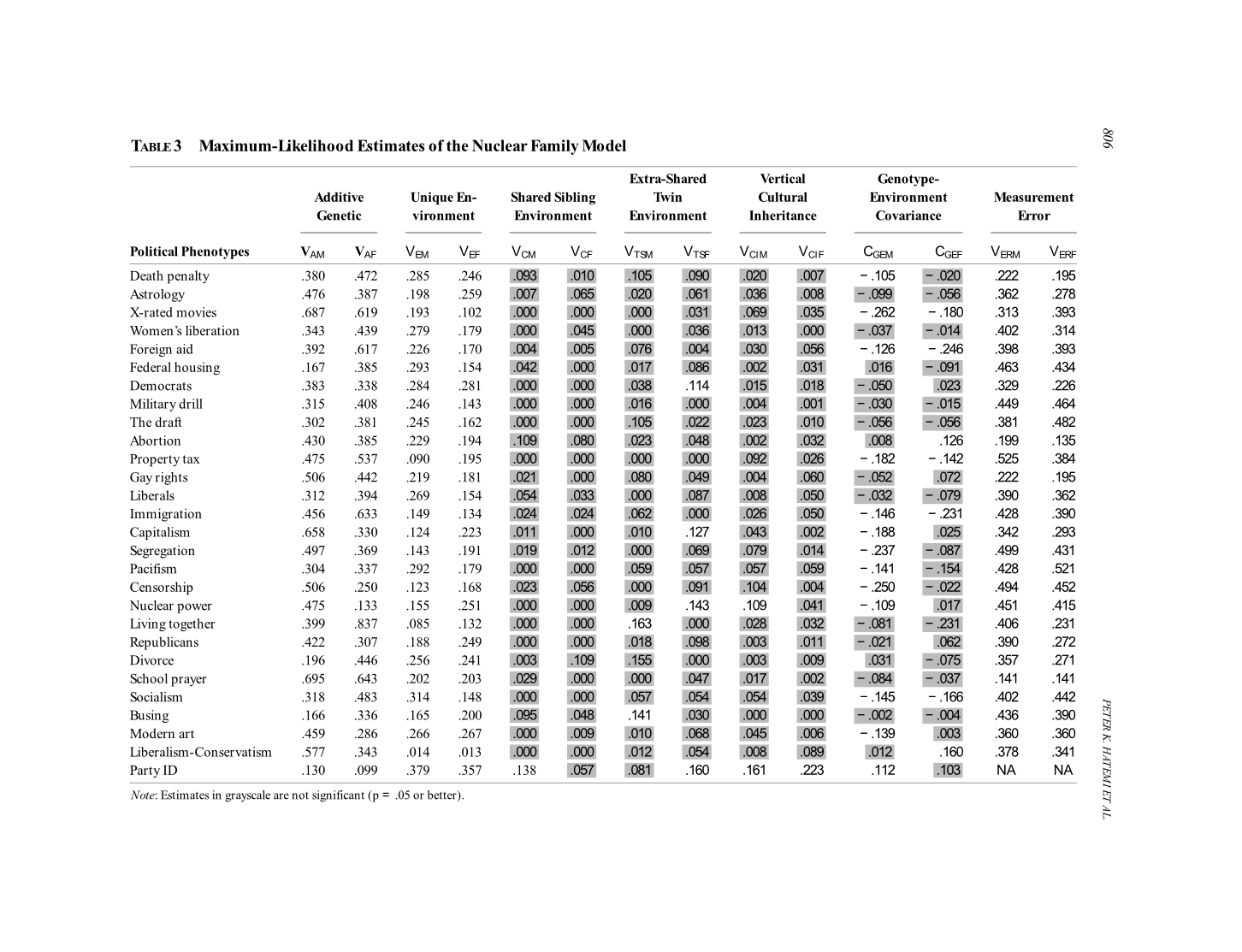
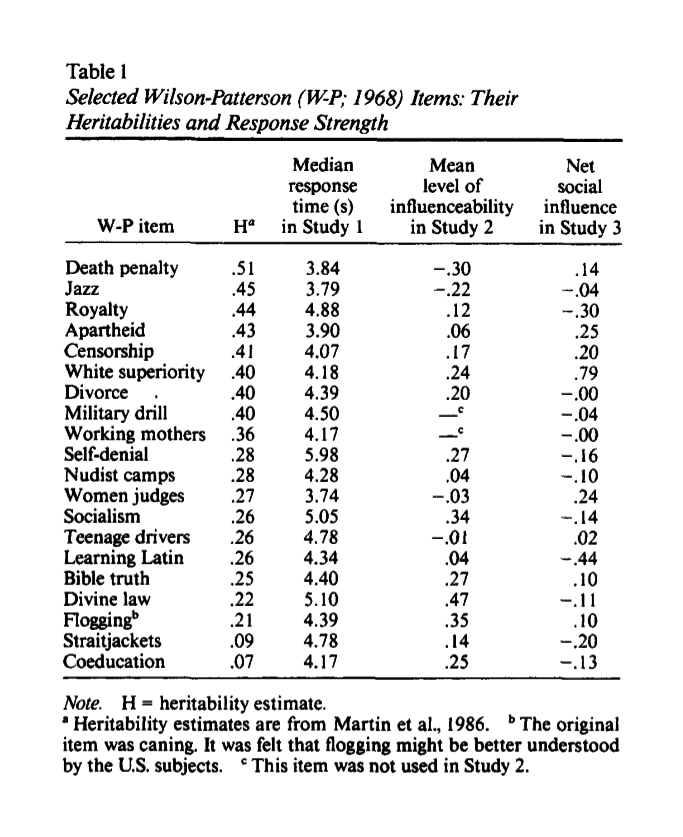
Loehlin & Nichols1976: A Study of 850 Sets of Twins
A discussion of extracting ~376 behavioral items relating to recreation/leisure from Loehlin & Nichols1976: A Study of 850 Sets of Twins, which reports comprehensive summary statistic twin correlations from an early large-scale twin study (canvassed via the National Merit Scholarship Qualifying Test, 1962 64ya). I transcribe them from the book, pool the weighted correlations by gender, and compute simple heritability estimates by Falconer’s formula for use in the recreation/leisure heritability literature review.
Loehlin & Nichols1976’s Heredity, Environment and Personality: A Study of 850 Sets of Twins (see also the briefer discussion in Heredity and Environment: Major Findings from Twin Studies of Ability, Personality, and Interests, Nichols1976/1979 14) is a twin study which attempted to compile a relatively large-scale twin sample by an extensive mail survey of the n = 1,507 11th-grade adolescent pairs of participants in the high school National Merit Scholarship Qualifying Test of 1962 64ya (total n ~ 600,000) who indicated they were twins (as well as a control sample of non-twins), yielding 514 identical twin & 336 (same-sex) fraternal twin pairs; they were questioned as follows:
…to these [participants] were mailed a battery of personality and interest tests, including the California Psychological Inventory (CPI), the Holland Vocational Preference Inventory (VPI), an experimental Objective Behavior Inventory (OBI), an Adjective Check List (ACL), and a number of other, briefer self-rating scales, attitude measures, and other items. In addition, a parent was asked to fill out a questionnaire describing the early experiences and home environment of the twins. Other brief questionnaires were sent to teachers and friends, asking them to rate the twins on a number of personality traits; because these ratings were available for only part of our basic sample, they have not been analyzed in detail and will not be discussed further in this book. (The parent and twin questionnaires, except for the CPI, are reproduced in Appendix A.)
Many of the questions asked about recreation & leisure, including hobbies, preferences, honors/achievements, and items available in their house (most of which would be useful for hobbies or non-school-work); Loehlin & Nichols1976 has been cited by eg. Plomin et al 1990 for the TV watching time use item demonstrating heritability of TV viewing, but most or all of the other items have not been cited much (if at all). The 2 exceptions appear to be the re-analyses Coon & Carey1989, and Hambrick & Tucker-Drob2015.
Unusually, the book includes twin-pair correlations for all of the reported items, not just full test-scales or subfactors, so it’s possible to extract all relevant-looking items and run Falconer on them to go far beyond just TV watching. I have done so below for ~376 items, skipping Vocational Preference Inventory, obligatory religious questions, some dating questions that seem to reflect other parties’ actions rather than preferences/activities, “Ideal Self” preferences, and most school-related or misbehavior questions. Because the respondent sample sizes are not always balanced by gender, I combine male/female correlations before estimating heritability, by transforming them into Fisher’s Z and then taking an average of the 2 correlations weighted by respondent n; results are rounded to 2 digits and floored at 0.
In interpreting the results, it’s worth remembering that single-item responses have severe measurement error and many of the items exemplify this by being extremely specific or suffering from dichotomizing or range restriction and floor / ceiling /sex differences even though most of them have high response rates and superficially seem like large n: for example, in the entire sample of ~1,700 respondents, only around 2 total have ever engaged in skydiving (unsurprising given the era & parents not generally endorsing that activity); only 1 twin managed to publish a scientific paper; 0 twins report getting a tattoo in the past year; 0 twins report national debate successes or inventing a patentable device; while in the other direction, ~96% report having a TV in the house and ~99.9% report ever using a dictionary; and it is not surprising that only a handful of twins have engaged in stock trading (or read the stock listings regularly), have attended prize fights, or that female twins never report growing beards in the past year. (And others are obsolete: teenagers are no longer “pinned” or go for “casual cokes”, and I have never pushed a stalled car to get it started in my life nor seen anyone do so, although it’s interesting to note that apparently almost as many households had sewing machines as had TVs but only ~25% had tape recorders). Since there is no variance or only a little variance, the heritability estimates will be 0 or will be extremely imprecise and could take on any value 0–1.
Some of these are rare for anyone, others are asked prematurely; but of course, we know that something like dictionary use would be heritable if we measured it better in terms of something like “number of dictionary uses per year”, or that publishing scientific papers or attending burlesque shows would be more easily shown to be heritable if the question was asked of the high schoolers a decade or 2 later, and TV ownership will probably be more heritable now that it is rarer. I could have tried to exclude any items which didn’t have a reasonable number of mean affirmative responses like 50, but that would risk cherrypicking, so I include all entries which I initially selected as relevant while reading the questionnaires and then transcribed the raw numbers for.
Entries are categorized by the survey instrument, and presented in the same order as in the Loehlin & Nichols1976 appendix; n refers to respondents, not how many endorse an item (which occasionally is as low as 0).
| Time Diary | 24 | Reading for pleasure | 0.11 | 0.28 | 0.03 | 0.28 | 209 | 285 | 129 | 192 | 0.21 | 0.18 | 0.06 |
|---|---|---|---|---|---|---|---|---|---|---|---|---|---|
| Time Diary | 26 | Watching TV | 0.38 | 0.57 | 0.32 | 0.42 | 207 | 284 | 131 | 192 | 0.5 | 0.38 | 0.24 |
| Time Diary | 27 | Attending movies and plays | 0.01 | 0.43 | 0.13 | 0.47 | 201 | 281 | 128 | 186 | 0.27 | 0.34 | 0 |
| Time Diary | 28 | Watching sports events | 0.19 | 0.52 | 0.52 | 0.46 | 203 | 276 | 129 | 181 | 0.39 | 0.49 | 0 |
| Time Diary | 32 | Daydreaming | 0.04 | 0.19 | 0 | 0.51 | 198 | 275 | 123 | 182 | 0.13 | 0.32 | 0 |
| Time Diary | 33 | Personal care (bathing, fixing hair, putting on make-up, etc.) | 0.13 | 0.2 | −0.03 | 0.22 | 208 | 286 | 129 | 188 | 0.17 | 0.12 | 0.1 |
| Time Diary | 34 | Attending club or organizational activities (meetings, [fraternity] pledge-duties, etc.) | 0.08 | 0.4 | 0.08 | 0.45 | 196 | 279 | 127 | 184 | 0.27 | 0.31 | 0 |
| Time Diary | 35 | Participating in musical, dramatic or artistic activities | 0.24 | 0.53 | 0.28 | 0.41 | 194 | 264 | 122 | 182 | 0.42 | 0.36 | 0.12 |
| Time Diary | 36 | Working on other projects or hobbies not directly related to course work or a job | 0.1 | 0.38 | 0.04 | 0.14 | 197 | 271 | 127 | 180 | 0.27 | 0.1 | 0.34 |
| Time Diary | 37 | Fooling around, wasting time | 0.08 | 0.49 | 0.07 | 0.38 | 199 | 278 | 123 | 185 | 0.33 | 0.26 | 0.14 |
| Time Diary | 38 | Playing games (cards, chess, etc.) | 0.02 | 0.42 | 0.21 | 0.29 | 197 | 271 | 124 | 178 | 0.26 | 0.26 | 0 |
| Time Diary | 39 | Participating in sports and practice sessions | 0.47 | 0.52 | 0.37 | 0.32 | 202 | 269 | 128 | 180 | 0.5 | 0.34 | 0.32 |
| Objective Behavior Inventory | 43 | Played checkers | 0.4 | 0.4 | 0.21 | 0.35 | 215 | 292 | 135 | 195 | 0.4 | 0.29 | 0.22 |
| Objective Behavior Inventory | 44 | Played chess | 0.61 | 0.66 | 0.32 | 0.46 | 215 | 292 | 135 | 195 | 0.64 | 0.4 | 0.48 |
| Objective Behavior Inventory | 45 | Went horseback riding | 0.62 | 0.65 | 0.43 | 0.5 | 215 | 291 | 134 | 195 | 0.64 | 0.47 | 0.34 |
| Objective Behavior Inventory | 46 | Went ice skating | 0.71 | 0.65 | 0.49 | 0.57 | 215 | 292 | 135 | 195 | 0.68 | 0.54 | 0.28 |
| Objective Behavior Inventory | 47 | Went roller skating | 0.58 | 0.55 | 0.49 | 0.48 | 214 | 292 | 134 | 195 | 0.56 | 0.48 | 0.16 |
| Objective Behavior Inventory | 48 | Picked-up a date in a bar, restaurant, or similar place | 0.25 | 0.41 | 0.15 | 0.45 | 213 | 292 | 135 | 193 | 0.34 | 0.33 | 0.02 |
| Objective Behavior Inventory | 49 | Made minor repairs around the house | 0.34 | 0.21 | 0.1 | 0.27 | 214 | 290 | 134 | 192 | 0.27 | 0.2 | 0.14 |
| Objective Behavior Inventory | 51 | Cared for tropical fish or goldfish | 0.41 | 0.47 | 0.27 | 0.58 | 215 | 290 | 135 | 194 | 0.44 | 0.47 | 0 |
| Objective Behavior Inventory | 52 | Cared for other pet animals | 0.74 | 0.65 | 0.63 | 0.64 | 213 | 290 | 134 | 194 | 0.69 | 0.64 | 0.1 |
| Objective Behavior Inventory | 55 | Discussed how to make money with friends | 0.29 | 0.25 | 0.04 | 0.13 | 215 | 292 | 135 | 193 | 0.27 | 0.09 | 0.36 |
| Objective Behavior Inventory | 56 | Listened to modern (progressive) jazz | 0.19 | 0.37 | 0.14 | 0.3 | 215 | 291 | 135 | 195 | 0.3 | 0.24 | 0.12 |
| Objective Behavior Inventory | 57 | Listened to New Orleans’ (Dixieland) jazz | 0.23 | 0.28 | 0.15 | 0.17 | 215 | 292 | 135 | 195 | 0.26 | 0.16 | 0.2 |
| Objective Behavior Inventory | 58 | Listened to folk music | 0.38 | 0.25 | 0.27 | 0.25 | 215 | 292 | 135 | 195 | 0.31 | 0.26 | 0.1 |
| Objective Behavior Inventory | 59 | Rode a motorcycle | 0.17 | 0.49 | 0.29 | 0.31 | 214 | 292 | 134 | 195 | 0.36 | 0.3 | 0.12 |
| Objective Behavior Inventory | 60 | Went to a party | 0.42 | 0.35 | 0.3 | −0.02 | 214 | 291 | 135 | 194 | 0.38 | 0.11 | 0.54 |
| Objective Behavior Inventory | 61 | Gambled with cards | 0.53 | 0.51 | 0.31 | 0.42 | 215 | 292 | 135 | 195 | 0.52 | 0.38 | 0.28 |
| Objective Behavior Inventory | 62 | Gambled with dice | 0.37 | 0.27 | 0.43 | 0.23 | 215 | 292 | 134 | 195 | 0.31 | 0.32 | 0 |
| Objective Behavior Inventory | 63 | Discussed school subjects with friends | 0 | −0.01 | −0.01 | 0 | 215 | 291 | 134 | 195 | −0.01 | 0 | 0 |
| Objective Behavior Inventory | 64 | Drive a car over 80MPH | 0.57 | 0.51 | 0.49 | 0.28 | 215 | 291 | 134 | 195 | 0.54 | 0.37 | 0.34 |
| Objective Behavior Inventory | 69 | Used ‘Man-Tan’, ‘Tan-O-Rama’, ‘Q.T.’ or similar [tanning] products | 0.34 | 0.48 | 0.33 | 0.44 | 213 | 292 | 134 | 193 | 0.42 | 0.4 | 0.04 |
| Objective Behavior Inventory | 70 | Played a practical joke on someone | 0.33 | 0.42 | 0.28 | 0.23 | 214 | 290 | 134 | 195 | 0.38 | 0.25 | 0.26 |
| Objective Behavior Inventory | 71 | Played golf | 0.53 | 0.55 | 0.58 | 0.4 | 214 | 290 | 135 | 195 | 0.54 | 0.48 | 0.12 |
| Objective Behavior Inventory | 72 | Ran track (dashes, hurdles, distance, etc.) | 0.51 | 0.55 | 0.32 | 0.5 | 214 | 289 | 135 | 194 | 0.53 | 0.43 | 0.2 |
| Objective Behavior Inventory | 73 | Went water skiing or surf board riding | 0.61 | 0.64 | 0.5 | 0.65 | 215 | 291 | 134 | 195 | 0.63 | 0.59 | 0.08 |
| Objective Behavior Inventory | 74 | Went skiing | 0.5 | 0.65 | 0.31 | 0.69 | 214 | 291 | 133 | 195 | 0.59 | 0.56 | 0.06 |
| Objective Behavior Inventory | 75 | Participated in crew events (sculls, pairs, fours, etc.) | 0.35 | 0.18 | 0.25 | 0.34 | 213 | 289 | 129 | 190 | 0.25 | 0.3 | 0 |
| Objective Behavior Inventory | 76 | Stayed up all night | 0.36 | 0.51 | 0.31 | 0.38 | 214 | 292 | 134 | 195 | 0.45 | 0.35 | 0.2 |
| Objective Behavior Inventory | 77 | Attended a public lecture (not for a course) | 0.3 | 0.47 | 0.2 | 0.24 | 215 | 288 | 133 | 194 | 0.4 | 0.22 | 0.36 |
| Objective Behavior Inventory | 79 | Gave a public recital (vocal, instrumental etc.) | 0.29 | 0.4 | 0.21 | 0.3 | 215 | 289 | 134 | 194 | 0.35 | 0.26 | 0.18 |
| Objective Behavior Inventory | 80 | Gave a prepared talk to 15 or more people | 0.3 | 0.26 | 0.25 | 0.22 | 215 | 292 | 135 | 195 | 0.28 | 0.23 | 0.1 |
| Objective Behavior Inventory | 81 | Listened to the radio | 0 | 0 | −0.01 | −0.01 | 213 | 292 | 135 | 195 | 0 | −0.01 | 0.02 |
| Objective Behavior Inventory | 82 | Performed magic or card tricks | 0.28 | 0.36 | 0.21 | 0.23 | 215 | 291 | 134 | 194 | 0.33 | 0.22 | 0.22 |
| Objective Behavior Inventory | 84 | Played a piano or other instrument while others were singing | 0.43 | 0.54 | 0.45 | 0.41 | 214 | 292 | 134 | 193 | 0.5 | 0.43 | 0.14 |
| Objective Behavior Inventory | 86 | Bought a folk music record | 0.53 | 0.6 | 0.3 | 0.6 | 215 | 292 | 134 | 194 | 0.57 | 0.49 | 0.16 |
| Objective Behavior Inventory | 88 | Made entries in a diary or journal | 0.11 | 0.5 | 0.11 | 0.24 | 215 | 292 | 135 | 195 | 0.35 | 0.19 | 0.32 |
| Objective Behavior Inventory | 90 | Worked on a scrap book | 0.46 | 0.45 | 0.28 | 0.3 | 215 | 291 | 135 | 194 | 0.45 | 0.29 | 0.32 |
| Objective Behavior Inventory | 91 | Knitted | −0.01 | 0.58 | −0.02 | 0.37 | 213 | 290 | 135 | 194 | 0.36 | 0.22 | 0.28 |
| Objective Behavior Inventory | 92 | Made an article of clothing | −0.01 | 0.54 | −0.01 | 0.4 | 215 | 290 | 134 | 194 | 0.33 | 0.24 | 0.18 |
| Objective Behavior Inventory | 93 | Went social (ballroom) dancing | 0.39 | 0.44 | 0.05 | 0.35 | 214 | 289 | 135 | 190 | 0.42 | 0.23 | 0.38 |
| Objective Behavior Inventory | 94 | Polished your toenails | 0.3 | 0.48 | 0.28 | 0.44 | 215 | 292 | 135 | 194 | 0.41 | 0.38 | 0.06 |
| Objective Behavior Inventory | 96 | Played Tic-Tac-Toe, Hangman’s Noose, or similar games in class | 0.21 | 0.32 | 0.12 | 0.2 | 215 | 291 | 135 | 193 | 0.27 | 0.17 | 0.2 |
| Objective Behavior Inventory | 98 | Took dancing lessons | 0.51 | 0.33 | 0.18 | 0.37 | 215 | 291 | 135 | 194 | 0.41 | 0.29 | 0.24 |
| Objective Behavior Inventory | 100 | Repaired or worked on a car | 0.52 | 0.26 | 0.31 | 0.36 | 215 | 291 | 135 | 194 | 0.38 | 0.34 | 0.08 |
| Objective Behavior Inventory | 101 | Changed clothes during the day (exclude gyms or athletics) | 0.14 | 0.24 | 0.15 | 0.09 | 215 | 292 | 135 | 195 | 0.2 | 0.11 | 0.18 |
| Objective Behavior Inventory | 102 | Baby sat | 0.62 | 0.6 | 0.51 | 0.46 | 215 | 292 | 135 | 194 | 0.61 | 0.48 | 0.26 |
| Objective Behavior Inventory | 103 | Performed [fraternity] pledge-duties | 0.31 | 0.37 | 0.04 | 0.39 | 212 | 282 | 133 | 190 | 0.34 | 0.25 | 0.18 |
| Objective Behavior Inventory | 105 | Sang in a church choir | 0.68 | 0.71 | 0.53 | 0.65 | 215 | 291 | 135 | 195 | 0.7 | 0.6 | 0.2 |
| Objective Behavior Inventory | 106 | Sang in a school choir | 0.71 | 0.75 | 0.49 | 0.61 | 214 | 292 | 134 | 194 | 0.73 | 0.56 | 0.34 |
| Objective Behavior Inventory | 107 | Sang in a small ensemble (trio, quartet, etc.) | 0.65 | 0.55 | 0.35 | 0.53 | 215 | 292 | 135 | 195 | 0.59 | 0.46 | 0.26 |
| Objective Behavior Inventory | 108 | Took golf lessons | 0.15 | 0.61 | 0.48 | 0.42 | 215 | 291 | 135 | 195 | 0.44 | 0.45 | 0 |
| Objective Behavior Inventory | 109 | Bought a popular or jazz record | 0.57 | 0.48 | 0.43 | 0.4 | 215 | 291 | 135 | 194 | 0.52 | 0.41 | 0.22 |
| Objective Behavior Inventory | 110 | Took horseback riding lessons | 0.39 | 0.34 | 0.65 | 0.26 | 215 | 292 | 135 | 195 | 0.36 | 0.44 | 0 |
| Objective Behavior Inventory | 111 | Cooked a complete meal | 0.32 | 0.35 | 0.35 | 0.32 | 215 | 292 | 135 | 195 | 0.34 | 0.33 | 0.02 |
| Objective Behavior Inventory | 112 | Cleaned and dusted your room | 0.45 | 0.66 | 0.28 | 0 | 215 | 291 | 135 | 195 | 0.58 | 0.12 | 0.92 |
| Objective Behavior Inventory | 114 | Worked backstage on a play | 0.37 | 0.57 | 0.29 | 0.4 | 214 | 292 | 135 | 195 | 0.49 | 0.36 | 0.26 |
| Objective Behavior Inventory | 115 | Did voluntary work for a hospital or service organization (Red Cross, Heart Fund, etc.) | 0.29 | 0.52 | 0.31 | 0.3 | 215 | 292 | 135 | 194 | 0.43 | 0.3 | 0.26 |
| Objective Behavior Inventory | 116 | Arranged a date for a friend | 0.42 | 0.55 | 0.38 | 0.47 | 215 | 291 | 135 | 193 | 0.5 | 0.43 | 0.14 |
| Objective Behavior Inventory | 117 | Attended athletic events | 0.33 | 0.38 | −0.03 | −0.03 | 215 | 292 | 135 | 195 | 0.36 | −0.03 | 0.78 |
| Objective Behavior Inventory | 118 | Worked on a number painting | 0.24 | 0.52 | 0.12 | 0.33 | 215 | 292 | 133 | 195 | 0.41 | 0.25 | 0.32 |
| Objective Behavior Inventory | 119 | Made bets on a game or other event (not cards or dice) | 0.45 | 0.21 | 0.43 | 0.14 | 215 | 291 | 135 | 195 | 0.32 | 0.26 | 0.12 |
| Objective Behavior Inventory | 120 | Played charades | 0.48 | 0.36 | 0.44 | 0.42 | 214 | 289 | 134 | 194 | 0.41 | 0.43 | 0 |
| Objective Behavior Inventory | 121 | Attended a burlesque show | 0.63 | −0.01 | 0.43 | 0.59 | 215 | 292 | 135 | 195 | 0.3 | 0.53 | 0 |
| Objective Behavior Inventory | 122 | Went to a party with a date | 0.49 | 0.63 | 0.47 | 0.42 | 215 | 290 | 134 | 195 | 0.57 | 0.44 | 0.26 |
| Objective Behavior Inventory | 123 | Went to an overnight or week-end party | 0.31 | 0.47 | 0.26 | 0.32 | 213 | 291 | 135 | 194 | 0.41 | 0.3 | 0.22 |
| Objective Behavior Inventory | 124 | Went square dancing | 0.57 | 0.47 | 0.58 | 0.49 | 215 | 292 | 135 | 195 | 0.51 | 0.53 | 0 |
| Objective Behavior Inventory | 125 | Cared for a potted plant | 0.2 | 0.47 | 0.24 | 0.21 | 215 | 290 | 134 | 194 | 0.36 | 0.22 | 0.28 |
| Objective Behavior Inventory | 127 | Bought a paper-back book | 0.33 | 0.59 | 0.38 | 0.44 | 213 | 292 | 134 | 195 | 0.49 | 0.42 | 0.14 |
| Objective Behavior Inventory | 128 | Bought a classical or semi-classical record | 0.33 | 0.5 | 0.13 | 0.48 | 215 | 291 | 135 | 195 | 0.43 | 0.35 | 0.16 |
| Objective Behavior Inventory | 129 | Chewed gum | 0.37 | 0.32 | 0.08 | −0.04 | 215 | 292 | 135 | 195 | 0.34 | 0.01 | 0.66 |
| Objective Behavior Inventory | 131 | Rode in a sports car | 0.36 | 0.54 | 0.3 | 0.5 | 215 | 292 | 135 | 195 | 0.47 | 0.42 | 0.1 |
| Objective Behavior Inventory | 132 | Went sightseeing | 0.3 | 0.36 | 0.36 | 0.18 | 215 | 291 | 135 | 195 | 0.33 | 0.26 | 0.14 |
| Objective Behavior Inventory | 133 | Practiced on a musical instrument | 0.56 | 0.62 | 0.4 | 0.5 | 215 | 292 | 135 | 195 | 0.6 | 0.46 | 0.28 |
| Objective Behavior Inventory | 135 | Talked in a language other than English | 0.49 | 0.56 | 0.32 | 0.34 | 215 | 292 | 135 | 194 | 0.53 | 0.33 | 0.4 |
| Objective Behavior Inventory | 136 | Conducted a choir, band or orchestra | 0.3 | 0.36 | 0.4 | 0.32 | 215 | 292 | 135 | 195 | 0.33 | 0.35 | 0 |
| Objective Behavior Inventory | 137 | Took voice lessons | −0.03 | 0.5 | −0.01 | 0.56 | 215 | 292 | 135 | 195 | 0.29 | 0.35 | 0 |
| Objective Behavior Inventory | 138 | Crocheted | 0.2 | 0.49 | −0.03 | 0.2 | 214 | 290 | 132 | 195 | 0.38 | 0.11 | 0.54 |
| Objective Behavior Inventory | 140 | Tutored someone for money | 0.35 | 0.48 | 0.36 | −0.02 | 215 | 292 | 135 | 195 | 0.43 | 0.14 | 0.58 |
| Objective Behavior Inventory | 141 | Tutored someone for free | 0.31 | 0.52 | 0.12 | 0.27 | 212 | 291 | 134 | 194 | 0.44 | 0.21 | 0.46 |
| Objective Behavior Inventory | 142 | Wrote articles for a school paper, yearbook, or similar publication | 0.46 | 0.47 | 0.25 | 0.48 | 215 | 292 | 135 | 194 | 0.47 | 0.39 | 0.16 |
| Objective Behavior Inventory | 143 | Went to a night club with a floor show | 0.6 | 0.5 | 0.42 | 0.54 | 215 | 292 | 135 | 195 | 0.54 | 0.49 | 0.1 |
| Objective Behavior Inventory | 144 | Took photographs | 0.32 | 0.4 | 0.21 | 0.38 | 215 | 292 | 135 | 195 | 0.37 | 0.31 | 0.12 |
| Objective Behavior Inventory | 145 | Built or flew a model airplane | 0.11 | −0.02 | 0.2 | 0.49 | 215 | 292 | 135 | 195 | 0.04 | 0.38 | 0 |
| Objective Behavior Inventory | 147 | Participated in a student demonstration (strike, water-fight, etc.) | 0.28 | 0.3 | 0.13 | 0.51 | 215 | 291 | 135 | 193 | 0.29 | 0.37 | 0 |
| Objective Behavior Inventory | 148 | Attended an orchestra concert | 0.41 | 0.49 | 0.42 | 0.41 | 215 | 292 | 135 | 195 | 0.46 | 0.41 | 0.1 |
| Objective Behavior Inventory | 149 | Attended a formal dance | 0.56 | 0.64 | 0.41 | 0.63 | 213 | 292 | 135 | 195 | 0.61 | 0.55 | 0.12 |
| Objective Behavior Inventory | 150 | Read magazines at a newsstand without buying any | 0.42 | 0.4 | 0.32 | 0.23 | 215 | 292 | 135 | 195 | 0.41 | 0.27 | 0.28 |
| Objective Behavior Inventory | 151 | Worked for a club or organization | 0.4 | 0.38 | 0.22 | 0.3 | 215 | 292 | 135 | 194 | 0.39 | 0.27 | 0.24 |
| Objective Behavior Inventory | 152 | Played football (touch or tackle) | 0.41 | 0.42 | 0.24 | 0.35 | 215 | 290 | 134 | 195 | 0.42 | 0.31 | 0.22 |
| Objective Behavior Inventory | 153 | Bowled | 0.51 | 0.6 | 0.51 | 0.36 | 215 | 291 | 134 | 195 | 0.56 | 0.42 | 0.28 |
| Objective Behavior Inventory | 154 | Went to the movies | 0.45 | 0.49 | 0.43 | 0.68 | 215 | 289 | 134 | 195 | 0.47 | 0.59 | 0 |
| Objective Behavior Inventory | 155 | Developed pictures (darkroom work) | 0.63 | 0.66 | 0.12 | 0.44 | 215 | 291 | 133 | 195 | 0.65 | 0.32 | 0.66 |
| Objective Behavior Inventory | 156 | Attended a professional stage play | 0.46 | 0.5 | 0.34 | 0.38 | 215 | 291 | 131 | 195 | 0.48 | 0.36 | 0.24 |
| Objective Behavior Inventory | 157 | Solicited advertising for a school paper, yearbook, or similar publication | 0.48 | 0.58 | 0.4 | 0.44 | 215 | 291 | 133 | 194 | 0.54 | 0.42 | 0.24 |
| Objective Behavior Inventory | 158 | Went swimming | 0.56 | 0.52 | 0.22 | 0.57 | 214 | 289 | 134 | 195 | 0.54 | 0.44 | 0.2 |
| Objective Behavior Inventory | 159 | Participated in field events (shot put, javelin, high jump, etc.) | 0.39 | 0.43 | 0.23 | 0.45 | 215 | 291 | 134 | 194 | 0.41 | 0.36 | 0.1 |
| Objective Behavior Inventory | 160 | Saw a foreign movie | 0.43 | 0.43 | 0.32 | 0.44 | 212 | 288 | 134 | 195 | 0.43 | 0.39 | 0.08 |
| Objective Behavior Inventory | 161 | Rode a bicycle | 0.44 | 0.51 | 0.19 | 0.51 | 215 | 291 | 134 | 195 | 0.48 | 0.39 | 0.18 |
| Objective Behavior Inventory | 162 | Attended a horse race | 0.66 | 0.52 | 0.36 | 0.59 | 212 | 291 | 134 | 195 | 0.58 | 0.5 | 0.16 |
| Objective Behavior Inventory | 163 | Played tennis | 0.64 | 0.66 | 0.45 | 0.57 | 215 | 290 | 134 | 195 | 0.65 | 0.52 | 0.26 |
| Objective Behavior Inventory | 165 | Attended a student stage play | 0.3 | 0.44 | 0.25 | 0.19 | 214 | 291 | 134 | 194 | 0.38 | 0.21 | 0.34 |
| Objective Behavior Inventory | 166 | Drove a car | 0.88 | 0.64 | 0.57 | 0.51 | 215 | 290 | 134 | 195 | 0.77 | 0.54 | 0.46 |
| Objective Behavior Inventory | 167 | Went boating | 0.5 | 0.44 | 0.32 | 0.5 | 215 | 291 | 134 | 195 | 0.47 | 0.43 | 0.08 |
| Objective Behavior Inventory | 168 | Washed dishes | 0.35 | 0.66 | 0.2 | 0 | 215 | 291 | 134 | 195 | 0.54 | 0.08 | 0.92 |
| Objective Behavior Inventory | 169 | Worked crossword puzzles | 0.27 | 0.38 | 0.22 | 0.3 | 215 | 291 | 134 | 194 | 0.33 | 0.27 | 0.12 |
| Objective Behavior Inventory | 171 | Watched TV | −0.01 | 0.21 | 0.11 | 0.3 | 215 | 291 | 134 | 195 | 0.12 | 0.22 | 0 |
| Objective Behavior Inventory | 172 | Put up decorations for a party | 0.39 | 0.54 | 0.27 | 0.25 | 215 | 291 | 134 | 195 | 0.48 | 0.26 | 0.44 |
| Objective Behavior Inventory | 173 | Attended a ballet performance | 0.43 | 0.48 | 0.65 | 0.18 | 215 | 291 | 133 | 195 | 0.46 | 0.4 | 0.12 |
| Objective Behavior Inventory | 175 | Visited a person in a hospital | 0.58 | 0.55 | 0.28 | 0.52 | 214 | 290 | 134 | 194 | 0.56 | 0.43 | 0.26 |
| Objective Behavior Inventory | 176 | Obtained a book or journal from the library | 0.03 | 0.33 | 0.11 | −0.03 | 215 | 291 | 134 | 194 | 0.21 | 0.03 | 0.36 |
| Objective Behavior Inventory | 177 | Read the Bible | 0.34 | 0.52 | 0.31 | 0.47 | 215 | 291 | 134 | 195 | 0.45 | 0.41 | 0.08 |
| Objective Behavior Inventory | 178 | Danced the twist | 0.39 | 0.56 | 0.55 | 0.26 | 215 | 291 | 134 | 194 | 0.49 | 0.39 | 0.2 |
| Objective Behavior Inventory | 180 | Participated in a drag race | 0.53 | 0.38 | 0.37 | 0.4 | 215 | 290 | 134 | 195 | 0.45 | 0.39 | 0.12 |
| Objective Behavior Inventory | 181 | Attended a professional prize fight or wrestling match | 0.55 | 0.35 | 0.47 | 0.27 | 215 | 291 | 134 | 195 | 0.44 | 0.36 | 0.16 |
| Objective Behavior Inventory | 182 | Flew in an airplane | 0.51 | 0.49 | 0.49 | 0.51 | 215 | 290 | 134 | 194 | 0.5 | 0.5 | 0 |
| Objective Behavior Inventory | 183 | Attended a fashion show | 0.37 | 0.56 | 0.6 | 0.55 | 214 | 291 | 134 | 195 | 0.48 | 0.57 | 0 |
| Objective Behavior Inventory | 184 | Visited a museum | 0.45 | 0.51 | 0.28 | 0.41 | 215 | 291 | 134 | 194 | 0.49 | 0.36 | 0.26 |
| Objective Behavior Inventory | 185 | Played baseball or softball | 0.43 | 0.48 | 0.32 | 0.28 | 215 | 291 | 132 | 195 | 0.46 | 0.3 | 0.32 |
| Objective Behavior Inventory | 186 | Went on a camping trip | 0.54 | 0.61 | 0.55 | 0.51 | 215 | 291 | 133 | 195 | 0.58 | 0.53 | 0.1 |
| Objective Behavior Inventory | 188 | Went hunting | 0.72 | 0.54 | 0.56 | 0.47 | 215 | 291 | 133 | 195 | 0.62 | 0.51 | 0.22 |
| Objective Behavior Inventory | 189 | Discussed religion with friends | 0.15 | 0.41 | 0.05 | 0.07 | 215 | 291 | 133 | 195 | 0.3 | 0.06 | 0.48 |
| Objective Behavior Inventory | 191 | Talked for over 30 minutes at a time on the telephone | 0.49 | 0.46 | 0.21 | 0.41 | 214 | 291 | 133 | 195 | 0.47 | 0.33 | 0.28 |
| Objective Behavior Inventory | 193 | Participated in a wedding (usher, bridesmaid, etc.) | 0.69 | 0.65 | 0.42 | 0.68 | 215 | 290 | 133 | 195 | 0.67 | 0.59 | 0.16 |
| Objective Behavior Inventory | 194 | Bought stamps for a stamp collection | 0.25 | 0.26 | 0.34 | 0.11 | 215 | 291 | 134 | 195 | 0.26 | 0.21 | 0.1 |
| Objective Behavior Inventory | 196 | Twirled a baton | 0.22 | 0.43 | 0.22 | 0.5 | 214 | 290 | 133 | 194 | 0.34 | 0.39 | 0 |
| Objective Behavior Inventory | 197 | Wrote letters to friends your own age | 0.42 | 0.39 | 0.2 | 0.25 | 215 | 290 | 134 | 194 | 0.4 | 0.23 | 0.34 |
| Objective Behavior Inventory | 198 | Went window shopping | 0.27 | 0.18 | 0.2 | 0.36 | 215 | 290 | 134 | 195 | 0.22 | 0.3 | 0 |
| Objective Behavior Inventory | 201 | Painted a picture (oil, watercolor, pastel, etc.) | 0.24 | 0.39 | 0.1 | 0.26 | 214 | 289 | 134 | 194 | 0.33 | 0.2 | 0.26 |
| Objective Behavior Inventory | 202 | Played cards (bridge, pinochle, etc.) | 0.29 | 0.47 | 0.25 | 0.34 | 215 | 291 | 133 | 195 | 0.4 | 0.3 | 0.2 |
| Objective Behavior Inventory | 203 | Told jokes | 0.09 | 0.29 | −0.02 | 0.22 | 213 | 290 | 134 | 93 | 0.21 | 0.08 | 0.26 |
| Objective Behavior Inventory | 204 | Listened to records in a store without buying | 0.37 | 0.46 | 0.24 | 0.38 | 215 | 291 | 134 | 195 | 0.42 | 0.32 | 0.2 |
| Objective Behavior Inventory | 205 | Played in a dance or jazz band | 0.56 | 0.44 | 0.49 | 0.7 | 213 | 291 | 133 | 194 | 0.49 | 0.62 | 0 |
| Objective Behavior Inventory | 206 | Ate Chinese food | 0.48 | 0.61 | 0.36 | 0.5 | 215 | 290 | 134 | 195 | 0.56 | 0.45 | 0.22 |
| Objective Behavior Inventory | 210 | Was consulted for help or advice by someone with a personal problem | 0.28 | 0.22 | 0.06 | 0.09 | 215 | 292 | 134 | 195 | 0.25 | 0.08 | 0.34 |
| Objective Behavior Inventory | 217 | Wrote a letter to a ‘pen-pal’ whom you have never met in person | 0.16 | 0.47 | 0.18 | 0.31 | 215 | 292 | 134 | 195 | 0.35 | 0.26 | 0.18 |
| Objective Behavior Inventory | 218 | Did an imitation or impersonation of another person | 0.23 | 0.31 | 0.2 | 0.21 | 215 | 292 | 134 | 194 | 0.28 | 0.21 | 0.14 |
| Objective Behavior Inventory | 222 | Attended a church or service of a religion other than your own | 0.37 | 0.54 | 0.5 | 0.42 | 214 | 291 | 134 | 194 | 0.47 | 0.45 | 0.04 |
| Objective Behavior Inventory | 223 | Placed a long distance call of over 500 miles | 0.38 | 0.4 | 0.28 | 0.17 | 215 | 290 | 134 | 194 | 0.39 | 0.22 | 0.34 |
| Objective Behavior Inventory | 224 | Went on a double date | 0.67 | 0.63 | 0.29 | 0.32 | 214 | 292 | 134 | 194 | 0.65 | 0.31 | 0.68 |
| Objective Behavior Inventory | 225 | Wrote a ‘love-letter’ | 0.38 | 0.37 | 0.25 | 0.27 | 214 | 290 | 134 | 194 | 0.37 | 0.26 | 0.22 |
| Objective Behavior Inventory | 227 | Wrote a ‘letter-to-the-editor’ | 0.35 | 0.65 | 0.33 | 0.29 | 215 | 292 | 134 | 195 | 0.54 | 0.31 | 0.46 |
| Objective Behavior Inventory | 229 | Played a slot machine | 0.18 | 0.34 | 0.4 | 0.41 | 215 | 292 | 134 | 195 | 0.27 | 0.41 | 0 |
| Objective Behavior Inventory | 231 | Read poetry that was not required reading | 0.4 | 0.46 | 0.15 | 0.29 | 215 | 292 | 134 | 195 | 0.44 | 0.23 | 0.42 |
| Objective Behavior Inventory | 232 | Wrote poetry on your own initiative | 0.17 | 0.3 | 0.08 | 0.11 | 213 | 291 | 134 | 193 | 0.25 | 0.1 | 0.3 |
| Objective Behavior Inventory | 237 | Borrowed clothing from a friend | 0.48 | 0.45 | 0.42 | 0.43 | 214 | 292 | 134 | 194 | 0.46 | 0.43 | 0.06 |
| Objective Behavior Inventory | 240 | Attended a religious revival meeting | 0.59 | 0.7 | 0.5 | 0.57 | 215 | 292 | 132 | 193 | 0.66 | 0.54 | 0.24 |
| Objective Behavior Inventory | 241 | Looked something up in an encyclopedia | −0.01 | 0 | −0.02 | 0.32 | 215 | 291 | 134 | 194 | 0 | 0.19 | 0 |
| Objective Behavior Inventory | 242 | Bought or sold corporate stocks | 0.46 | 0.28 | 0.46 | 0.49 | 215 | 291 | 134 | 194 | 0.36 | 0.48 | 0 |
| Objective Behavior Inventory | 243 | Baked a cake or pie from scratch (no mixes) | 0.28 | 0.54 | −0.03 | 0.32 | 215 | 292 | 134 | 195 | 0.44 | 0.18 | 0.52 |
| Objective Behavior Inventory | 244 | Wore sun glasses after dark | 0.46 | 0.39 | 0.15 | 0.19 | 214 | 292 | 133 | 191 | 0.42 | 0.17 | 0.5 |
| Objective Behavior Inventory | 246 | Ate a steak cooked rare | 0.25 | 0.42 | 0.24 | 0.23 | 215 | 292 | 134 | 195 | 0.35 | 0.23 | 0.24 |
| Objective Behavior Inventory | 249 | Entered a speech or debate contest | 0.36 | 0.41 | 0.21 | 0.39 | 215 | 290 | 133 | 195 | 0.39 | 0.32 | 0.14 |
| Objective Behavior Inventory | 250 | Had your back rubbed | 0.26 | 0.38 | 0.14 | 0.34 | 214 | 291 | 134 | 195 | 0.33 | 0.26 | 0.14 |
| Objective Behavior Inventory | 254 | Produced a work of art (not for a course) | 0.24 | 0.29 | 0.05 | 0.19 | 214 | 292 | 133 | 195 | 0.27 | 0.13 | 0.28 |
| Objective Behavior Inventory | 260 | Visited a friend’s home overnight | 0.47 | 0.62 | 0.3 | 0.4 | 213 | 292 | 135 | 194 | 0.56 | 0.36 | 0.4 |
| Objective Behavior Inventory | 261 | Visited a relative’s home overnight | 0.48 | 0.53 | 0.42 | 0.44 | 215 | 291 | 135 | 194 | 0.51 | 0.43 | 0.16 |
| Objective Behavior Inventory | 262 | Had a friend visit your home overnight | 0.61 | 0.6 | 0.45 | 0.46 | 215 | 292 | 135 | 193 | 0.6 | 0.46 | 0.28 |
| Objective Behavior Inventory | 263 | Started a conversation with strangers | 0.3 | 0.28 | 0.15 | −0.01 | 215 | 292 | 135 | 194 | 0.29 | 0.06 | 0.46 |
| Objective Behavior Inventory | 264 | Went to the movies alone | 0.43 | 0.36 | 0.38 | 0.35 | 214 | 290 | 135 | 192 | 0.39 | 0.36 | 0.06 |
| Objective Behavior Inventory | 265 | Tried on clothes in a store without buying anything | 0.4 | 0.4 | 0.23 | 0.16 | 215 | 292 | 135 | 192 | 0.4 | 0.19 | 0.42 |
| Objective Behavior Inventory | 266 | Pushed a stalled car (other than your own) | 0.38 | 0.37 | 0.4 | 0.33 | 215 | 290 | 135 | 194 | 0.37 | 0.36 | 0.02 |
| Objective Behavior Inventory | 267 | Listened to classic or semi-classical music | 0.31 | 0.41 | 0.25 | 0.12 | 215 | 292 | 135 | 193 | 0.37 | 0.17 | 0.4 |
| Objective Behavior Inventory | 269 | Played a pinball machine | 0.39 | 0.41 | 0.36 | 0.37 | 215 | 292 | 135 | 194 | 0.4 | 0.37 | 0.06 |
| Objective Behavior Inventory | 270 | Went skin diving | 0.43 | 0.49 | 0.54 | −0.01 | 215 | 292 | 135 | 194 | 0.47 | 0.24 | 0.46 |
| Objective Behavior Inventory | 271 | Attended an art exhibition | 0.26 | 0.39 | 0.29 | 0.35 | 215 | 291 | 135 | 194 | 0.34 | 0.33 | 0.02 |
| Objective Behavior Inventory | 272 | Played polo (indoor or outdoor) | 0.16 | 0 | −0.02 | 0.39 | 214 | 292 | 135 | 194 | 0.07 | 0.23 | 0 |
| Objective Behavior Inventory | 273 | Went skeet or trapshooting | 0.55 | 0.39 | 0.34 | −0.01 | 214 | 291 | 135 | 194 | 0.46 | 0.14 | 0.64 |
| Objective Behavior Inventory | 275 | Acted in a play | 0.37 | 0.48 | 0.53 | 0.44 | 215 | 292 | 135 | 194 | 0.43 | 0.48 | 0 |
| Objective Behavior Inventory | 276 | Tried to hypnotize someone | 0.38 | 0.45 | 0.1 | 0.23 | 215 | 292 | 135 | 194 | 0.42 | 0.18 | 0.48 |
| Objective Behavior Inventory | 277 | Taught Sunday school | 0.75 | 0.69 | 0.34 | 0.59 | 215 | 291 | 135 | 193 | 0.72 | 0.5 | 0.44 |
| Objective Behavior Inventory | 281 | Played basketball | 0.47 | 0.6 | 0.07 | 0.42 | 215 | 292 | 135 | 194 | 0.55 | 0.28 | 0.54 |
| Objective Behavior Inventory | 282 | Mended clothing | 0.3 | 0.12 | 0.1 | 0.01 | 215 | 291 | 135 | 194 | 0.2 | 0.05 | 0.3 |
| Objective Behavior Inventory | 283 | Discussed sports with friends | 0.38 | 0.3 | 0.18 | 0.39 | 214 | 292 | 135 | 194 | 0.33 | 0.31 | 0.04 |
| Objective Behavior Inventory | 285 | Had a blind date | 0.25 | 0.42 | 0.13 | 0.24 | 215 | 291 | 135 | 193 | 0.35 | 0.2 | 0.3 |
| Objective Behavior Inventory | 288 | Wore formal clothing (evening gown, tuxedo, dinner jacket, etc.) | 0.51 | 0.6 | 0.31 | 0.51 | 215 | 289 | 135 | 194 | 0.56 | 0.43 | 0.26 |
| Objective Behavior Inventory | 289 | Told a ‘dirty joke’ to male friends | 0.35 | 0.56 | 0.34 | 0.37 | 215 | 288 | 135 | 194 | 0.48 | 0.36 | 0.24 |
| Objective Behavior Inventory | 290 | Told a ‘dirty joke’ to female friends | 0.38 | 0.55 | 0.33 | 0.42 | 215 | 289 | 135 | 194 | 0.48 | 0.38 | 0.2 |
| Objective Behavior Inventory | 295 | Lent clothing to a friend | 0.5 | 0.41 | 0.4 | 0.4 | 215 | 289 | 135 | 194 | 0.45 | 0.4 | 0.1 |
| Objective Behavior Inventory | 296 | Played Monopoly, Scrabble, or similar games | 0.33 | 0.39 | 0.42 | 0.34 | 215 | 291 | 135 | 194 | 0.36 | 0.37 | 0 |
| Objective Behavior Inventory | 298 | Participated in a science contest or talent search | 0.5 | 0.39 | 0.25 | 0.36 | 214 | 290 | 135 | 194 | 0.44 | 0.32 | 0.24 |
| Objective Behavior Inventory | 300 | Played in a concert orchestra | 0.5 | 0.59 | 0.31 | 0.4 | 215 | 291 | 135 | 194 | 0.55 | 0.36 | 0.38 |
| Objective Behavior Inventory | 301 | Lifted weights | 0.42 | 0.39 | 0.35 | 0.39 | 214 | 290 | 135 | 194 | 0.4 | 0.37 | 0.06 |
| Objective Behavior Inventory | 302 | Played table tennis or ping-pong | 0.26 | 0.42 | 0.45 | 0.4 | 215 | 290 | 135 | 194 | 0.35 | 0.42 | 0 |
| Objective Behavior Inventory | 303 | Worked on Hi-Fi or radio equipment | 0.37 | 0.06 | 0.22 | 0.07 | 215 | 291 | 133 | 194 | 0.2 | 0.13 | 0.14 |
| Objective Behavior Inventory | 304 | Dined by candle light | 0.38 | 0.49 | 0.27 | 0.26 | 214 | 290 | 135 | 194 | 0.44 | 0.26 | 0.36 |
| Objective Behavior Inventory | 305 | Participated in a debate or speech contest | 0.33 | 0.44 | 0.07 | 0.47 | 214 | 291 | 134 | 194 | 0.39 | 0.32 | 0.14 |
| Objective Behavior Inventory | 306 | Played soccer | 0.43 | 0.44 | 0.31 | 0.37 | 215 | 291 | 135 | 194 | 0.44 | 0.35 | 0.18 |
| Objective Behavior Inventory | 307 | Played in a marching band | 0.69 | 0.78 | 0.59 | 0.55 | 215 | 291 | 135 | 194 | 0.74 | 0.57 | 0.34 |
| Objective Behavior Inventory | 309 | Went fishing | 0.54 | 0.42 | 0.41 | 0.47 | 215 | 291 | 135 | 194 | 0.47 | 0.45 | 0.04 |
| Objective Behavior Inventory | 311 | Led a cheering section | 0.27 | 0.47 | 0.19 | 0.32 | 215 | 291 | 135 | 194 | 0.39 | 0.27 | 0.24 |
| Objective Behavior Inventory | 313 | Played Solitaire | 0.46 | 0.55 | 0.35 | 0.4 | 215 | 290 | 135 | 194 | 0.51 | 0.38 | 0.26 |
| Objective Behavior Inventory | 314 | Collected insect specimens | 0.28 | 0.33 | −0.07 | 0.28 | 215 | 291 | 135 | 194 | 0.31 | 0.14 | 0.34 |
| Objective Behavior Inventory | 315 | Ate candy | −0.02 | 0.66 | 0.11 | −0.02 | 215 | 291 | 135 | 194 | 0.42 | 0.03 | 0.78 |
| Objective Behavior Inventory | 317 | Rode on a roller coaster, Ferris wheel, merry go round, or similar ride | 0.51 | 0.44 | 0.24 | 0.3 | 215 | 292 | 135 | 195 | 0.47 | 0.28 | 0.38 |
| Objective Behavior Inventory | 319 | Studied with the radio, record player, or TV on | 0.45 | 0.23 | 0.34 | 0 | 215 | 292 | 135 | 194 | 0.33 | 0.14 | 0.38 |
| Objective Behavior Inventory | 321 | Paid someone to polish your shoes | 0.36 | 0.25 | 0.35 | −0.04 | 215 | 292 | 135 | 195 | 0.3 | 0.13 | 0.34 |
| Objective Behavior Inventory | 322 | Cut your own hair | 0.42 | 0.49 | 0.12 | 0.27 | 215 | 292 | 135 | 194 | 0.46 | 0.21 | 0.5 |
| Objective Behavior Inventory | 325 | Spent an hour at a time daydreaming | 0.17 | 0.26 | 0 | 0.3 | 215 | 292 | 135 | 194 | 0.22 | 0.18 | 0.08 |
| Objective Behavior Inventory | 329 | Read in bed before going to sleep | 0.39 | 0.54 | 0.41 | 0.17 | 215 | 292 | 135 | 195 | 0.48 | 0.27 | 0.42 |
| Objective Behavior Inventory | 331 | Rode a horse | 0.6 | 0.6 | 0.3 | 0.48 | 214 | 292 | 135 | 195 | 0.6 | 0.41 | 0.38 |
| Objective Behavior Inventory | 332 | Obtained the autograph of a famous person | 0.24 | 0.56 | 0.19 | 0.43 | 215 | 292 | 135 | 195 | 0.44 | 0.34 | 0.2 |
| Objective Behavior Inventory | 335 | Dove from a diving board or tower more than 6 feet above the water | 0.51 | 0.37 | 0.4 | 0.28 | 215 | 292 | 135 | 195 | 0.43 | 0.33 | 0.2 |
| Objective Behavior Inventory | 336 | Jumped in a parachute | 0 | 0 | 0 | 0 | 215 | 289 | 135 | 195 | 0 | 0 | 0 |
| Objective Behavior Inventory | 339 | Ate 2 or more candy bars a day | 0.28 | 0.47 | 0.23 | 0.26 | 215 | 291 | 135 | 195 | 0.39 | 0.25 | 0.28 |
| Objective Behavior Inventory | 344 | Tried to convince someone to change his (her) religious beliefs | 0.22 | 0.48 | 0.26 | 0.22 | 215 | 289 | 135 | 195 | 0.38 | 0.24 | 0.28 |
| Objective Behavior Inventory | 345 | Tried to convince someone to change his (her) political or social beliefs | 0.22 | 0.36 | 0.08 | 0.25 | 215 | 289 | 135 | 194 | 0.3 | 0.18 | 0.24 |
| Objective Behavior Inventory | 346 | Practiced decorative or unusual handwriting | 0.24 | 0.12 | 0.15 | 0.11 | 214 | 290 | 135 | 195 | 0.17 | 0.13 | 0.08 |
| Objective Behavior Inventory | 347 | Took a bubble bath | 0.28 | 0.49 | 0.2 | 0.26 | 215 | 290 | 135 | 195 | 0.41 | 0.24 | 0.34 |
| Objective Behavior Inventory | 348 | Read the editorial page of a newspaper | 0.2 | 0.23 | 0.11 | 0.31 | 215 | 290 | 135 | 195 | 0.22 | 0.23 | 0 |
| Objective Behavior Inventory | 349 | Made a new friend | 0.13 | 0.28 | −0.02 | −0.01 | 215 | 291 | 135 | 195 | 0.22 | −0.01 | 0.46 |
| Objective Behavior Inventory | 352 | Took a long walk alone | 0.38 | 0.38 | 0.15 | 0.3 | 214 | 290 | 135 | 195 | 0.38 | 0.24 | 0.28 |
| Objective Behavior Inventory | 353 | Wrote a letter to a congressman | 0.22 | 0.41 | 0.09 | 0.42 | 213 | 291 | 135 | 195 | 0.33 | 0.29 | 0.08 |
| Objective Behavior Inventory | 355 | Took exercises | 0.34 | 0.39 | −0.02 | −0.04 | 215 | 289 | 134 | 195 | 0.37 | −0.03 | 0.8 |
| Objective Behavior Inventory | 357 | Turned down an invitation for a date | 0.55 | 0.58 | 0.33 | 0.42 | 214 | 290 | 135 | 195 | 0.57 | 0.38 | 0.38 |
| Objective Behavior Inventory | 358 | Stayed out on a date after 2 A.M. | 0.51 | 0.52 | 0.32 | 0.3 | 215 | 291 | 135 | 195 | 0.52 | 0.31 | 0.42 |
| Objective Behavior Inventory | 359 | Read the Stock Market quotations | 0.45 | 0.37 | 0.42 | 0.22 | 215 | 292 | 135 | 195 | 0.4 | 0.31 | 0.18 |
| Objective Behavior Inventory | 360 | Fed a stray dog or cat | 0.26 | 0.38 | 0.14 | 0.37 | 213 | 291 | 135 | 195 | 0.33 | 0.28 | 0.1 |
| Objective Behavior Inventory | 361 | Washed and/or polished a car | 0.45 | 0.42 | 0.22 | 0.54 | 215 | 292 | 135 | 194 | 0.43 | 0.42 | 0.02 |
| Objective Behavior Inventory | 362 | Ate breakfast in bed (not as a patient) | 0.12 | 0.25 | −0.03 | 0.38 | 215 | 292 | 135 | 195 | 0.2 | 0.22 | 0 |
| Objective Behavior Inventory | 363 | Looked up a word in the dictionary | 0 | 0 | 0 | −0.01 | 215 | 292 | 134 | 195 | 0 | −0.01 | 0.02 |
| Objective Behavior Inventory | 365 | Confused people by pretending to be your twin | 0.35 | 0.39 | 0.3 | 0.5 | 214 | 291 | 135 | 195 | 0.37 | 0.42 | 0 |
| Life Goals | 371 | Becoming accomplished in one of the performing arts (acting, dancing, etc.) | 0.23 | 0.44 | 0.05 | 0.22 | 211 | 285 | 130 | 189 | 0.35 | 0.15 | 0.4 |
| Life Goals | 375 | Becoming an outstanding athlete | 0.43 | 0.36 | 0.25 | 0.14 | 212 | 289 | 134 | 193 | 0.39 | 0.19 | 0.4 |
| Life Goals | 377 | Becoming a community leader | 0.41 | 0.36 | 0.23 | 0.27 | 213 | 288 | 133 | 193 | 0.38 | 0.25 | 0.26 |
| Life Goals | 384 | Writing good fiction (poems, novels, short stories, etc.) | 0.31 | 0.39 | 0.09 | 0.01 | 209 | 286 | 131 | 193 | 0.36 | 0.04 | 0.64 |
| Life Goals | 385 | Being well read | 0.26 | 0.32 | 0.14 | 0.33 | 207 | 290 | 132 | 194 | 0.3 | 0.26 | 0.08 |
| Life Goals | 388 | Keeping in good physical condition | 0.25 | 0.18 | 0.04 | 0.21 | 214 | 288 | 132 | 189 | 0.21 | 0.14 | 0.14 |
| Life Goals | 389 | Producing good artistic work (painting, sculpture, decorating, etc.) | 0.29 | 0.42 | 0.04 | 0.15 | 214 | 285 | 133 | 192 | 0.37 | 0.11 | 0.52 |
| Life Goals | 390 | Becoming an accomplished musician (performer or composer) | 0.33 | 0.6 | 0.32 | 0.4 | 212 | 289 | 131 | 188 | 0.5 | 0.37 | 0.26 |
| Life Goals | 392 | Keeping up to date with political affairs | 0.38 | 0.4 | 0.19 | 0.25 | 213 | 291 | 134 | 193 | 0.39 | 0.23 | 0.32 |
| Life Goals | 400 | Engaging in exciting and stimulating activities | 0.21 | 0.29 | 0.03 | 0.14 | 214 | 288 | 133 | 191 | 0.26 | 0.1 | 0.32 |
| Dating | 406 | Frequency of dates: Casual coke [soda], coffee or study dates per month | 0.13 | 0.38 | 0.19 | 0.21 | 189 | 271 | 126 | 186 | 0.28 | 0.2 | 0.16 |
| Dating | 407 | Frequency of dates: Informal dates to movies, student gathers etc. per month | 0.26 | 0.5 | 0.25 | 0.24 | 200 | 277 | 131 | 186 | 0.41 | 0.24 | 0.34 |
| Dating | 408 | Frequency of dates: Formal dates to dances and big parties per month | 0.26 | 0.41 | 0.1 | 0.44 | 194 | 274 | 125 | 179 | 0.35 | 0.31 | 0.08 |
| Done During Past Year | 412 | Took a course over and above requirements | 0.14 | 0.33 | 0.23 | 0.13 | 214 | 290 | 134 | 194 | 0.25 | 0.17 | 0.16 |
| Done During Past Year | 414 | Became pinned [‘going steady’] or engaged | 0.29 | 0.37 | 0.01 | 0.08 | 215 | 289 | 134 | 193 | 0.34 | 0.05 | 0.58 |
| Done During Past Year | 417 | Donated money to a charity | 0.29 | 0.35 | 0.17 | 0.17 | 210 | 289 | 133 | 191 | 0.33 | 0.17 | 0.32 |
| Done During Past Year | 418 | Worked for the election of a political party or candidate | 0.41 | 0.4 | 0.1 | 0.3 | 215 | 291 | 134 | 193 | 0.4 | 0.22 | 0.36 |
| Done During Past Year | 419 | Contributed money to a political party or candidate | 0.15 | 0.2 | 0.27 | −0.02 | 214 | 290 | 134 | 191 | 0.18 | 0.1 | 0.16 |
| Done During Past Year | 425 | Signed a petition | 0.32 | 0.39 | 0.32 | 0.42 | 215 | 291 | 133 | 191 | 0.36 | 0.38 | 0 |
| Done During Past Year | 426 | Customized an automobile | 0.45 | −0.01 | 0.1 | −0.01 | 207 | 285 | 134 | 190 | 0.2 | 0.04 | 0.32 |
| Done During Past Year | 427 | Read one or more non-fiction books that were not required reading | 0.16 | 0.36 | 0.18 | 0.22 | 215 | 291 | 134 | 193 | 0.28 | 0.2 | 0.16 |
| Done During Past Year | 428 | Painted a room or house | 0.31 | 0.58 | 0.39 | 0.47 | 215 | 291 | 134 | 193 | 0.48 | 0.44 | 0.08 |
| Done During Past Year | 429 | Got a tattoo | 0 | 0 | 0 | 0 | 215 | 291 | 133 | 193 | 0 | 0 | 0 |
| Done During Past Year | 431 | Set up a schedule with specific times for various activities | 0.28 | 0.35 | 0.01 | 0.22 | 215 | 288 | 134 | 193 | 0.32 | 0.14 | 0.36 |
| Done During Past Year | 432 | Went to a carnival, amusement park or circus | 0.32 | 0.39 | 0.35 | 0.26 | 215 | 290 | 133 | 193 | 0.36 | 0.3 | 0.12 |
| Done During Past Year | 434 | Made your own Christmas cards | 0.16 | 0.54 | 0.25 | 0.26 | 215 | 289 | 134 | 192 | 0.39 | 0.26 | 0.26 |
| Done During Past Year | 435 | Grew a beard | 0.32 | 0 | 0.23 | 0 | 214 | 291 | 134 | 192 | 0.14 | 0.1 | 0.08 |
| Done During Past Year | 436 | Bleached or dyed your hair | 0.54 | 0.63 | 0.27 | 0.44 | 215 | 291 | 134 | 191 | 0.59 | 0.37 | 0.44 |
| Done During Past Year | 437 | Wore a wig | 0.39 | 0.19 | −0.01 | 0.31 | 214 | 289 | 134 | 191 | 0.28 | 0.18 | 0.2 |
| Done During Past Year | 443 | Visited a foreign country | 0.35 | 0.57 | 0.55 | 0.66 | 212 | 287 | 134 | 191 | 0.48 | 0.62 | 0 |
| Done During Past Year | 446 | Read one or more novels that were not required | 0.26 | 0.47 | 0.28 | 0.28 | 215 | 287 | 134 | 191 | 0.38 | 0.28 | 0.2 |
| Done During Past Year | 447 | Went on a vacation trip with friends your own age | 0.38 | 0.5 | 0.32 | 0.47 | 214 | 288 | 134 | 191 | 0.45 | 0.41 | 0.08 |
| Done During Past Year | 449 | Donated blood | 0.7 | 0 | −0.01 | 0 | 215 | 287 | 134 | 191 | 0.36 | 0 | 0.72 |
| Done During Past Year | 454 | Read the biography of a famous person | 0.11 | 0.13 | 0.11 | 0.13 | 213 | 284 | 133 | 188 | 0.12 | 0.12 | 0 |
| Done During Past Year | 456 | Changed your hair style | 0.29 | 0.36 | 0.09 | 0.02 | 212 | 289 | 134 | 190 | 0.33 | 0.05 | 0.56 |
| Items In The Home | 575 | Carpentry tools (hand) | 0.43 | 0.39 | −0.03 | 0.14 | 215 | 292 | 132 | 194 | 0.41 | 0.07 | 0.68 |
| Items In The Home | 576 | Power tools | 0.75 | 0.68 | 0.71 | 0.56 | 215 | 290 | 132 | 193 | 0.71 | 0.63 | 0.16 |
| Items In The Home | 577 | Library of more than 200 books | 0.64 | 0.74 | 0.62 | 0.71 | 214 | 288 | 132 | 192 | 0.7 | 0.68 | 0.04 |
| Items In The Home | 578 | One or more musical instruments | 0.75 | 0.75 | 0.73 | 0.82 | 215 | 291 | 132 | 193 | 0.75 | 0.79 | 0 |
| Items In The Home | 579 | Some art supplies or equipment | 0.41 | 0.54 | 0.32 | 0.36 | 214 | 289 | 132 | 192 | 0.49 | 0.34 | 0.3 |
| Items In The Home | 580 | Sports equipment | 0.26 | 0.54 | −0.03 | 0.42 | 215 | 292 | 132 | 193 | 0.43 | 0.25 | 0.36 |
| Items In The Home | 581 | A sewing machine | 0.9 | 0.86 | 0.91 | 0.94 | 215 | 291 | 132 | 194 | 0.88 | 0.93 | 0 |
| Items In The Home | 582 | Photographic equipment | 0.26 | 0.43 | 0.31 | 0.21 | 215 | 291 | 132 | 193 | 0.36 | 0.25 | 0.22 |
| Items In The Home | 583 | A photographic dark room | 0.65 | 0.74 | 0.68 | 0.95 | 213 | 288 | 129 | 194 | 0.7 | 0.89 | 0 |
| Items In The Home | 584 | Fishing or hunting equipment | 0.83 | 0.75 | 0.62 | 0.83 | 215 | 292 | 130 | 194 | 0.79 | 0.76 | 0.06 |
| Items In The Home | 585 | A collection of classical records | 0.63 | 0.68 | 0.47 | 0.7 | 213 | 291 | 132 | 194 | 0.66 | 0.62 | 0.08 |
| Items In The Home | 586 | A Hi-Fi or Stereo set | 0.74 | 0.75 | 0.73 | 0.79 | 214 | 291 | 132 | 194 | 0.75 | 0.77 | 0 |
| Items In The Home | 587 | Reproductions of famous paintings | 0.41 | 0.65 | 0.58 | 0.49 | 215 | 292 | 132 | 192 | 0.56 | 0.53 | 0.06 |
| Items In The Home | 588 | Examples of original art work (paintings, sculpture, ceramics, etc.) | 0.33 | 0.36 | 0.34 | 0.42 | 215 | 291 | 132 | 193 | 0.35 | 0.39 | 0 |
| Items In The Home | 589 | A foreign cook book | 0.42 | 0.65 | 0.51 | 0.63 | 214 | 290 | 131 | 192 | 0.56 | 0.58 | 0 |
| Items In The Home | 590 | A motor boat or sail boat | 0.84 | 0.86 | 0.75 | 0.91 | 215 | 292 | 132 | 193 | 0.85 | 0.86 | 0 |
| Items In The Home | 591 | A motorcycle or motorbike | 0.82 | 0.49 | 0.79 | 0.66 | 215 | 292 | 132 | 193 | 0.66 | 0.72 | 0 |
| Items In The Home | 592 | A flower or vegetable garden | 0.44 | 0.69 | 0.55 | 0.64 | 215 | 292 | 132 | 194 | 0.6 | 0.61 | 0 |
| Items In The Home | 593 | A pet dog or cat | 0.95 | 0.98 | 0.95 | 0.97 | 214 | 291 | 132 | 194 | 0.97 | 0.96 | 0.02 |
| Items In The Home | 594 | Other animal pets | 0.65 | 0.83 | 0.72 | 0.86 | 211 | 284 | 130 | 190 | 0.77 | 0.81 | 0 |
| Items In The Home | 595 | A telescope | 0.68 | 0.78 | 0.67 | 0.8 | 215 | 292 | 131 | 194 | 0.74 | 0.75 | 0 |
| Items In The Home | 596 | Farm equipment | 0.67 | 0.77 | 0.59 | 0.86 | 215 | 291 | 131 | 192 | 0.73 | 0.78 | 0 |
| Items In The Home | 597 | Chemical laboratory equipment | 0.52 | 0.59 | 0.49 | 0.52 | 215 | 291 | 131 | 192 | 0.56 | 0.51 | 0.1 |
| Items In The Home | 598 | Electronic laboratory equipment | 0.53 | 0.62 | 0.77 | 0.59 | 214 | 292 | 130 | 194 | 0.58 | 0.67 | 0 |
| Items In The Home | 599 | Botany or zoology laboratory equipment | 0.5 | 0.57 | 0.27 | 0.42 | 214 | 291 | 131 | 194 | 0.54 | 0.36 | 0.36 |
| Items In The Home | 600 | A tape recorder | 0.93 | 0.93 | 0.93 | 0.93 | 214 | 292 | 131 | 194 | 0.93 | 0.93 | 0 |
| Items In The Home | 601 | A movie or slide projector | 0.94 | 0.9 | 0.88 | 0.89 | 214 | 292 | 131 | 194 | 0.92 | 0.89 | 0.06 |
| Items In The Home | 602 | Leather working tools | 0.66 | 0.58 | 0.39 | 0.65 | 213 | 290 | 131 | 193 | 0.62 | 0.56 | 0.12 |
| Items In The Home | 603 | A typewriter | 0.82 | 0.8 | 0.65 | 0.7 | 214 | 292 | 131 | 194 | 0.81 | 0.68 | 0.26 |
| Items In The Home | 604 | An encyclopedia set | 0.74 | 0.81 | 0.85 | 0.75 | 214 | 292 | 131 | 194 | 0.78 | 0.8 | 0 |
| Items In The Home | 605 | Automotive tools or work shop | 0.47 | 0.46 | 0.43 | 0.47 | 214 | 289 | 131 | 193 | 0.46 | 0.45 | 0.02 |
| Items In The Home | 606 | An unabridged dictionary | 0.43 | 0.43 | 0.34 | 0.37 | 214 | 291 | 131 | 190 | 0.43 | 0.36 | 0.14 |
| Items In The Home | 607 | 5 or more magazine subscriptions | 0.58 | 0.66 | 0.52 | 0.76 | 214 | 290 | 131 | 194 | 0.63 | 0.68 | 0 |
| Items In The Home | 608 | A world atlas | 0.58 | 0.58 | 0.61 | 0.71 | 213 | 288 | 131 | 193 | 0.58 | 0.67 | 0 |
| Items In The Home | 609 | Books in a foreign language | 0.41 | 0.67 | 0.45 | 0.67 | 214 | 291 | 131 | 191 | 0.57 | 0.59 | 0 |
| Items In The Home | 610 | A stop watch | 0.68 | 0.61 | 0.88 | 0.64 | 214 | 290 | 131 | 194 | 0.64 | 0.76 | 0 |
| Items In The Home | 611 | A tent or sleeping bag | 0.85 | 0.77 | 0.84 | 0.87 | 212 | 292 | 131 | 194 | 0.81 | 0.86 | 0 |
| Items In The Home | 612 | A barometer | 0.69 | 0.68 | 0.71 | 0.76 | 213 | 290 | 131 | 193 | 0.68 | 0.74 | 0 |
| Items In The Home | 613 | An FM radio | 0.59 | 0.61 | 0.58 | 0.67 | 214 | 287 | 131 | 191 | 0.6 | 0.64 | 0 |
| Items In The Home | 614 | 2 or more cars | 0.86 | 0.85 | 0.95 | 0.93 | 214 | 292 | 131 | 194 | 0.85 | 0.94 | 0 |
| Items In The Home | 615 | A television set | 1 | 0.91 | 0.92 | 0.92 | 215 | 292 | 131 | 194 | 1 | 0.92 | 0.16 |
| Items In Room | 811 | The walls are blank (by choice) | 0.35 | 0.54 | 0.4 | 0.28 | 216 | 293 | 135 | 195 | 0.46 | 0.33 | 0.26 |
| Items In Room | 812 | Pennants | 0.67 | 0.68 | 0.49 | 0.64 | 216 | 293 | 135 | 195 | 0.68 | 0.58 | 0.2 |
| Items In Room | 813 | Pin-ups | 0.51 | 0.41 | 0.2 | 0.51 | 216 | 293 | 135 | 195 | 0.45 | 0.39 | 0.12 |
| Items In Room | 814 | Maps | 0.55 | 0.51 | 0.62 | 0.42 | 216 | 293 | 135 | 195 | 0.53 | 0.51 | 0.04 |
| Items In Room | 815 | A [hanging] mobile | 0.31 | 0.55 | 0.23 | 0.32 | 216 | 293 | 135 | 195 | 0.46 | 0.28 | 0.36 |
| Items In Room | 816 | Quotations and mottoes | 0.5 | 0.59 | 0.25 | 0.44 | 216 | 293 | 135 | 195 | 0.55 | 0.37 | 0.36 |
| Items In Room | 817 | Scientific models | 0.31 | 0.33 | 0.08 | 0.32 | 216 | 293 | 135 | 195 | 0.32 | 0.22 | 0.2 |
| Items In Room | 818 | Religious articles | 0.58 | 0.65 | 0.33 | 0.64 | 216 | 293 | 135 | 195 | 0.62 | 0.53 | 0.18 |
| Items In Room | 819 | Diplomas | 0.47 | 0.41 | 0.25 | 0.49 | 216 | 293 | 135 | 195 | 0.44 | 0.4 | 0.08 |
| Items In Room | 820 | Scholarship trophies | 0.43 | 0.51 | 0.2 | 0.24 | 216 | 293 | 135 | 195 | 0.48 | 0.22 | 0.52 |
| Items In Room | 821 | calendars or schedules | 0.52 | 0.5 | 0.34 | 0.43 | 216 | 293 | 135 | 195 | 0.51 | 0.39 | 0.24 |
| Items In Room | 822 | Abstract paintings | 0.6 | 0.49 | 0.35 | 0.43 | 216 | 293 | 135 | 195 | 0.54 | 0.4 | 0.28 |
| Items In Room | 823 | Other paintings or drawings | 0.5 | 0.52 | 0.35 | 0.51 | 216 | 293 | 135 | 195 | 0.51 | 0.45 | 0.12 |
| Items In Room | 824 | Photographs of friends | 0.52 | 0.45 | 0.2 | 0.51 | 216 | 293 | 135 | 195 | 0.48 | 0.39 | 0.18 |
| Items In Room | 825 | Sculpture | 0.41 | 0.47 | 0.25 | 0.24 | 216 | 293 | 135 | 195 | 0.45 | 0.24 | 0.42 |
| Items In Room | 826 | Jokes | 0.63 | 0.24 | 0.21 | 0.38 | 216 | 293 | 135 | 195 | 0.43 | 0.31 | 0.24 |
| Items In Room | 827 | Medals | 0.44 | 0.41 | 0.39 | 0.4 | 216 | 293 | 135 | 195 | 0.42 | 0.4 | 0.04 |
| Items In Room | 828 | Biological charts | 0.39 | 0.66 | 0.66 | 0 | 216 | 293 | 135 | 195 | 0.56 | 0.31 | 0.5 |
| Items In Room | 829 | Flags | 0.42 | 0.42 | 0.45 | 0.53 | 216 | 293 | 135 | 195 | 0.42 | 0.5 | 0 |
| Items In Room | 830 | Sports trophies | 0.45 | 0.53 | 0.47 | 0.47 | 216 | 293 | 135 | 195 | 0.5 | 0.47 | 0.06 |
| Items In Room | 831 | Sports equipment | 0.51 | 0.27 | 0.12 | 0.23 | 216 | 293 | 135 | 195 | 0.38 | 0.19 | 0.38 |
| Honors | 1000 | Did an independent, scientific experiment (not a course assignment) | 0.32 | 0.22 | 0.12 | 0.18 | 216 | 293 | 135 | 195 | 0.26 | 0.16 | 0.2 |
| Honors | 1002 | Invented a patentable device | 0 | 0 | 0 | 0 | 216 | 293 | 135 | 195 | 0 | 0 | 0 |
| Honors | 1003 | Had a paper published in a scientific journal | −0.01 | 0 | 0 | 0 | 216 | 293 | 135 | 195 | 0 | 0 | 0 |
| Honors | 1004 | Built a piece of equipment or laboratory apparatus on my own (not course work) | 0.21 | 0.17 | 0.19 | −0.02 | 216 | 293 | 135 | 195 | 0.19 | 0.07 | 0.24 |
| Honors | 1005 | Participated in a scientific contest or talent search | 0.49 | 0.43 | 0.22 | 0.3 | 216 | 293 | 135 | 195 | 0.46 | 0.27 | 0.38 |
| Honors | 1011 | Won a prize for any other scientific work or study | 0.33 | 0.25 | 0.29 | 0.18 | 216 | 293 | 135 | 195 | 0.28 | 0.23 | 0.1 |
| Honors | 1012 | Placed first, second or third in a: national speech or debate contest | 0 | 0 | 0 | 0 | 216 | 293 | 135 | 195 | 0 | 0 | 0 |
| Honors | 1013 | Placed first, second or third in a: regional or state speech or debate contest | 0.27 | 0.19 | 0.72 | 0.48 | 216 | 293 | 135 | 195 | 0.22 | 0.59 | 0 |
| Honors | 1014 | Placed first, second or third in a: city or county speech or debate contest | 0.16 | 0.24 | −0.03 | 0.22 | 216 | 293 | 135 | 195 | 0.21 | 0.12 | 0.18 |
| Honors | 1015 | Placed first, second or third in a: school speech or debate contest | 0.41 | 0.47 | 0.11 | 0.1 | 216 | 293 | 135 | 195 | 0.45 | 0.1 | 0.7 |
| Honors | 1016 | Had a leading role in one or more plays | 0.41 | 0.39 | 0.38 | 0.08 | 216 | 293 | 135 | 195 | 0.4 | 0.21 | 0.38 |
| Honors | 1017 | Had minor roles in one or more players | 0.35 | 0.43 | 0.48 | 0.26 | 216 | 293 | 135 | 195 | 0.4 | 0.36 | 0.08 |
| Honors | 1018 | Wrote a play | 0.49 | 0.31 | 0.23 | 0.48 | 216 | 293 | 135 | 195 | 0.39 | 0.38 | 0.02 |
| Honors | 1019 | Directed a play | 0.79 | 0.36 | −0.02 | 0.26 | 216 | 293 | 135 | 195 | 0.59 | 0.15 | 0.88 |
| Honors | 1020 | Appeared on radio or TV as a performer | 0.41 | 0.51 | 0.14 | 0.56 | 216 | 293 | 135 | 195 | 0.47 | 0.41 | 0.12 |
| Honors | 1021 | Read for a part in a high school or church play | 0.44 | 0.48 | 0.3 | 0.33 | 216 | 293 | 135 | 195 | 0.46 | 0.32 | 0.28 |
| Honors | 1022 | Read for a part in a play which was not sponsored by my school or church | 0.1 | 0.48 | −0.05 | 0.48 | 216 | 293 | 135 | 195 | 0.33 | 0.28 | 0.1 |
| Honors | 1023 | Organized a school political group or campaign | 0.33 | 0.42 | 0.14 | 0.19 | 216 | 293 | 135 | 195 | 0.38 | 0.17 | 0.42 |
| Honors | 1024 | Organized my own business or service | 0.39 | 0.57 | 0.32 | −0.01 | 216 | 293 | 135 | 195 | 0.5 | 0.13 | 0.74 |
| Honors | 1025 | Received a Junior Achievement award | 0.17 | 0.27 | 0.1 | 0.29 | 216 | 293 | 135 | 195 | 0.23 | 0.21 | 0.04 |
| Honors | 1026 | Composed music which has been given at least one public performance | −0.01 | 0.24 | 0.39 | 0 | 216 | 293 | 135 | 195 | 0.14 | 0.17 | 0 |
| Honors | 1027 | Performed with a professional orchestra | 0.32 | 0.44 | 0.23 | −0.01 | 216 | 293 | 135 | 195 | 0.39 | 0.09 | 0.6 |
| Honors | 1028 | Played in a school musical organization | 0.71 | 0.65 | 0.57 | 0.5 | 216 | 293 | 135 | 195 | 0.68 | 0.53 | 0.3 |
| Honors | 1029 | Played a musical instrument | 0.57 | 0.65 | 0.5 | 0.64 | 216 | 293 | 135 | 195 | 0.62 | 0.59 | 0.06 |
| Honors | 1030 | Played in a dance or jazz band for wages | 0.47 | 0.33 | 0.31 | −0.01 | 216 | 293 | 135 | 195 | 0.39 | 0.12 | 0.54 |
| Honors | 1031 | Organized your own dance or jazz band | 0.38 | 0 | 0.25 | 0 | 216 | 293 | 135 | 195 | 0.17 | 0.1 | 0.14 |
| Honors | 1032 | Received a rating of ‘Good’ or ‘Excellent’ in a: national music contest | 0.39 | 0.5 | 0.27 | −0.01 | 216 | 293 | 135 | 195 | 0.45 | 0.11 | 0.68 |
| Honors | 1033 | Received a rating of ‘Good’ or ‘Excellent’ in a: regional or state music contest | 0.55 | 0.56 | 0.47 | 0.48 | 216 | 293 | 135 | 195 | 0.56 | 0.48 | 0.16 |
| Honors | 1034 | Received a rating of ‘Good’ or ‘Excellent’ in a: city or county music contest | 0.41 | 0.14 | 0.22 | 0.32 | 216 | 293 | 135 | 195 | 0.26 | 0.28 | 0 |
| Honors | 1035 | Received a rating of ‘Good’ or ‘Excellent’ in a: school music contest | 0.52 | 0.62 | 0.07 | 0.5 | 216 | 293 | 135 | 195 | 0.58 | 0.34 | 0.48 |
| Honors | 1036 | Organized a singing group | 0.45 | 0.53 | 0.3 | 0.28 | 216 | 293 | 135 | 195 | 0.5 | 0.29 | 0.42 |
| Honors | 1037 | Directed (publicly) a band or orchestra | 0.35 | −0.01 | 0.27 | 0.49 | 216 | 293 | 135 | 195 | 0.15 | 0.41 | 0 |
| Honors | 1038 | Exhibited a work of art (painting, sculpture, etc.) at: A national art show | −0.01 | −0.01 | 0 | 0.32 | 216 | 293 | 135 | 195 | −0.01 | 0.19 | 0 |
| Honors | 1039 | Exhibited a work of art (painting, sculpture, etc.) at: A regional or state art show | −0.01 | 0.33 | −0.01 | 0.16 | 216 | 293 | 135 | 195 | 0.19 | 0.09 | 0.2 |
| Honors | 1040 | Exhibited a work of art (painting, sculpture, etc.) at: A city or county art show | −0.03 | 0.46 | −0.05 | 0.21 | 216 | 293 | 135 | 195 | 0.27 | 0.11 | 0.32 |
| Honors | 1041 | Exhibited a work of art (painting, sculpture, etc.) at: A school art show | 0.23 | 0.32 | 0.05 | 0.23 | 216 | 293 | 135 | 195 | 0.28 | 0.16 | 0.24 |
| Honors | 1042 | Won a prize or award for an artistic creation (painting, sculpture, etc.) at: A national art show | 0 | 0.33 | 0 | 0 | 216 | 293 | 135 | 195 | 0.19 | 0 | 0.38 |
| Honors | 1043 | Won a prize or award for an artistic creation (painting, sculpture, etc.) at: A regional or state art show | 0 | −0.01 | −0.01 | −0.02 | 216 | 293 | 135 | 195 | −0.01 | −0.02 | 0.02 |
| Honors | 1044 | Won a prize or award for an artistic creation (painting, sculpture, etc.) at: A city or county art show | −0.02 | 0.54 | −0.01 | 0.12 | 216 | 293 | 135 | 195 | 0.33 | 0.07 | 0.52 |
| Honors | 1045 | Won a prize or award for an artistic creation (painting, sculpture, etc.) at: A school art show | −0.02 | 0.27 | −0.02 | −0.03 | 216 | 293 | 135 | 195 | 0.15 | −0.03 | 0.36 |
| Honors | 1046 | Won a prize or award for a work published in a public newspaper or magazine | −0.02 | 0.25 | 0.23 | 0.32 | 216 | 293 | 135 | 195 | 0.14 | 0.28 | 0 |
| Honors | 1047 | Edited a school paper or literary magazine | 0.19 | 0.34 | 0.08 | 0.27 | 216 | 293 | 135 | 195 | 0.28 | 0.19 | 0.18 |
| Honors | 1048 | Won a literary award for creative writing | 0.17 | 0.17 | 0.1 | 0.37 | 216 | 293 | 135 | 195 | 0.17 | 0.26 | 0 |
| Honors | 1049 | Had poems, stories, essays or articles published in a school publication | 0.43 | 0.47 | 0.15 | 0.4 | 216 | 293 | 135 | 195 | 0.45 | 0.3 | 0.3 |
| Honors | 1050 | Wrote an original, but unpublished piece of creative writing on my own (not as part of a course) | 0.32 | 0.33 | 0.14 | 0.4 | 216 | 293 | 135 | 195 | 0.33 | 0.3 | 0.06 |
| Honors | 1051 | Published one or more issues of my own newspaper | 0.39 | 0.39 | −0.01 | 0.27 | 216 | 293 | 135 | 195 | 0.39 | 0.16 | 0.46 |
| Honors | 1052 | Had poems, stories or articles published in a public newspaper or magazine (not school) | 0.26 | 0.22 | 0.17 | 0.12 | 216 | 293 | 135 | 195 | 0.24 | 0.14 | 0.2 |
loehlin <- read.table(sep="|", quote="", file="loehlin.txt",
    colClasses=c("factor", "factor", "character", "numeric", "numeric", "numeric", "numeric",
                  "integer", "integer", "integer", "integer"), header=TRUE)
averageRviaZ <- function(r1, r2, n1, n2) { n <- n1+n2;
                 tanh(weighted.mean(c(atanh(r1), atanh(r2)), c(n1, n2))) }
averageRviaZ(0.39, 0.39, 216, 293)
# [1] 0.39
averageRviaZ(0.19, 0.34, 216, 293)
# [1] 0.2779414388
loehlin$Identical._r_ <- with(loehlin, round(digits=2,
    unlist(Map(averageRviaZ, Identical.Male._r_, Identical.Female._r_,
    Identical.Male._n_, Identical.Female._n_))))
loehlin$Fraternal._r_ <- with(loehlin, round(digits=2,
    unlist(Map(averageRviaZ, Fraternal.Male._r_, Fraternal.Female._r_,
    Fraternal.Male._n_, Fraternal.Female._n_))))
loehlin$H2 <- with(loehlin, unlist(Map(function(rmz, rdz) {
    round(digits=2, max(0.00, 2*(rmz-rdz)))}, Identical._r_, Fraternal._r_)))

summary(loehlin)
#                           Category         ID          Item           Identical.Male._r_   Identical.Female._r_ Fraternal.Male._r_
#  Objective Behavior Inventory :220    100   :  1   Length:376         Min.   :-0.0300000   Min.   :-0.0200000   Min.   :-0.0700000
#  Honors                       : 47    1000 :  1   Class :character   1st Qu.: 0.2600000   1st Qu.: 0.3575000   1st Qu.: 0.1375000
#  Items In The Home            : 41    1002 :  1   Mode :character   Median : 0.3850000   Median : 0.4500000   Median : 0.2700000
#  Done During Past Year        : 22    1003 :  1                      Mean   : 0.3861702   Mean   : 0.4428723   Mean   : 0.2891489
#  Items In Room                : 21    1004 :  1                      3rd Qu.: 0.5100000   3rd Qu.: 0.5500000   3rd Qu.: 0.4100000
#  Time Diary                   : 12    1005 :  1                      Max.   : 1.0000000   Max.   : 0.9800000   Max.   : 0.9500000
#  (Other)                      : 13   (Other):370
#  Fraternal.Female._r_ Identical.Male._n_ Identical.Female._n_ Fraternal.Male._n_ Fraternal.Female._n_ Identical._r_
#  Min.   :-0.0400000   Min.   :189.0000   Min.   :264.0000     Min.   :122.0000   Min.   : 93.0000     Min.   :-0.0100000
#  1st Qu.: 0.2275000   1st Qu.:214.0000   1st Qu.:290.0000     1st Qu.:134.0000   1st Qu.:194.0000     1st Qu.: 0.3300000
#  Median : 0.3600000   Median :215.0000   Median :291.0000     Median :135.0000   Median :194.0000     Median : 0.4200000
#  Mean   : 0.3544149   Mean   :214.0984   Mean   :290.5293     Mean   :133.7713   Mean   :193.4282     Mean   : 0.4224468
#  3rd Qu.: 0.4800000   3rd Qu.:215.0000   3rd Qu.:292.0000     3rd Qu.:135.0000   3rd Qu.:195.0000     3rd Qu.: 0.5200000
#  Max.   : 0.9700000   Max.   :216.0000   Max.   :293.0000     Max.   :135.0000   Max.   :195.0000     Max.   : 1.0000000
#
#  Fraternal._r_              H2
#  Min.   :-0.0300000   Min.   :0.0000000
#  1st Qu.: 0.2000000   1st Qu.:0.0600000
#  Median : 0.3100000   Median :0.1800000
#  Mean   : 0.3311436   Mean   :0.2106383
#  3rd Qu.: 0.4300000   3rd Qu.:0.3200000
#  Max.   : 0.9600000   Max.   :0.9200000

write.table(quote=FALSE, sep=" | ", row.names=FALSE, file="loehlin2.txt", loehlin)
Waller Et Al 1995, “Occupational and Leisure Time Interests, and Personality”
Extracting domain interests from Waller et al 1995’s reported summary statistics & test-retest reliabilities, I compute pooled weighted correlations, corrected for measurement error based on the test-retest reliabilities, for use in the table of heritabilities.
Published in Assessing Individual Differences in Human Behavior: New Concepts, Methods, and Findings, Lubinski et al 1995:
Intellectual Interests Reading or rereading literary classics Politics Working with others on political or social issues Socializing Getting together with a lively group of friends and acquaintances Hunting-Fishing Hunting small game, rabbits, squirrels, etc. Sierra Club Backpacking, hiking, camping out Religion Doing work for your church or synagogue Husbandry Rebuilding, repairing things (furniture, clothes, cars, machines, etc.) Domestic Working with fabrics, yarn (sewing, knitting, crocheting, tailoring, etc.) Passive Entertainment Watching TV adventure or comedy programs Fitness Jogging or running for exercise Gambling Betting on the horses, dog races, etc. Police Calls-Fires Going to fires The Arts Attending live theater or musicals Foreign Travel Going on a cruise ship to interesting places Reading Reading mystery or detective novels Sports Fan Attending sporting events (ballgames, races, hockey, etc.) Swinging [dancing] Nightlife (bars, nightclubs, discos, etc.) Danger Seeking Risky pastimes (hang gliding, mountain climbing, surfing, etc.) […]
A total of 768 pairs of Minnesota Registry twins were concordant in providing complete test data. Of these concordant pairs, 240 were asked to retake the Occupational Interests Inventory and the Leisure Time Interest Inventory between 2 to 3 years after the first administration; complete returns were obtained from both members of 198 pairs, 53 MZ and 52 DZ female pairs plus 49 MZ and 33 DZ male pairs. These data allowed us to investigate both the heritability and the stability of occupational and leisure time interests.
Quadratic regressions on age were computed for the interest scales separately by sex, and norms were constructed to permit the scale scores to be converted to age-corrected and sex-corrected t -scores with a mean of 50 and SD of 10. This procedure partials out the effects of age and sex on the intraclass correlations and subsequent heritability estimates (see McGue & Bouchard1984, for a justification of this procedure).
Tables 6 and 7 report the MZ and DZ intraclass correlations, heritabilities (h 2), and test-retest stabilities for the occupational interest and leisure time interest scales from this sample. The heritabilities were computed via Falconer’s formula: twice the difference between the MZ and DZ correlations. This method provides valid estimates of heritability when the data satisfy the following assumptions: (a) assortative mating is absent, (b) genetic effects are purely additive, and (c) gene-environment interaction is minimal. Even when these assumptions are not entirely valid, minor violations of the assumptions should not vitiate the general conclusions. However, when the MZ correlations are more than twice the value of the corresponding DZ correlations, the MZ correlation itself is the best estimate of heritability (these estimates are shown in parentheses in the tables). We do not present these data as final estimates of heritability, but only as evidence that genetic factors statistically-significantly influence expressed interests.
N of pairs: [listed separately from Table 7, due to formatting limitations]
- Male MZ: 148
- Male DZ: 119
- Female MZ: 273
- Female DZ: 228
- MZA: 33 (~22 female/11 male) 15
Intellectual Interests 0.57 0.20 (0.57) 0.80 0.59 0.27 (0.59) 0.76 0.54 Politics 0.46 0.20 (0.46) 0.70 0.42 0.27 0.30 0.70 0.16 Socializing 0.50 0.14 (0.50) 0.67 0.39 0.21 0.36 0.70 0.42 Hunting-Fishing 0.67 0.39 0.56 0.87 0.48 0.26 0.44 0.75 0.42 Sierra Club 0.51 0.26 0.50 0.70 0.56 0.24 (0.56) 0.79 0.53 Religion 0.52 0.36 0.32 0.83 0.63 0.28 (0.63) 0.82 0.57 Husbandry 0.63 0.17 (0.63) 0.80 0.41 0.08 (0.41) 0.68 0.65 Domestic 0.47 0.25 0.44 0.73 0.46 0.21 (0.46) 0.83 0.46 Passive Entertainment 0.51 0.13 (0.51) 0.68 0.52 0.18 (0.52) 0.75 0.46 Fitness 0.49 0.13 (0.49) 0.79 0.56 0.23 (0.56) 0.71 0.41 Gambling 0.61 0.33 0.56 0.83 0.45 0.35 0.20 0.78 0.48 Police Calls-Fires 0.49 0.15 (0.49) 0.74 0.44 0.28 0.32 0.66 0.77 The Arts 0.50 0.18 (0.50) 0.78 0.47 0.21 (0.47) 0.76 0.22 Foreign Travel 0.27 -0.05 (0.27) 0.52 0.43 0.11 (0.43) 0.57 0.17 Reading 0.45 0.07 (0.45) 0.69 0.46 0.18 (0.46) 0.72 0.16 Sports Fan 0.51 0.34 0.34 0.87 0.46 0.22 (0.46) 0.75 0.59 Swinging 0.43 0.15 (0.43) 0.75 0.45 0.20 (0.45) 0.77 0.47 Danger Seeking 0.39 0.26 0.26 0.63 0.43 0.14 (0.43) 0.75 0.46 The data reported in Tables 6 and 7 illustrate that the twin intercorrelations and test-retest stabilities for the interest scales were quite similar for both sexes. For example, the median MZ correlations for the occupational interest scales were 0.43 and 0.44 for the male and female subjects, respectively. The median DZ correlations were 0.18 and 0.21 for males and females, respectively. The median test-retest stabilities were 0.75 and 0.72. Within-pair correlations for MZ twins reared apart (MZA) directly estimate broad heritability Without relying on the assumptions of the Falconer formula. It is noteworthy that 4 of the 17 occupational interest scales yield negligible MZA correlations (0.13 or less), whereas 8 of them yield substantial correlations, ranging 0.41–0.65. The average MZA correlation for the occupational interest scales was 0.35, in contrast to 0.14 for 34 DZA pairs. The average MZA correlation for the 18 leisure time interest scales was 0.45, versus 0.18 for the DZA twins.
The data for the leisure time interest scales mirror almost exactly the pattern of relations found for occupational interests. The median MZ correlation was 0.50 for the males and 0.46 for the females. The median DZ correlations were 0.19 and 0.18 for males and females, respectively; the median test-retest stabilities were 0.75 for both sexes. As might be expected, less stable interests (eg. ‘Military’ or ‘Foreign Travel’) are associated with lower MZ correlations. Put another way, it is the stable component of interest variance that sets the upper limit for heritability. It may be that some of these interests are less stable because they are, in fact, less traited, that is, relatively large numbers of people do not have well-defined attitudes toward some of these occupations or activities.
The 3 sets of MZ/DZ/MZA correlations are converted to heritabilities by Falconer, the h 2 is corrected for the respective measurement error (ceiling at h 2 = 0.9 to avoid improbably high estimates or undefined z estimates), then converted to Fisher’s z, the weighted mean taken, and converted back to h 2:
waller <- read.table(sep="|", quote="", file="waller.txt", header=TRUE)
f <- function(n1, mz1, dz1, merror1, n2, mz2, dz2, merror2, n3, mza3, merror3) {
    h2_1 <- 2*(mz1-dz1)
    h2_2 <- 2*(mz2-dz2)
    h2_3 <- mza3

    h2_1_latent <- min(0.9, h2_1 / sqrt(1*merror1))
    h2_2_latent <- min(0.9, h2_2 / sqrt(1*merror2))
    h2_3_latent <- min(0.9, h2_3 / sqrt(1*merror3))

    h2_1_latent_z <- atanh(h2_1_latent)
    h2_2_latent_z <- atanh(h2_2_latent)
    h2_3_latent_z <- atanh(h2_3_latent)

    h2_all <- tanh(weighted.mean(c(h2_1_latent_z, h2_2_latent_z, h2_3_latent_z), c(n1,n2,n3)))
    return(h2_all)
    }
waller$H2 <- with(waller, round(digits=2, unlist(Map(f, (148+119)/2, MZ..male., DZ..male., Test.retest.MZ...DZ,
    (273+228)/2, MZ..female., DZ..female., Test.retest.MZ...DZ.1,
    33, MZA.h2, Test.retest.MZ...DZ))))
subset(waller, select=c(Factors, H2))
#                Factors   H2
# Intellectual Interests 0.76
#               Politics 0.44
#            Socializing 0.64
#        Hunting-Fishing 0.53
#            Sierra Club 0.68
#               Religion 0.66
#              Husbandry 0.84
#               Domestic 0.54
#  Passive Entertainment 0.82
#                Fitness 0.78
#               Gambling 0.39
#     Police Calls-Fires 0.61
#               The Arts 0.62
#         Foreign Travel 0.84
#                Reading 0.75
#             Sports Fan 0.51
#               Swinging 0.59
#         Danger Seeking 0.57
Bibliography
[Bibliography of links/references used in page]
Also impressive is Valve’s estimate of computer gaming-time done just through Steam: >20 billion hours annually
…As with special effects in movies, consumers become desensitized to ads the more they see them. The scary creatures from 1950s films, the shark in Jaws or the spaceships from science-fiction movies of the 1990s now often look like jokes. Political ads often age badly, too. In his history of negative campaigning, Going Dirty, David Mark writes that in the 1994 32ya election, dozens of Republican congressional candidates used “morphing” technology in ads to visually transform their Democratic opponents into President Bill Clinton, to devastating effect. But, in my observation, even one election cycle later, with the technology outdated and overused, people stopped responding. That’s why political consultants say straightforward TV ads no longer work. People tune them out. As technology develops, the same wearout effect is likely to occur with advertising based on fake news. As we are inundated with new, targeted, deceptive ads, we may get sick of them and, perhaps, stop finding them persuasive. For now, it’s the best hope we have.
“fruit”: h 2 = 0.49
“snacks”: h 2 = 0.43
Food-level correlations are reported; picking out a subset which strike me as being optional/recreational and calculating heritabilities from Table 2:
Table of 18 selected snack/dessert/junk food preference heritabilities estimated via Falconer’s formula from Smith et al 2016
Foodstuff
r MZ
r DZ
Falconer
h 2
Oranges
0.400
0.177
2 × (0.400 − 0.177)
0.45
Grapes
0.429
0.107
2 × (0.429 − 0.107)
0.64
Apples
0.553
0.000
2 × (0.553 − 0.000)
1.00
Melon
0.342
0.139
2 × (0.342 − 0.139)
0.41
Peaches
0.489
0.231
2 × (0.489 − 0.231)
0.52
Apricots
0.381
0.205
2 × (0.381 − 0.205)
0.35
Strawberries
0.460
0.082
2 × (0.460 − 0.082)
0.76
Cream
0.266
0.013
2 × (0.266 − 0.013)
0.51
Yogurt
0.310
0.067
2 × (0.310 − 0.067)
0.49
Custard
0.494
0.203
2 × (0.494 − 0.203)
0.58
Chips
0.339
0.071
2 × (0.339 − 0.071)
0.54
Plain biscuits
0.329
0.200
2 × (0.329 − 0.200)
0.26
Chocolate biscuits
0.276
0.107
2 × (0.276 − 0.107)
0.34
Cake
0.179
0.140
2 × (0.179 − 0.140)
0.08
Ice cream
0.293
0.095
2 × (0.293 − 0.095)
0.40
Chocolate
0.277
0.076
2 × (0.277 − 0.076)
0.40
Crisps
0.362
0.114
2 × (0.362 − 0.114)
0.50
Gummy sweets
0.420
0.152
2 × (0.420 − 0.152)
0.54
Sugared cereal
0.347
0.206
2 × (0.347 − 0.206)
0.28
Similar food-level twin correlations are reported from the Gemini study in “Nature and nurture in children’s food preferences”, Fildes et al 2014, and Vink et al 2020. See also the 23andMe GWASes on ice cream & chocolate. Lin et al 2020 is an interesting study on fat taste perception.
Footnotes
-
BBC: “most Americans in 1790 236ya consumed an average 5.8 gallons of pure alcohol a year…In 1830 196ya, consumption peaked at 7.1 gallons a year and drinking became a moral issue…[contemporary] Americans drink an average of 2.3 gallons of pure alcohol a year.” ↩
-
I was struck by Netflix’s 2019-01-17 quarterly shareholder letter where they estimate they have ~10% of the US television market—because they serve 100 million hours of viewing-time per day (or to put it another way, ~143 human-lifetimes per day), and estimate total US viewing-time at ~1 billion hours. ↩
-
Austan Goolsbee provides an example from political advertising’s negative attack ads: ↩
-
For more background on early studies of musical occupation & perception, see The Psychology of Musical Ability, Shuter1968 ↩
-
There are a few candidate-gene studies but they look typical & no more likely to replicate than the usual candidate-gene study. ↩
-
Perhaps surprisingly, personality traits don’t seem to do a good job of predicting interests, to quote Hansen1984: “for the most part, correlational studies between interest scores and personality scores have been extremely disappointing.” ↩
-
See Nettle2006 / Penke et al 2007 / Penke & Jokela2016. Personality GCTAs typically find near-zero additive SNP heritabilities and accordingly, as of 2018, even very large GWASes using 23andMe/ UKBB have failed to find more than a few hits for any of the Big Five personality traits or explain more than a few percentage points of variance despite the usual ≥50% heritability from twin studies. ↩
-
Specifically: “a self-report inventory addressing involvement in different arts and science domains. Here, only the music item was used which consisted of 7 statements about music achievement, ranging from (1) ‘I am not engaged in music at all’ via (4) ‘I have played or sung, or my music has been played in public concerts in my home town, but I have not been paid for this’ to (7) ‘I am professionally active as a musician and have been reviewed/featured in the national or international media and/or have received an award for my musical activities’.” ↩
-
From Tesser1993; re Tesser1993, see also Olson et al 2001 & Conway III et al 2011 ↩
-
See also Lykken et al 1993 & Waller et al 1995 ↩
-
See also Simonson & Sela2009 ↩
-
Smith et al 2016, “Genetic and environmental influences on food preferences in adolescence”, reports basic foodstuffs and 2 factors pertaining to more optional/recreational types of food in TEDS: ↩
-
See also Frederiksen & Christensen2003, Stubbe & de Geus2009, Aaltonen et al 2014 ↩
-
Nichols1979 is sometimes cited as Nichols1976, and internally it references the upcoming publication of Loehlin & Nichols1976; this is because it is an expansion/republication of a Nichols1976 “Invited address presented at the American Psychological Association meeting, Washington, D. C., September 4, 1976 50ya.”, hence the confusion over years in citations. ↩
-
“33 pairs of adult MZ twins (MZA twins) and 34 pairs of DZ (DZA) twins who had been separated in infancy and reared apart. This sample is more fully described in Tellegen et al 1988.” ↩