Flexoki is an inky color scheme for prose and code. Flexoki is designed for reading and writing on digital screens. It is inspired by analog inks and warm shades of paper.
Flexoki is minimalistic and high-contrast. The colors are calibrated for legibility and perceptual balance across devices and when switching between light and dark modes.
Flexoki is open-source under the MIT license. Flexoki is available for dozens of popular apps, including Obsidian using my theme Minimal.
Palette
Flexoki is the color palette used on this site. To switch between light and dark mode press the D key or use the toggle at the top of the page. Click any swatch to copy a color to your clipboard.
bg
bg-2
ui
ui-2
ui-3
tx-3
tx-2
tx
re
or
ye
gr
cy
bl
pu
ma
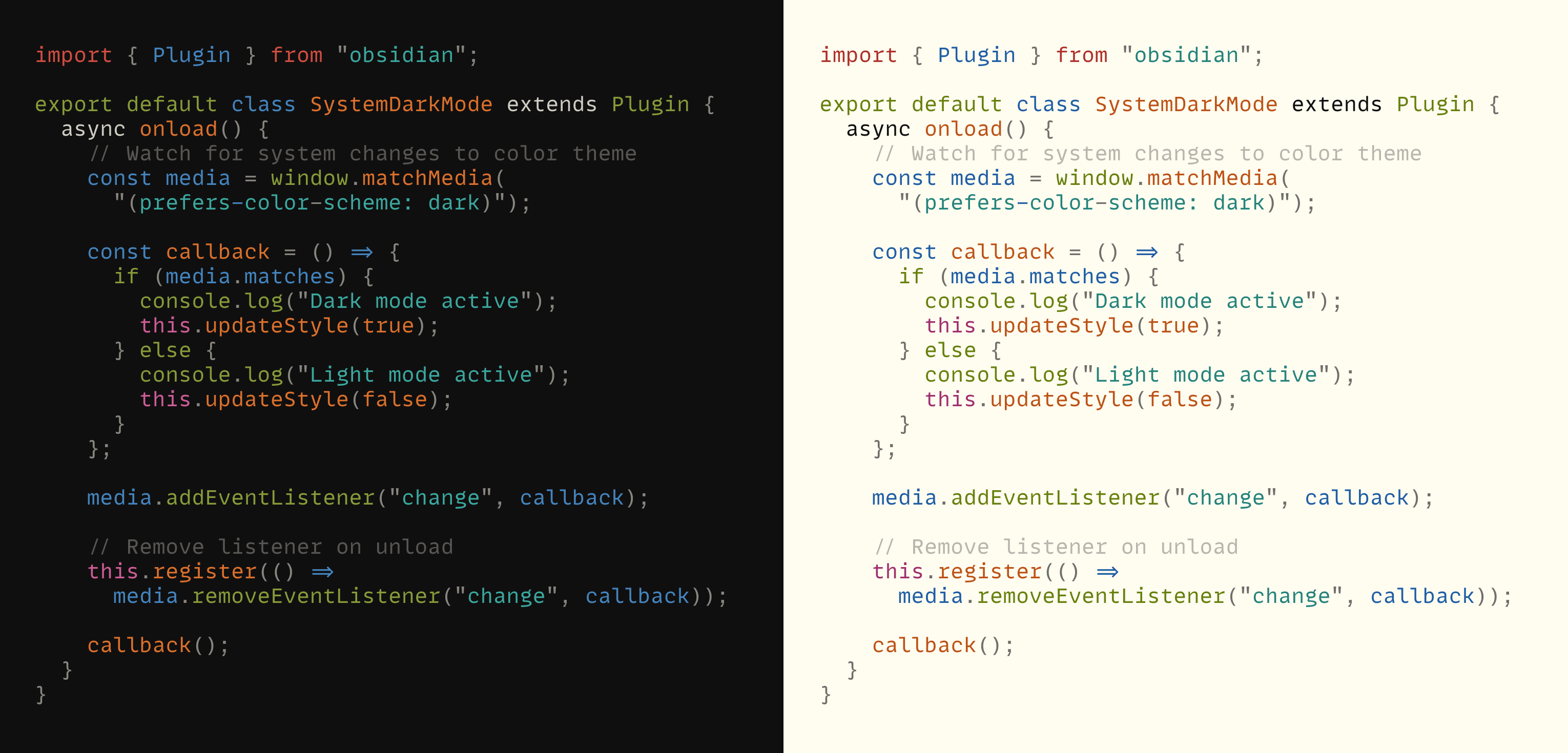
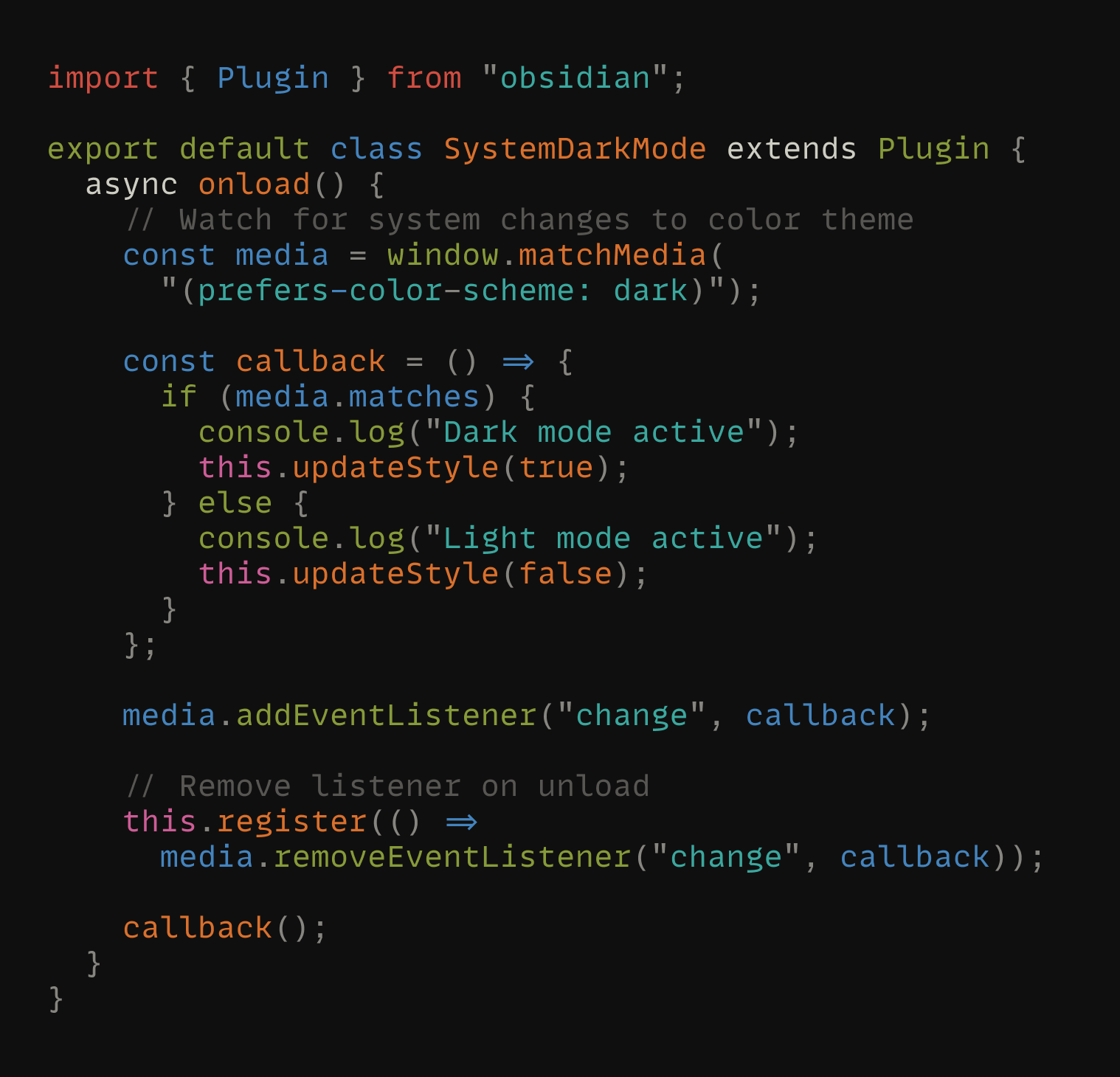
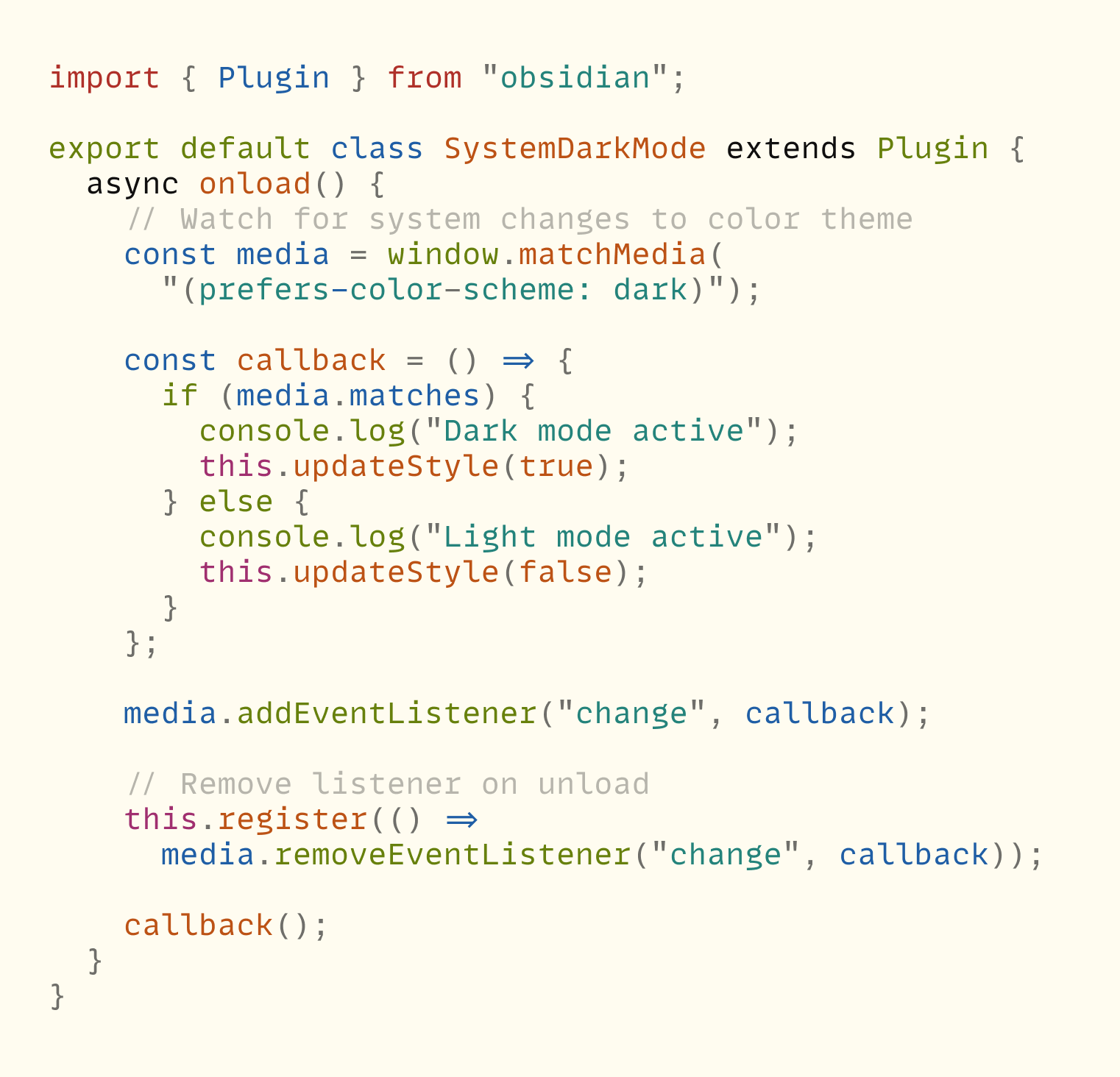
Syntax highlighting
Why?
I created Flexoki for my personal site, stephango.com. You’re reading it now. I wanted the colors to feel distinctive yet familiar. Like ink on paper.
The name Flexoki comes from flexography — a common printing process for paper and cardboard 1. I spent many years working with dyes and inks particularly for my companies Inkodye and Lumi. I also have a fascination with digital paper. I wanted to bring the comfort of analog color to emissive digital screens.
One challenge is that ink on paper is a subtractive process whereas LCD and OLED screens use additive color. Replicating the effect of mixing pigments digitally is difficult. The following video illustrates the problem:
See the full SIGGRAPH 2021 talk
Mixing blue and yellow paint creates green, whereas digital color mixing results in a brownish hue. Watercolors retain their saturation when you dilute them, whereas reducing the opacity of digital colors makes them look desaturated.
Another challenge with digital color is human perception across color spaces. For example, yellow appears much brighter than blue. Ethan Schoonover’s color scheme Solarized (2011) was an important inspiration for Flexoki. His emphasis on lightness relationships in the CIELAB color space helped me understand how to find colors that appear cohesive. Flexoki derives colors from the more recent Oklab color space to maintain those perceptual relationships at the light and dark ends of the spectrum — ramping up color intensity exponentially to emulate the vibrancy that pigments exhibit even when diluted.
I found that choosing colors with perfect perceptual consistency can be at odds with the distinctiveness of colors in practical applications like syntax highlighting. If you adhere too closely to evenness in perceptual lightness you can end up with a palette that looks washed out and difficult to parse.
This project has been a battle between my competing desires in science and art. One part of my brain searches for reliability and precision, while another part searches for those elusive imperfections that remind us what feels real. Solving for all these problems is how I arrived at Flexoki. I hope you find it useful.
Base color
Flexoki uses warm monochromatic base values that blend the black value with the paper value. 8 values are used in light and dark mode:
- 3 text values: normal, muted, faint
- 3 interface values: normal, hover, active
- 2 background values: primary, secondary
Incremental values can be derived using opacity. For example, you can use a 60% opacity black value on top of the paper value to create the 600 value.
| Color | Hex | Light theme | Dark theme |
|---|---|---|---|
black | #100F0F | tx | bg |
base-950 | #1C1B1A | bg-2 | |
base-900 | #282726 | ui | |
base-850 | #343331 | ui-2 | |
base-800 | #403E3C | ui-3 | |
base-700 | #575653 | tx-3 | |
base-600 | #6F6E69 | tx-2 | |
base-500 | #878580 | tx-2 | |
base-300 | #B7B5AC | tx-3 | |
base-200 | #CECDC3 | ui-3 | tx |
base-150 | #DAD8CE | ui-2 | |
base-100 | #E6E4D9 | ui | |
base-50 | #F2F0E5 | bg-2 | |
paper | #FFFCF0 | bg |
Accent colors
8 accent colors are available for accents and syntax highlighting. Unlike the base values, accent values cannot be derived using opacity because this desaturates the pigment effect. Use the extended palette for the full range of values.
The following 16 values are the main accent values used for syntax highlighting and interface elements like buttons and links. Light themes should use 600 for syntax highlighted text, dark themes should use 400.
| Color | Hex | Light theme | Dark theme |
|---|---|---|---|
red-600 | #AF3029 | re | re-2 |
orange-600 | #BC5215 | or | or-2 |
yellow-600 | #AD8301 | ye | ye-2 |
green-600 | #66800B | gr | gr-2 |
cyan-600 | #24837B | cy | cy-2 |
blue-600 | #205EA6 | bl | bl-2 |
purple-600 | #5E409D | pu | pu-2 |
magenta-600 | #A02F6F | ma | ma-2 |
| Color | Hex | Light theme | Dark theme |
|---|---|---|---|
red-400 | #D14D41 | re-2 | re |
orange-400 | #DA702C | or-2 | or |
yellow-400 | #D0A215 | ye-2 | ye |
green-400 | #879A39 | gr-2 | gr |
cyan-400 | #3AA99F | cy-2 | cy |
blue-400 | #4385BE | bl-2 | bl |
purple-400 | #8B7EC8 | pu-2 | pu |
magenta-400 | #CE5D97 | ma-2 | ma |
Extended palette
If you wish to use Flexoki for more complex applications beyond syntax highlighting and basic color schemes, the extended palette includes a complete set of values for every accent color from 50 to 950.
Note that paper and black are special values that represent the lightest and darkest colors in the palette, equivalent to 0 and 1000.
Flexoki emulates the feeling of pigment on paper by exponentially increasing intensity as colors get lighter or darker. This makes the colors feel vibrant and warm, like watercolor inks.
Base
50
#F2F0E5
100
#E6E4D9
150
#DAD8CE
200
#CECDC3
300
#B7B5AC
400
#9F9D96
500
#878580
600
#6F6E69
700
#575653
800
#403E3C
850
#343331
900
#282726
950
#1C1B1A
Red
50
#FFE1D5
100
#FFCABB
150
#FDB2A2
200
#F89A8A
300
#E8705F
400
#D14D41
500
#C03E35
600
#AF3029
700
#942822
800
#6C201C
850
#551B18
900
#3E1715
950
#261312
Orange
50
#FFE7CE
100
#FED3AF
150
#FCC192
200
#F9AE77
300
#EC8B49
400
#DA702C
500
#CB6120
600
#BC5215
700
#9D4310
800
#71320D
850
#59290D
900
#40200D
950
#27180E
Yellow
50
#FAEEC6
100
#F6E2A0
150
#F1D67E
200
#ECCB60
300
#DFB431
400
#D0A215
500
#BE9207
600
#AD8301
700
#8E6B01
800
#664D01
850
#503D02
900
#3A2D04
950
#241E08
Green
50
#EDEECF
100
#DDE2B2
150
#CDD597
200
#BEC97E
300
#A0AF54
400
#879A39
500
#768D21
600
#66800B
700
#536907
800
#3D4C07
850
#313D07
900
#252D09
950
#1A1E0C
Cyan
50
#DDF1E4
100
#BFE8D9
150
#A2DECE
200
#87D3C3
300
#5ABDAC
400
#3AA99F
500
#2F968D
600
#24837B
700
#1C6C66
800
#164F4A
850
#143F3C
900
#122F2C
950
#101F1D
Blue
50
#E1ECEB
100
#C6DDE8
150
#ABCFE2
200
#92BFDB
300
#66A0C8
400
#4385BE
500
#3171B2
600
#205EA6
700
#1A4F8C
800
#163B66
850
#133051
900
#12253B
950
#101A24
Purple
50
#F0EAEC
100
#E2D9E9
150
#D3CAE6
200
#C4B9E0
300
#A699D0
400
#8B7EC8
500
#735EB5
600
#5E409D
700
#4F3685
800
#3C2A62
850
#31234E
900
#261C39
950
#1A1623
Magenta
50
#FEE4E5
100
#FCCFDA
150
#F9B9CF
200
#F4A4C2
300
#E47DA8
400
#CE5D97
500
#B74583
600
#A02F6F
700
#87285E
800
#641F46
850
#4F1B39
900
#39172B
950
#24131D
Mappings
This table describes how to use each variable in the context of user interfaces and syntax highlighting.
| Color | Variable | UI | Syntax highlighting | |
|---|---|---|---|---|
bg | Main background | |||
bg-2 | Secondary background | |||
ui | Borders | |||
ui-2 | Hovered borders | |||
ui-3 | Active borders | |||
tx-3 | Faint text | Comments | ||
tx-2 | Muted text | Punctuation, operators | ||
tx | Primary text | |||
re | Error text | Invalid, imports | ||
or | Warning text | Functions | ||
ye | Constants | |||
gr | Success text | Keywords | ||
cy | Links, active states | Strings | ||
bl | Variables, attributes | |||
pu | Numbers | |||
ma | Language features |
Ports
Flexoki is available for the following apps and tools. See the full list.
Apps
- Alacritty
- Drafts
- Emacs
- Ghostty (built-in)
- IntelliJ
- iTerm2
- Kitty
- Lite XL
- macOS Terminal
- Neovim
- Obsidian and included with Minimal
- Omarchy
- Slack
- Standard Notes
- Sublime Text
- tmux
- Ulysses
- VS Code
- Warp
- WezTerm
- Windows Terminal
- Xresources
- Zed
- Zellij
Frameworks
Other
Contributing
Flexoki is MIT licensed. You are free to port Flexoki to any app. Please include attribution and a link to stephango.com/flexoki. You can submit your port to the list via pull request on the Flexoki repo.
Changelog
| Date | ||
|---|---|---|
| 2025‑01‑07 | 2.0 | Add 88 new values from 50 to 950 for accent colors. |
| 2023‑10‑07 | 1.0 | Initial release. |
Footnotes
-
 I also have a dog named Flexo whose greatness deserved to be immortalized. ↩