There’s only so much fun you can have trying to follow another person’s footsteps to arrive at a known solution. There’s only so much confidence you can build from fighting against a problem that someone else has intentionally set up to be well-posed and elegantly solvable if you think about it the right way.
Cross-posted from here.
Want to get notified about new posts? Join the mailing list and follow on X/Twitter.
I would consider recreational math to be math that you do outside of a structured curriculum – the mathematical equivalent of playing pick-up basketball in the park as opposed to structured training with a performance coach.
Typically, there are two kinds of recreational mathematics that people might engage in: projects, in which the solution and even the tractability of the problem is unknown, and puzzles, in which there is some known solution that can be leveraged quickly through some swoop of insight.
Personally, my most enjoyable and productive recreational math experiences came from projects, not puzzles. Some examples:
-
When I learned about partial fractions decomposition in high school, I wondered if I could come up with a formula for the coefficients $c_{jk}$ in the partial fractions expression of
$\begin{align*} \dfrac{b_0 + b_1 x_1 + b_2 x_2 + \cdots + b_n x^n}{(x-a_1)^{k_1} (x-a_2)^{k_2} \cdots (x-a_m)^{k_m}} = \sum_{j=1}^m \sum_{k=1}^{k_j} \dfrac{c_{jk}}{(x-a_j)^k} \end{align*}$
by writing down and solving the system of equations in the general case, and also conducting numerical experiments to look for relevant patterns that I could prove and leverage in helpful ways. This turned out to be a very difficult and messy project but I did obtain one reasonably neatly-packaged result,
$\begin{align*} \dfrac{x^n}{(x-a)^k} = \sum_{i=0}^{n-k} \binom{n-1-i}{k-1} a^{n-k-i} x^i + \sum_{i=\max(k-n,1)}^k \dfrac{\binom{n}{k-i} a^{n-k+i}}{(x-a)^i}, \end{align*}$
and proving it gave me my first experience with double-induction.
-
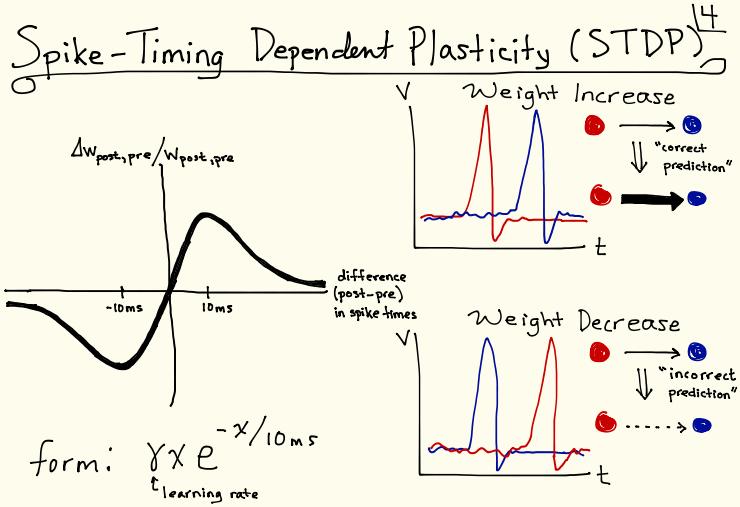
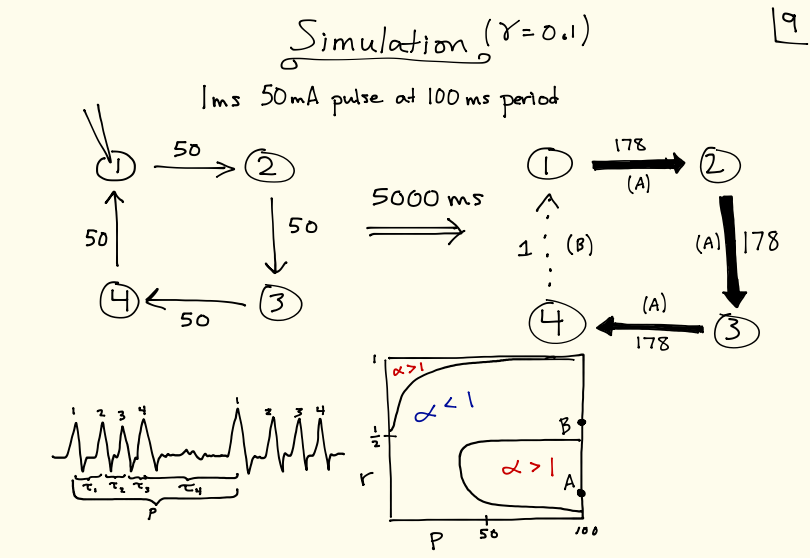
In my first year of college I got interested in neuroscience and I wondered if it was possible to, given a network of neurons, work out how the network’s connectivity will change if you pick one neuron and repeatedly “activate” it with a pulse that ripples through the network. (Whenever two neurons activate, the connection strength between them changes according to known biological learning rules — the simplest and earliest-discovered rule is “what fires together wires together,” known as Hebbian learning, but since then more nuanced rules have been discovered like spike-timing-dependent plasticity, which takes temporal directionality into account.)
Similar to the previous problem, my approach was again a combination of working out math by hand and also running computer simulations to look for helpful patterns. The problem was again very difficult and messy, but again I really leveled up my skills by grappling with it and I discovered plenty of interesting things along the way.
More info about these and a ton of other projects can be found here: justinmath.com/old-projects
They were a lot of hard work, and I can’t say that any of them were academically successful in the sense of yielding publishable results, but they were tons of fun and boy did they level up my confidence in wrestling with really hard problems.
That’s the thing about projects versus puzzles. To me, at least, there’s only so much fun you can have trying to follow another person’s footsteps to arrive at a known solution. There’s only so much confidence you can build from fighting against a problem that someone else has intentionally set up to be well-posed and elegantly solvable if you think about it the right way.
Want to get notified about new posts? Join the mailing list and follow on X/Twitter.